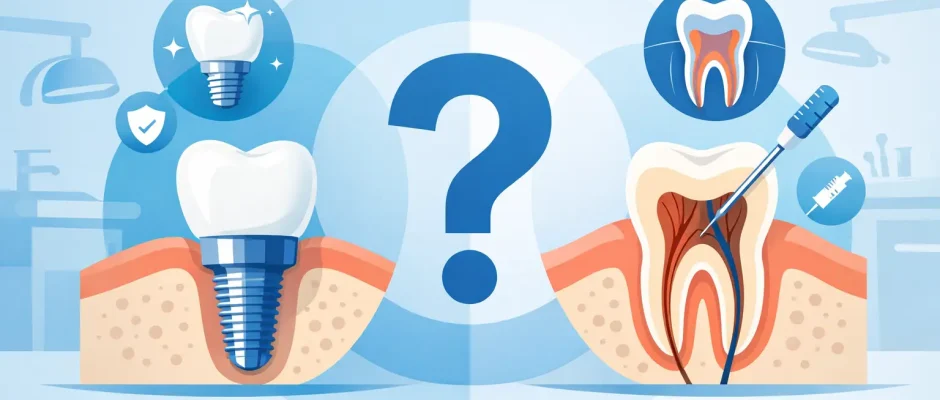
A dental implant vs root canal decision is rarely as simple as choosing the “better” procedure. A root canal can preserve a tooth that still has a sound foundation. An implant can be the safer, more predictable solution when that foundation is too compromised to restore. The right choice depends on the tooth itself, the surrounding bone and gums, your bite, and the long-term prognosis – not only on whether the tooth hurts today.
For many patients, the goal is to keep a natural tooth whenever it can be treated predictably. But saving a tooth at any cost is not always the same as saving it well. Careful diagnostics help distinguish a tooth that needs treatment from a tooth that has reached the limits of restoration.
Dental Implant vs Root Canal: The Core Difference
A root canal is a tooth-preserving procedure. It removes infected or inflamed pulp from inside the tooth, disinfects the root canal system, and seals it. The tooth remains in place and is usually restored with a filling, onlay, or crown, depending on how much healthy tooth structure remains.
A dental implant replaces a tooth after extraction or when the tooth is already missing. A titanium implant is placed in the jawbone, where it integrates with bone over time. After healing, it supports a crown that restores appearance and chewing function without involving neighboring teeth.
These procedures therefore solve different clinical problems. Root canal treatment addresses infection inside a tooth. Implant treatment replaces a tooth that cannot be retained or is already absent. Comparing them only by cost, treatment time, or fear of surgery can lead to the wrong decision.
When a Root Canal Is Usually the Better Option
A natural tooth has biological advantages. Its periodontal ligament provides sensory feedback while chewing, and preserving it avoids an extraction and implant surgery. If the tooth can be cleaned, sealed, and restored with a favorable prognosis, root canal treatment is often the first choice.
This is commonly the case when decay has reached the nerve but enough healthy tooth structure remains above the gumline. It may also be appropriate after trauma, a deep old filling, or a crack limited to the crown of the tooth. If the roots are stable, bone support is adequate, and the tooth can receive a properly fitted final restoration, it may function for many years.
The final restoration matters as much as the root canal itself. A back tooth that has lost substantial structure can fracture if it is left with only a temporary filling. A well-designed crown or onlay protects the remaining walls and helps distribute biting forces. For front teeth, restoration may be simpler, but esthetics and the amount of remaining enamel still influence the plan.
Root canal treatment is not necessarily a “quick fix.” It requires accurate imaging, isolation from saliva, careful cleaning of complex canals, and a reliable restoration. In some cases, retreatment by an endodontist or microsurgical treatment around the root tip can preserve a tooth that has a persistent infection after an earlier root canal.
Situations That Make Tooth Preservation Less Predictable
The question changes when the tooth has a vertical root fracture, severe decay extending deeply below the gumline, advanced mobility, or extensive loss of supporting bone from periodontal disease. These conditions may prevent a durable seal or leave too little structure to support a crown.
A tooth may also have a poor prognosis if infection has caused significant bone destruction, if the root anatomy makes retreatment unrealistic, or if repeated procedures have already removed too much tooth structure. In these situations, trying to save the tooth can mean more treatment, recurring inflammation, and eventual extraction anyway.
When an Implant May Be the More Predictable Choice
An implant is often considered after a tooth has been extracted, but it can also be recommended when extraction is necessary because restoration is no longer predictable. Its main advantage is that it replaces the entire tooth, including the root, without preparing the adjacent teeth for a bridge.
For a tooth with a root fracture, a non-restorable cavity, or severe recurrent infection, an implant can provide a stable long-term option after the site has healed appropriately. It can also help maintain bone volume, although bone preservation is not automatic. The quality and quantity of bone, gum thickness, bite forces, oral hygiene, and implant position all affect the outcome.
Implant treatment requires surgical planning. A three-dimensional CBCT scan may be needed to assess bone, nearby anatomical structures, sinus position in the upper jaw, and the ideal direction of the implant. Digital planning and a surgical guide can improve precision, particularly in esthetically sensitive areas or complex cases.
If bone is insufficient, guided bone regeneration, bone grafting, or a sinus lift may be required before or at the time of implant placement. These procedures are not a failure of implant treatment. They are part of planning a foundation that can support the implant in the correct position for a functional, cleansable, natural-looking crown.
Can an Implant Be Placed Immediately After Extraction?
Sometimes, yes. Immediate implant placement may be possible when the extraction is atraumatic, the socket walls are sufficiently preserved, infection is controlled, and the implant can achieve stable initial fixation. In selected cases, a temporary crown may also be considered.
However, immediate placement is not automatically the best option. If there is extensive infection, a thin facial bone wall, inadequate primary stability, or a need for major grafting, a staged approach may be safer. The best protocol is the one that protects bone and soft tissue while creating a predictable final result.
Treatment Time, Comfort, and Cost Are Real Factors
Root canal treatment is typically completed in one or several visits, followed by the final restoration. The overall process may be shorter than implant treatment when the tooth is readily restorable. Local anesthesia is used, and most patients are comfortable during the procedure.
Implant treatment is a sequence rather than a single appointment: diagnostics, extraction if needed, possible grafting, implant placement, healing, and the final crown. Healing can take several months, particularly when bone augmentation is involved. Modern surgical protocols, gentle tissue handling, and appropriate pain control help make this process manageable, but it should not be presented as effortless or identical for every patient.
Cost should be evaluated as part of the complete treatment plan. A root canal alone is not comparable to an implant with a crown, just as an implant alone is not the final tooth replacement. Ask for a plan that includes diagnostics, endodontic treatment or extraction, temporary restoration when necessary, grafting if indicated, the implant, abutment, final crown, and follow-up care.
The least expensive first step can become costly if the tooth has a poor prognosis and requires repeated treatment. Conversely, extracting a tooth that could have been predictably restored means losing natural tissue unnecessarily. A transparent treatment plan should explain both pathways.
Questions That Lead to a Better Decision
The most useful consultation is not focused only on “Can this tooth be saved?” It asks, “Can this tooth be saved with a stable result that makes sense for me?” Your dentist or specialist should assess the following:
- How much healthy tooth structure remains above and below the gumline
- Whether there is a crack or vertical root fracture
- The quality of bone and gum support around the tooth
- The condition of the root canal system and the chance of successful retreatment
- Your bite, clenching habits, hygiene, medical history, and esthetic expectations
High-quality imaging is especially valuable when the answer is unclear. A periapical X-ray may show infection around the root tip, while CBCT imaging can reveal hidden fractures, missed canals, bone defects, and the relationship between roots and surrounding anatomy. The purpose of diagnostics is not to push treatment toward implants or root canals. It is to reduce uncertainty before an irreversible decision is made.
A Decision Built Around Long-Term Prognosis
If a tooth has a favorable prognosis, preserving it with root canal treatment and a proper restoration is often the most conservative path. If the tooth is fractured, non-restorable, or likely to fail despite repeated treatment, extraction and implant planning may be more responsible.
Do not let pain alone decide the issue. Some severely damaged teeth are painless, while a treatable tooth with acute inflammation can feel dramatic. Ask for a clear explanation of the diagnosis, available alternatives, likely risks, and what each option means for your chewing function and future care. A calm, evidence-based plan is the best way to move forward with confidence.


