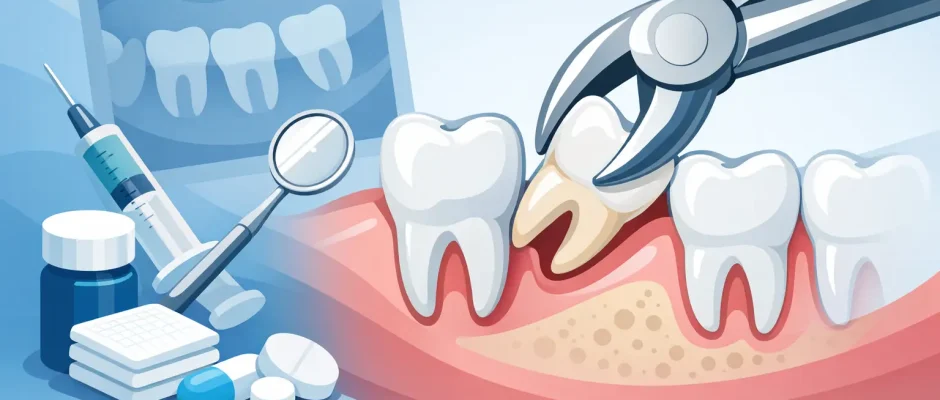
That dull pressure behind the last molar, the gum that swells and settles down, the sudden pain when you open your mouth wide – these are often the moments when patients start looking for a guide to impacted wisdom tooth removal. Most are not trying to become experts in oral surgery. They want clear answers to three questions: do I really need this removed, how difficult will it be, and how rough is recovery likely to feel.
A retained or impacted wisdom tooth is a third molar that does not erupt into a normal, functional position. It may stay fully under the gum, remain partially covered, or grow at an angle into the adjacent tooth. Some impacted teeth stay quiet for years. Others create a repeating pattern of inflammation, food trapping, gum infection, pressure, decay, cyst formation, or damage to the second molar. The decision to remove it is not based on the fact that it is a wisdom tooth alone. It is based on anatomy, symptoms, imaging, and future risk.
A practical guide to removing an impacted wisdom tooth
The first useful distinction is simple: not every impacted wisdom tooth requires immediate surgery, but every impacted wisdom tooth deserves proper evaluation. A clinical exam and high-quality imaging help determine whether the tooth is likely to remain stable or become a problem. In surgical practice, the most important questions are the tooth’s angulation, the depth within bone, the shape of the roots, the condition of the surrounding gum and bone, and the relationship to the mandibular nerve or maxillary sinus.
This is where patients often hear different opinions and get confused. That does not always mean one doctor is right and the other is wrong. It often means the case sits in a gray zone. A deeply impacted tooth with no symptoms in a 24-year-old may be managed differently than the same tooth in a 52-year-old with gum pockets, decay on the second molar, and a history of recurrent infections. Timing matters because surgery can become technically more demanding as bone density increases and healing potential changes with age.
When removal is usually recommended
Removal is commonly advised when there is repeated inflammation around a partially erupted tooth, pain due to pressure or infection, decay in the wisdom tooth or the neighboring molar, resorption of the second molar, cystic changes, or orthodontic and prosthetic reasons that make retention undesirable. In some patients, the issue is less dramatic but still clinically significant: chronic food impaction, unpleasant taste, swelling, and tenderness that return every few months.
There are also preventive indications. If imaging shows that the tooth is positioned in a way that will likely damage the adjacent molar over time, early removal may be the more conservative choice overall. Keeping a problematic wisdom tooth can sometimes create a larger treatment burden later, including root canal treatment, periodontal defects, or loss of the second molar – which is a much more valuable tooth in daily function.
When observation can be reasonable
Observation may be appropriate if the tooth is fully embedded, symptom-free, and not associated with disease on imaging. But observation is not neglect. It means periodic follow-up, repeat imaging when indicated, and an honest understanding that the plan may change. This is one of the main trade-offs in a guide to removing an impacted wisdom tooth: immediate surgery avoids future uncertainty, while watchful monitoring avoids a procedure that may never become necessary. The right answer depends on the clinical picture, not on a one-size-fits-all rule.
What makes removal simple, difficult, or high-risk
From the patient perspective, all wisdom tooth surgery can feel equally intimidating. Surgically, these cases are very different. A partially erupted lower third molar in a young adult may be relatively straightforward. A deeply impacted mandibular tooth close to the inferior alveolar nerve is a different category of planning altogether.
The main factors that influence complexity are depth of impaction, position in the jaw, root curvature, access, surrounding bone density, and proximity to important structures. Lower wisdom teeth are often discussed more cautiously because of the nearby nerve that supplies feeling to the lower lip and chin. Upper wisdom teeth bring their own considerations, especially when roots are close to the sinus.
This is where careful preoperative planning matters more than speed. A rushed extraction can turn a manageable case into a traumatic one. A properly planned procedure focuses on controlled access, sectioning the tooth when needed, protecting bone, minimizing unnecessary force, and closing the site in a way that supports predictable healing.
What to expect before, during, and after surgery
The consultation should not feel vague. You should understand why the tooth is being removed, how difficult the case appears, what imaging was used, which anesthesia option is appropriate, what the main risks are in your specific case, and what recovery usually looks like. If a CBCT scan is needed to assess nerve or sinus proximity, that is not over-planning. In selected cases, it is the safest route to a more accurate surgical plan.
On the day of surgery, local anesthesia is enough for many patients. Others benefit from sedation, especially if the procedure is expected to be longer or anxiety is high. The goal is not only pain control. It is also a calmer operating field and a better overall patient experience.
For impacted teeth, removal often involves a small incision, careful elevation of soft tissue, limited bone removal, and sectioning of the tooth into parts for controlled extraction. Sutures are commonly placed. In experienced surgical hands, this is precise work, not a force-based procedure.
After surgery, the first 48 to 72 hours are usually the most noticeable. Swelling, soreness, and limited mouth opening are common, especially for lower impacted teeth. Mild bleeding or oozing on the first day is also expected. Most patients improve steadily over the first week, although complete tissue remodeling takes longer.
Recovery: what helps and what causes problems
A smooth recovery depends on both surgical technique and patient compliance. Ice in the early period, prescribed medication as directed, hydration, soft food, and good but gentle oral hygiene all matter. Smoking significantly worsens healing and increases the risk of dry socket. Vigorous rinsing, spitting, or heavy physical exertion too soon after surgery can also disrupt the clot and prolong pain.
Patients often ask whether recovery is always severe. No. Some cases are surprisingly easy, while others involve several days of real discomfort. Age, anatomy, duration of surgery, tissue trauma, and baseline inflammation all influence the experience. This is why honest counseling matters. Promising that every impacted wisdom tooth removal is easy is not good medicine.
One technique that may support healing in selected cases is the use of PRF, a platelet-rich fibrin prepared from the patient’s own blood. It can be placed into the socket to support soft tissue healing and clot stability. It is not magic, and it does not replace surgical skill, but in the right setting it can be a useful adjunct.
Risks patients should understand without being alarmed
Every surgical procedure has risks, and wisdom tooth surgery is no exception. The most common issues are swelling, bruising, trismus, and temporary discomfort. Dry socket can occur, particularly after lower extractions. Infection is less common but possible. Temporary numbness can happen when a lower tooth lies close to the nerve; persistent sensory changes are less common, but they are part of informed consent and should be discussed clearly.
The important point is not to dramatize these risks or dismiss them. Good surgical planning reduces risk. Precise imaging reduces guesswork. Gentle technique reduces tissue trauma. Clear postoperative instructions reduce avoidable complications. Predictability in surgery comes from protocol, not luck.
Choosing the right timing and the right surgeon
If the tooth is actively infected, timing may need adjustment. Sometimes surgery proceeds once acute inflammation is controlled. Sometimes persistent symptoms are the reason not to delay. There is no universal rule here. The decision depends on examination findings and your overall health.
As for surgeon selection, patients usually feel the difference in the consultation long before the procedure. You want a doctor who explains the anatomy, identifies the real difficulty of the case, discusses alternatives when they exist, and gives a concrete recovery plan instead of generic reassurance. In more complex surgical practices, including work with digital imaging, microsurgical principles, and advanced extraction protocols, this planning-first approach tends to improve both safety and comfort.
If you are seeking care in Tel Aviv or elsewhere in Israel, this matters even more when the case is close to the nerve, associated with cystic change, or complicated by age, root anatomy, or previous infections. These are not situations where the lowest-friction option is always the best one.
A good guide should leave you calmer, not just more informed. If an impacted wisdom tooth is starting to interfere with daily life, ask for a precise diagnosis and a treatment plan that is built around your anatomy, not around averages. Surgery is easier to face when the unknowns are reduced to specifics.


