Full Mouth Dental Implants Procedure Explained
Losing most or all teeth changes more than appearance. It affects chewing, speech, facial support, confidence, and often daily comfort. The full mouth dental implants procedure is designed to restore an entire upper arch, lower arch, or both with fixed teeth supported by implants – not a removable denture that shifts during meals or conversation.
For many patients, the first question is simple: will this be done in one day, or will it take months? The honest answer is that both can be true. In some cases, implants and a fixed temporary bridge are placed on the same day. In others, treatment needs to be staged because of infection, severe bone loss, medical factors, or bite-related risks. A good plan is not the fastest plan by default. It is the one most likely to heal predictably and last.
What the full mouth dental implants procedure actually involves
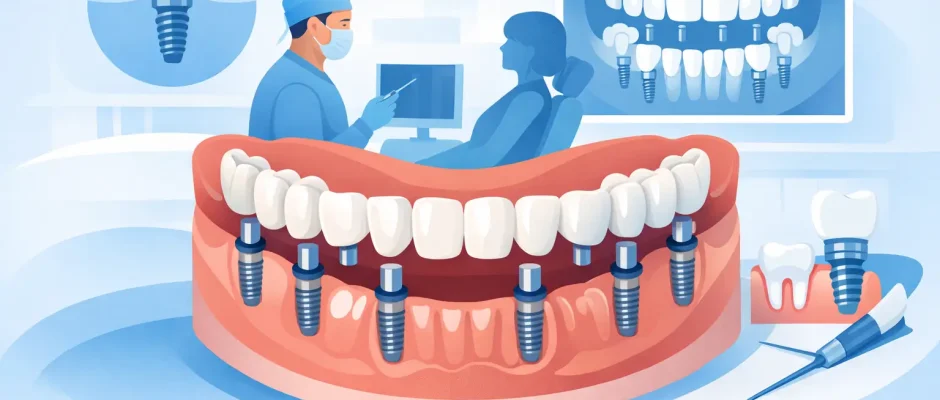
This treatment replaces all missing or non-restorable teeth in one jaw or both jaws using a limited number of implants to support a full fixed prosthesis. Patients often hear terms such as All-on-4 or All-on-6. These are not marketing labels alone – they describe the number and distribution of implants used to support the restoration.
The exact design depends on anatomy and load. A lower jaw with dense bone may be restored differently from an upper jaw with sinus expansion and softer bone. Some patients do well with four implants in one arch. Others need six or more for better support, improved force distribution, or long-term mechanical security. The goal is not simply to place implants. It is to create a stable, cleanable, functional bite with healthy soft tissue around it.
Who is a candidate for full mouth implants
The best candidates are patients with multiple failing teeth, advanced periodontal breakdown, full or near-full tooth loss, or longstanding dentures that no longer fit well. This approach is also considered when repeated repair of individual teeth has become more invasive, less predictable, and more expensive than a comprehensive solution.
That said, candidacy is never based on the number of missing teeth alone. Bone volume matters. Gum condition matters. Smoking, diabetes control, clenching, past implant failures, and sinus anatomy can all influence the plan. Patients with significant bone deficiency may still be candidates, but the procedure may require bone grafting, sinus lift surgery, angled implants, zygomatic concepts in select settings, or a staged approach rather than immediate loading.
A careful consultation should include a clinical exam, photographs, digital scanning when appropriate, and a CBCT scan to assess bone in three dimensions. This is where assumptions end. Without 3D imaging, it is easy to underestimate anatomical limitations or overpromise timing.
Planning the full mouth dental implants procedure
This is the phase patients rarely see, but it strongly influences the outcome. Treatment planning starts with diagnosis, not implant placement. The surgeon and restorative team evaluate facial proportions, smile line, lip support, jaw relationships, vertical dimension, and how much prosthetic space is available. Those details determine whether the final teeth will look natural and whether the prosthesis will be easy to maintain.
Digital planning can improve precision, especially in complex cases. Surgical guides may help transfer the virtual plan into the clinical procedure more accurately. This matters when implants must be placed within limited bone while avoiding anatomical structures such as the maxillary sinus or the inferior alveolar nerve.
Planning also includes a frank discussion about trade-offs. Immediate fixed teeth are attractive, but they are not ideal in every case. If infection is extensive or implant stability at placement is insufficient, rushing to a same-day bridge may raise the risk of failure. Predictability comes first.
Surgical stages and what happens on treatment day
The surgical day varies depending on whether teeth are already missing. If failing teeth remain, they are removed as atraumatically as possible to preserve bone and soft tissue. In selected cases, implants are placed immediately into extraction sites. In others, site development is needed first.
After implant placement, the next decision is whether the implants can be loaded right away. Immediate loading means a fixed temporary restoration is attached within a short period, sometimes on the same day. This is possible only when implant stability is high enough and the bite can be controlled. If those conditions are not met, the implants are left to heal under a temporary removable prosthesis or another transitional solution.
Many patients are surprised that the first fixed teeth are usually temporary, not final. That is intentional. Temporary restorations protect healing, shape the gums, test speech and bite, and reveal adjustments needed before the final prosthesis is fabricated. Trying to skip this stage often creates avoidable problems later.
If bone loss is present
Bone deficiency is common in full-arch cases, especially when teeth have been missing for years or chronic infection has destroyed supporting tissue. This does not automatically exclude implant treatment, but it changes the protocol.
Some patients need guided bone regeneration or sinus augmentation before implants. Others can avoid major grafting if implants are strategically angled into available bone. There is no universal winner between these approaches. A grafted solution may improve implant positioning and prosthetic design, while a graft-free concept may reduce treatment time and morbidity in the right anatomy. The best option depends on the amount and location of bone loss, the desired prosthesis, and the patient’s medical and financial priorities.
PRF may also be used as part of the surgical protocol to support soft tissue healing and improve patient comfort. It is not magic, but in the right setting it can be a useful biologic adjunct.
Recovery after surgery
Most patients expect severe pain and are relieved to find that swelling, pressure, and fatigue are more common than sharp pain. The first 72 hours are usually the most demanding. A soft diet is essential, especially when implants are immediately loaded with a temporary bridge. Even if the teeth feel stable, the implants are still healing microscopically in bone.
Speech may feel different at first, particularly with upper full-arch restorations. Saliva flow can increase temporarily. Muscles also need time to adapt to a new bite. None of this means something is wrong. It means the mouth is adjusting.
Follow-up visits matter. The surgical result is only part of treatment. Healing checks, suture management, hygiene instruction, bite refinement, and monitoring of soft tissue response are all part of what makes the outcome safer and more comfortable.
Risks, limitations, and realistic expectations
The full mouth dental implants procedure has high success rates when properly planned and maintained, but it is still surgery. Risks include bleeding, infection, swelling, implant failure, sinus complications in the upper jaw, temporary or permanent numbness if a nerve is affected, and mechanical problems such as screw loosening or fracture of provisional materials.
There are also prosthetic limitations that should be discussed in advance. Fixed full-arch teeth do not feel exactly like natural teeth. Food can collect under certain prosthesis designs. Daily cleaning is mandatory. Night guards are often recommended for patients who clench or grind. Smoking raises biological risk. Poor maintenance can lead to peri-implant inflammation and bone loss.
A predictable result depends on teamwork between surgeon, restorative dentist, and patient. The patient’s role is not passive. Home care, recall visits, and respect for dietary instructions during healing directly affect outcome.
How long the process takes
Some treatment can be completed with extractions, implant placement, and a fixed temporary prosthesis in a single day. But the overall process is longer. Final restorations are commonly delivered after a healing period of several months, once the implants integrate and the tissues stabilize.
If grafting is required first, treatment can extend further. That longer timeline is frustrating for some patients, especially those traveling for care, but it may be the safer path. In a well-run implant practice, timing is based on biology and mechanics, not pressure to compress every case into the same schedule.
What to ask before you decide
Patients considering this treatment should ask who plans the surgery, whether CBCT-based planning and surgical guides are used when indicated, what happens if primary stability is not strong enough for immediate loading, and how maintenance will be handled after delivery of the final teeth. It is also reasonable to ask how often the team manages complex bone-loss cases and whether the quote includes follow-up care, temporary restorations, imaging, and any adjunctive procedures.
Those questions are not about being difficult. They are how you separate a sales pitch from a treatment protocol.
In experienced hands, full-arch implant rehabilitation can be life-changing. The best cases are not defined by how dramatic the before-and-after photos look. They are the ones where the patient can chew comfortably, smile without hesitation, clean the restoration properly, and stop thinking about their teeth every hour of the day. That is the standard worth aiming for.


