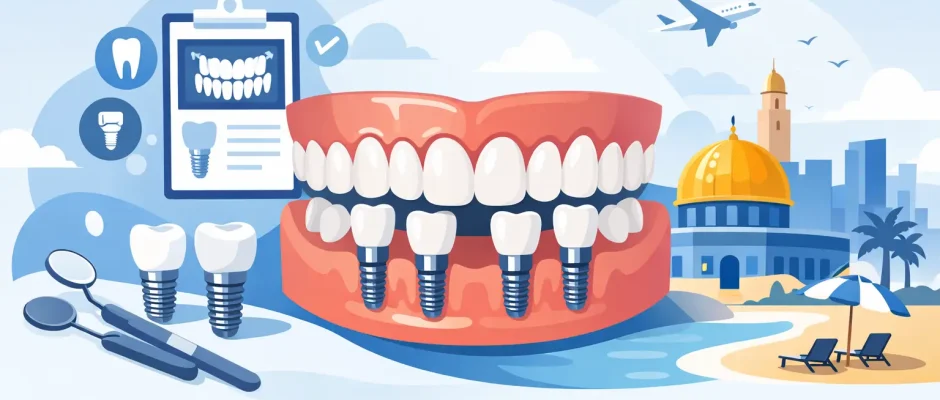
Full Mouth Implant Cost Israel: What to Expect
When patients ask about full mouth implant cost Israel, they are usually not asking for a single number. They are asking what they will actually need, what is included, and whether the result will be stable, safe, and worth the investment. That is the right question, because full-arch rehabilitation is not one procedure with one universal fee. It is a treatment plan built around anatomy, bone volume, medical history, bite, and the type of fixed teeth you want at the end.
For some patients, treatment is straightforward: extractions, four to six implants per arch, and a fixed provisional bridge followed by the final prosthesis. For others, the case is more complex. There may be advanced bone loss, chronic infection, failed old implants, sinus anatomy limitations, or a need for guided bone regeneration before implants can be placed predictably. The cost changes because the biology changes.
What shapes full mouth implant cost in Israel
The biggest factor is whether you need treatment for one arch or both. Replacing all teeth in the upper jaw is one level of treatment. Rebuilding both upper and lower arches is a different scope entirely, with more surgery, more prosthetic work, and more planning.
The second major factor is the treatment concept. Some patients are candidates for an All-on-4 approach. Others will benefit from six implants, or from a staged approach with bone reconstruction before final implant placement. A lower upfront price may reflect a simpler protocol, but not always the best one for long-term stability.
The prosthetic design also matters. A temporary fixed bridge, a final acrylic prosthesis, and a premium zirconia bridge are not equivalent in cost or performance. They differ in material strength, esthetics, wear behavior, maintenance, and laboratory complexity. If you compare quotes from different clinics, this is one of the first places where numbers become misleading. Two plans may both say “full mouth implants,” while the actual restoration is very different.
Full mouth implant cost Israel: typical price logic
In Israel, full-mouth implant treatment is usually priced as a combination of surgical and prosthetic stages rather than one flat universal package. The surgical side may include CBCT diagnostics, digital planning, surgical guides, extractions, bone reduction when indicated, implant placement, suturing, PRF support, and follow-up visits. The prosthetic side may include impressions or scans, a temporary bridge, try-ins, framework fabrication, and the final fixed teeth.
That means the final number depends on what is included from the start. A treatment quote that looks lower may exclude sedation, temporary restorations, grafting materials, or the final prosthesis. A more transparent plan is often more useful than a cheaper-looking one.
As a general rule, a single full arch with fixed implant support in Israel may start from the lower five figures in US dollars equivalent and rise significantly depending on implant number, grafting needs, and prosthetic level. Both arches can double that range or exceed it in complex cases. There is no honest way to reduce this to one exact figure without examining the patient.
Why some cases cost more than expected
Bone loss is one of the most common reasons. If teeth have been missing for a long time, or if there is chronic periodontal disease, the available bone may be insufficient for safe implant placement. In these situations, the surgeon may recommend sinus lift procedures, guided bone regeneration, ridge augmentation, or a staged protocol. These are not optional add-ons invented to increase the bill. They are often the difference between a short-term implant placement and a stable result.
Another driver is infection control. Severely compromised teeth, cystic changes, old root fragments, or failed prior dental work can turn a seemingly simple case into a reconstructive one. The treatment must first create healthy conditions for osseointegration. Skipping that step may seem economical in the moment, but it tends to become expensive later.
Anatomy also matters. The upper jaw is often more demanding because bone density is lower and sinus position can limit implant placement. The lower jaw may require special attention to the inferior alveolar nerve and soft tissue conditions. Full-mouth treatment is not just about placing implants where teeth used to be. It is about rebuilding function within anatomical limits while keeping the result maintainable.
What should be included in the price
A proper quote should make it clear whether diagnostics are included, how many implants are planned, whether extractions are part of the fee, and what temporary and final prosthetics you are paying for. It should also clarify whether surgical guides, PRF, bone graft materials, membrane use, and post-op visits are included.
This matters because good implant dentistry is highly protocol-driven. Digital planning and guided surgery are not decorative technology. In many full-arch cases, they improve accuracy, reduce surprises, and support prosthetically driven placement. That can save both time and complications.
Patients should also ask about maintenance. A well-made full-arch prosthesis still requires periodic review, professional hygiene, and occasional servicing. Screws may need retightening, acrylic may need repair over time, and bite adjustments are sometimes necessary. If a clinic presents treatment as a one-time purchase with no maintenance reality, that is a warning sign.
Cheap vs fair pricing
Not every high fee is justified, and not every moderate fee is suspicious. The issue is whether the treatment plan is biologically sound and clearly explained. Fair pricing reflects diagnostics, surgical complexity, implant system quality, laboratory standards, sterility protocols, and the experience required to manage complications.
Very low pricing often means something is being simplified. Sometimes it is the implant brand. Sometimes it is the number of implants. Sometimes it is the absence of a surgical guide, a lower standard temporary, or a final prosthesis that is less durable than the patient assumes. In more concerning situations, low fees hide underdiagnosis – no discussion of bone volume, no bite analysis, no explanation of soft tissue management.
Full-mouth work is where shortcuts become visible later. An implant can integrate and still be placed in a prosthetically compromised position. A bridge can look acceptable and still be hard to clean or overloaded in function. Correcting those problems later is harder than planning properly from the start.
Why surgeon experience changes value
In complex full-arch cases, surgical judgment affects both cost and risk. Knowing when immediate loading is appropriate, when to stage treatment, when to graft, and when to preserve tissue instead of aggressively reducing bone has a direct effect on the final outcome.
This is especially relevant for patients with severe atrophy, long-standing denture wear, failed implants, smoking history, or systemic conditions that may influence healing. The treatment plan should not only answer, “Can implants be placed?” It should answer, “Can they be placed in a way that gives a predictable prosthetic result and safe healing?”
That is where a surgeon with a strong background in oral and maxillofacial surgery, digital protocols, and microsurgical technique brings real value. In a clinic focused on predictable outcomes, comfort and safety are not separate from cost. They are part of what the patient is paying for.
How to compare quotes intelligently
If you are comparing clinics in Israel, ask each one the same questions. How many implants per arch are planned? Are extractions included? Is the temporary fixed bridge included? What material is the final bridge made from? Do you need bone grafting or sinus work? Will surgery be guided digitally? Are post-op visits included? What happens if the treatment needs to be staged?
Also ask who is actually performing the surgery and who is designing the prosthetic plan. Full-mouth treatment works best when surgery and prosthetics are coordinated from the beginning. A price without a coherent plan is not a bargain. It is just an incomplete number.
For patients traveling for treatment, scheduling matters too. Immediate-load protocols can reduce the number of visits, but only if the case is suitable. Sometimes the safer option is a staged approach with healing time between phases. That can affect both total cost and logistics, so it should be discussed early.
A realistic way to think about full mouth implant cost Israel
It helps to see the cost not as a price tag on implants alone, but as the price of diagnosis, surgery, reconstruction, and long-term function. You are paying for stable chewing, facial support, easier hygiene than failing teeth, and a plan that reduces the chance of starting over in a few years.
At Implantolog.co.il, this kind of planning is approached as a clinical reconstruction rather than a commodity purchase. The right starting point is not the cheapest package. It is a clear examination, imaging, and a treatment plan that explains exactly what your anatomy allows and what result can be delivered safely.
If you are considering full-mouth implants, the most useful next step is a consultation with imaging and a written plan. Once the biology is clear, the numbers become clearer too – and so does the path to a result you can trust.


