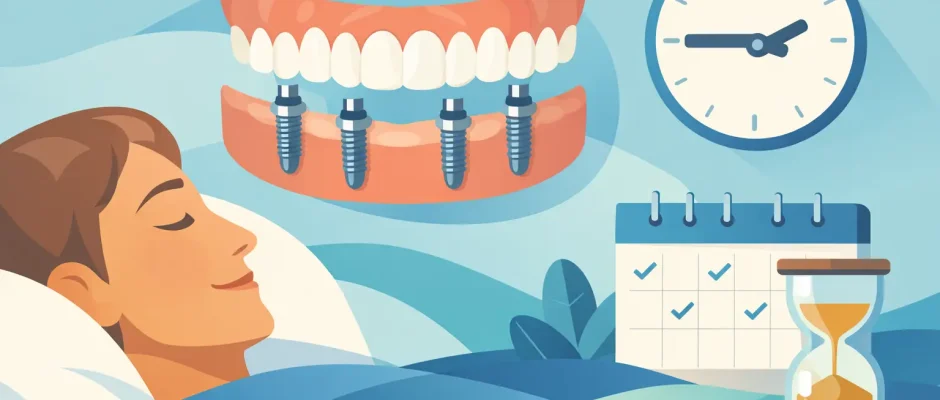
Most patients asking about all-on-4 recovery time are not really asking about a calendar. They want to know when they will feel normal again, when they will be able to eat without thinking about every bite, and how long swelling, tenderness, and caution will dominate daily life.
That is the right question to ask. With All-on-4, the timeline is usually faster than many people expect, but recovery still happens in stages. The first improvement comes quickly. Full biological healing takes longer. If you understand that difference before surgery, the entire process feels more predictable and much less stressful.
All-on-4 recovery time is usually measured in phases
In most cases, patients are functional very early. They can leave the clinic the same day, speak carefully, drink, and return to light daily activity within a short period. But “functional” does not mean “fully healed.” The implants need time to integrate with the bone, the gums need to mature, and the bite needs to remain protected while the system stabilizes.
A practical way to think about all-on-4 recovery time is in three layers. The first is immediate surgical recovery – swelling, soreness, and fatigue in the first days. The second is soft tissue recovery – the gums settling and becoming less sensitive over the first weeks. The third is implant integration – the deeper healing phase that usually takes several months.
For many patients, day 3 is harder than day 1. This is normal. Local anesthesia has worn off, swelling can peak around 48 to 72 hours, and the mouth feels unfamiliar. By the end of the first week, many people feel noticeably better. By two weeks, the acute phase is usually behind them. By three to six months, the implants have typically reached a much more stable biological state and the final prosthetic phase can be considered, depending on the treatment plan.
What the first 72 hours usually feel like
The first three days are about control, not speed. Even when surgery is well planned and performed with a precise protocol, your body still reacts to extractions, implant placement, tissue manipulation, and pressure from the temporary bridge.
Swelling is expected. Mild bleeding or oozing on the first day is also common. The jaw may feel tight, and the cheeks can become more puffy on the second day than they were right after surgery. Some patients also notice that speaking takes effort at first, especially if the tongue is adapting to a new prosthesis.
Pain levels vary, but many patients describe the experience as pressure and soreness rather than sharp pain. That said, there is no universal rule. Recovery depends on the number of extractions, the condition of the bone and gums before surgery, how much infection was present, whether bone reduction was needed, and the patient’s general healing response.
This is why a personalized surgical plan matters. When treatment is guided by detailed diagnostics and a disciplined protocol, the goal is not only implant placement. It is also to reduce unnecessary trauma and make recovery more controlled.
The first two weeks after All-on-4
During the first week, most patients gradually move from discomfort to adaptation. Swelling starts to come down. Sleep improves. The mouth feels less tender. You are still healing, but the feeling of “I just had surgery” usually starts to fade.
At the same time, this is the period when patients can accidentally interfere with healing if they feel too confident too soon. The temporary prosthesis can make it seem as though the teeth are already “back.” Functionally, yes. Biologically, no. The implants still need protection from excessive loading.
A soft diet is not a formality. It is part of treatment. Biting into hard bread, nuts, raw vegetables, tough meat, or crusty food too early can create micro-movements that are not helpful during implant integration. Even if it does not cause immediate pain, it may compromise stability.
By 10 to 14 days, follow-up visits often show that the soft tissues are progressing well. Sutures may be removed if non-resorbable sutures were used. The gums usually look calmer. Bruising, if it occurred, often fades during this period.
What affects all-on-4 recovery time
Two patients can have the same procedure on paper and very different recoveries. That does not always mean something went wrong. It often reflects real biological differences.
Bone quality is one of the main factors. Denser bone may provide excellent initial implant stability, but healing behavior can still vary. Softer bone may require a more cautious loading strategy. If extractions were performed at the same time as implant placement, the tissues may need more time to settle than in a case without active infection or damaged teeth.
General health matters as well. Smoking, uncontrolled diabetes, poor oral hygiene, chronic inflammation, and certain medications can slow healing or increase complication risk. Bruxism is another important factor. A patient who clenches or grinds can overload a fresh temporary prosthesis and put more stress on the implants than they realize.
Surgical technique also matters. Careful planning, prosthetically driven implant positioning, and, when indicated, the use of digital protocols and surgical guides can improve precision. Precision does not guarantee zero swelling or zero discomfort, but it can make treatment more predictable and reduce avoidable trauma.
Eating, talking, and returning to normal life
Many patients are surprised that they can speak relatively soon after treatment, although speech may sound slightly different at first. The tongue adapts quickly, but certain words may feel awkward for several days. This is common and usually temporary.
Eating follows a slower curve. In the beginning, the priority is not testing the new teeth. It is protecting the implants while maintaining nutrition. Soft, high-protein foods are usually easier and more helpful during recovery. Temperature matters too – very hot foods and drinks can be irritating in the early stage.
Most patients can return to desk work or light routine activity within a few days, sometimes sooner. Physically demanding exercise is different. Heavy lifting, intense workouts, and any activity that raises blood pressure significantly are better postponed during the early healing phase, especially in the first few days after surgery.
Social recovery is often faster than biological recovery. Once the immediate swelling settles, many patients feel comfortable being seen in public long before the implants are fully integrated.
When recovery is not going as expected
A normal recovery includes soreness, swelling, tightness, and gradual improvement. A recovery that needs attention may include increasing pain after the first few days, persistent heavy bleeding, fever, bad taste with pus, prosthesis mobility, or swelling that worsens instead of improving.
Patients sometimes hesitate to report symptoms because they do not want to “overreact.” After implant surgery, early communication is always better than waiting. Small issues are easier to correct than advanced complications.
This is one reason structured follow-up matters. Good surgical care does not end when the implants are placed. The postoperative phase is part of the treatment itself.
The long phase: healing under the surface
By the time the mouth looks much better, deep healing is still underway. This is where many misunderstandings happen. Patients feel better, so they assume the implants are fully secure. But osseointegration is a biological process, not a sensation.
Over the next several months, the bone remodels around the implants. The gums mature. The bite can be reassessed. The temporary prosthesis has done its job by maintaining function and esthetics while protecting the healing phase.
In appropriate cases, the final bridge is planned after enough integration and tissue stabilization have occurred. The exact timing depends on clinical findings, not only on the calendar. A patient with excellent healing and stable tissues may move forward smoothly. A more complex case may need extra time. In implantology, patience is often part of achieving a durable result.
A realistic expectation of recovery
If you want a short answer, all-on-4 recovery time is usually a few days for the hardest part, about two weeks for the acute postoperative phase to settle, and several months for full implant healing and final stabilization.
If you want the honest medical answer, it depends. It depends on anatomy, bone quality, extractions, inflammation, systemic health, oral habits, and how carefully the recovery instructions are followed. The good news is that with proper planning and disciplined postoperative care, recovery is usually manageable and much more predictable than many patients fear.
The best mindset is not to ask, “How fast can I get back to normal?” but “How can I heal well enough to make this result last?” That question leads to better decisions – and usually to a calmer recovery.


