Who Is a Candidate for All-on-4?
A patient comes in saying, “I was told I do not have enough bone for implants,” and often assumes that fixed teeth are no longer an option. In many cases, that is exactly where the question of who is a candidate for all-on-4 becomes clinically relevant. This treatment was designed for people who need full-arch restoration and want a fixed solution, but candidacy depends on anatomy, health status, bite, and expectations – not on marketing promises.
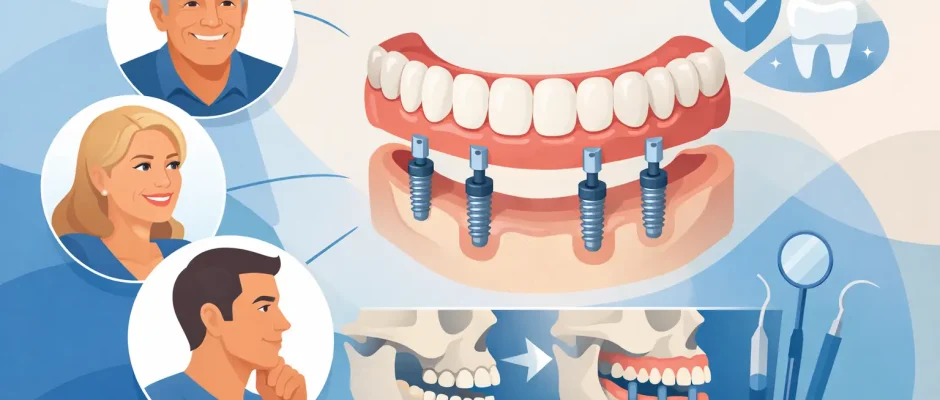
All-on-4 is not simply “four implants and a bridge.” It is a full-arch implant concept in which four strategically placed implants support a fixed prosthesis, usually with the posterior implants angled to maximize available bone and reduce the need for additional grafting. For the right patient, it can shorten treatment time, improve stability, and restore function and appearance with a more efficient surgical plan.
Who is a candidate for All-on-4
The best candidate is usually someone who is missing all teeth in one jaw, or is close to losing the remaining teeth due to severe decay, advanced periodontal disease, fracture, failing crowns and bridges, or long-term instability of the dentition. In these situations, saving individual teeth may lead to repeated treatment with a poor long-term prognosis. A full-arch implant solution can be more predictable than trying to maintain multiple compromised teeth.
All-on-4 is also often considered for patients who currently wear a complete denture and are unhappy with its movement, pressure points, limited chewing ability, or the loss of confidence that comes with removable teeth. Lower dentures, in particular, can be unstable and frustrating. A fixed full-arch restoration supported by implants can change day-to-day function significantly, but only after careful evaluation of the available bone and the bite relationship.
Another common group includes patients with moderate to significant bone loss who still have enough strategically usable bone in the front part of the jaw. This is one of the reasons the concept became so widely used. By tilting the back implants, the surgeon can often avoid anatomical structures and use the bone that remains more effectively. That said, “less bone” does not automatically mean “ideal for All-on-4.” The amount, width, density, and distribution of bone still matter.
Clinical signs that support candidacy
A good candidate typically has a clear indication for full-arch treatment, not just a wish for a faster procedure. If several teeth are non-restorable, mobile, infected, or structurally hopeless, replacing the entire arch may be more rational than performing multiple separate procedures with uncertain longevity.
The condition of the gums and bone is equally important. Active infection around failing teeth does not always prevent treatment, but it changes the surgical plan. Some patients can undergo extractions, implant placement, and immediate provisionalization in one coordinated protocol. Others need a staged approach to control inflammation and improve tissue conditions first.
General health matters as well. Patients with well-controlled chronic conditions are often still candidates. Diabetes, for example, is not an automatic exclusion if it is properly managed. The same applies to many cardiovascular conditions. What matters is surgical safety, healing capacity, and the ability to maintain oral hygiene after treatment.
A practical but often overlooked factor is the patient’s ability to follow instructions. All-on-4 is not passive treatment. It requires diagnostics, planning, surgery, a temporary phase, maintenance, and regular follow-up. The best results are seen when the patient understands the process and accepts that precision aftercare is part of the treatment, not an optional extra.
When bone loss is not a deal-breaker
One reason patients ask who is a candidate for all-on-4 is that they have already been told they have bone atrophy. In reality, bone loss is common among people who need full-arch rehabilitation. The question is not whether bone has been lost, but whether enough bone remains in the right positions to place implants with primary stability.
This is where imaging and digital planning become essential. A clinical exam alone is not enough. Three-dimensional diagnostics allow the surgeon to assess bone volume, sinus anatomy in the upper jaw, the position of the inferior alveolar nerve in the lower jaw, angulation options, and prosthetic space. In well-planned cases, surgical guides can improve accuracy and make the procedure more predictable.
Some patients with advanced atrophy are still candidates, but not always for a classic four-implant protocol. They may need additional implants, zygomatic solutions in rare situations, or bone augmentation before a fixed restoration is safe and stable. It depends on the anatomy. A careful surgeon should not force every case into the same template.
Who may not be a good candidate
Not everyone who wants fixed teeth is ready for All-on-4 immediately. Heavy uncontrolled bruxism can increase the risk of mechanical complications and overload, especially if the prosthetic design does not adequately account for it. This does not always rule treatment out, but it raises the need for protective planning and realistic discussion.
Patients with uncontrolled diabetes, active chemotherapy-related complications, severe immune suppression, untreated periodontal inflammation, or heavy smoking may have a higher risk of impaired healing and implant failure. Smoking is especially important. It does not make treatment impossible in every case, but it clearly affects tissue health, circulation, and long-term prognosis.
Poor oral hygiene is another major concern. Full-arch implant restorations still require daily cleaning and professional maintenance. Some patients assume fixed means maintenance-free. It does not. If the patient cannot or will not keep the prosthesis clean, inflammation around implants can develop and compromise the result.
There are also cases where preserving natural teeth is the better decision. If several teeth are healthy or can be predictably maintained, removing them just to fit a full-arch concept may be too aggressive. Good treatment planning starts with diagnosis, not with the name of the procedure.
The role of immediate teeth
Many patients are interested in All-on-4 because they want to avoid a period without teeth. In suitable cases, immediate loading with a fixed temporary bridge is possible. This means implants are placed and a provisional restoration is delivered shortly after surgery, often on the same day or within a short timeframe.
However, immediate teeth are not guaranteed in every case. The implants must achieve sufficient primary stability, the bite must be favorable, and the patient must follow a controlled diet during early healing. If stability is borderline or the bone quality is poor, a delayed loading protocol may be safer. The right choice is the one that protects osseointegration.
Why the prosthetic plan matters as much as surgery
Patients often focus on implant placement, but candidacy for All-on-4 is also prosthetic candidacy. The relationship between the jaws, smile line, lip support, facial profile, and available restorative space all affect whether this concept will work well.
For example, if the patient has a very high smile line, transitions between prosthetic material and soft tissue may become visible. If the bite is severely unbalanced, the design of the final bridge must compensate carefully for force distribution. If there is limited vertical space, the restoration may be compromised mechanically. These are not minor details. They determine comfort, esthetics, speech, and long-term durability.
That is why full-arch treatment should be planned backward from the final result. The question is not just, “Can four implants be placed?” The better question is, “Can four implants support a functional, hygienic, esthetic restoration in this specific patient?”
What happens during the evaluation
A proper candidacy assessment usually includes a detailed medical history, examination of the remaining teeth and soft tissues, bite analysis, CBCT imaging, and a discussion of goals. Some patients want the shortest path to fixed teeth. Others care most about esthetics, long-term maintenance, or avoiding grafting. These priorities influence the plan.
In more complex cases, digital planning can help simulate implant position and prosthetic design before surgery. This is especially valuable when bone is limited, extractions are planned at the same time, or immediate loading is being considered. In experienced hands, combining digital workflow with strict surgical protocols helps reduce uncertainty and improve precision.
For patients traveling for treatment or trying to minimize the number of visits, this kind of structured planning is even more important. It allows the treatment team to define what can be done immediately, what should be staged, and where compromises would be unsafe.
All-on-4 can be an excellent solution for patients with failing teeth, complete tooth loss, denture instability, or bone loss that still allows strategic implant placement. It is less about fitting a label and more about matching anatomy, health, and expectations to a protocol that is biologically sound and prosthetically realistic. The right plan should leave you feeling informed, not pressured – because the best full-arch result starts with a diagnosis that respects your case as it actually is.


