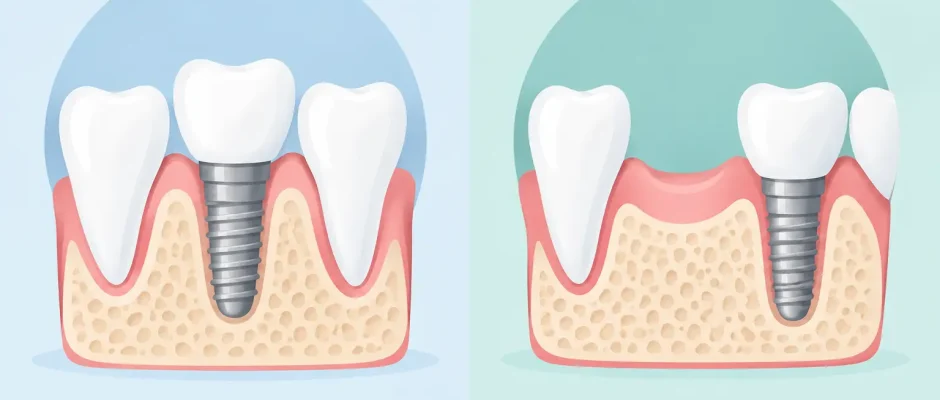
Late Implant Placement vs Early Placement
A tooth extraction creates an important clinical decision: should the implant be placed after a short healing period, or only after the socket and bone have healed completely? In the discussion of late implant placement vs early placement, neither option is automatically better. The right timing depends on the condition of the extraction site, the quality of the surrounding bone and gums, the presence of infection, and the esthetic demands of the final restoration.
For patients, this is not simply a question of waiting longer or finishing treatment faster. Implant timing affects surgical complexity, the possible need for bone grafting, the appearance of the gum line, and the predictability of the long-term result.
What Do Early and Late Implant Placement Mean?
Implant placement is often described according to the healing period after tooth removal. Immediate placement means inserting an implant during the same visit as the extraction. It can be appropriate in selected cases, but it is not the focus of every treatment plan.
Early implant placement is performed after the initial soft-tissue healing phase. Depending on the clinical protocol, this is commonly around 4 to 8 weeks after extraction, or after a longer early-healing period of approximately 12 to 16 weeks. The socket has begun to heal, inflammation can be reassessed, and the gum tissue is often easier to manage surgically.
Late implant placement is usually performed after more complete bone healing, often several months after extraction. By this stage, the extraction socket has remodeled into healed bone. If the ridge has lost width or height during healing, guided bone regeneration or another augmentation procedure may be needed before or during implant placement.
These time frames are useful reference points, not rigid rules. A CBCT scan, clinical examination, periodontal assessment, and a review of the reason for extraction determine whether the site is truly ready.
Why Timing Matters After an Extraction
After a tooth is removed, the jawbone no longer receives the same functional stimulation from the tooth root. Bone remodeling begins quickly, especially on the thin outer bone wall around front teeth. The ridge may become narrower, and the soft tissues may lose support.
This is why an extraction should be treated as the first stage of implant planning, not as an isolated procedure. A careful atraumatic extraction, socket preservation when indicated, PRF protocols, and precise management of the wound can help preserve the foundation for a future implant.
The key goal is not to place an implant at the earliest possible date. It is to place it when there is enough healthy tissue to position it correctly in three dimensions. An implant that is placed too far toward the lip, too shallow, too deep, or outside the available bone may create esthetic and functional problems that are difficult to correct later.
Early Placement: When It Can Be a Strong Option
Early placement is often chosen when the tooth had infection, a fracture, or another condition that makes immediate placement less predictable, but the clinician does not want to wait through complete bone remodeling. The initial healing period allows the extraction site to stabilize and gives the surgeon an opportunity to confirm that inflammation has resolved.
For many patients, early placement offers a useful balance. Soft tissue has had time to close over the socket, while the ridge may still retain more of its original contours than it would after prolonged healing. This can be especially valuable in the smile zone, where gum architecture and facial bone thickness affect the appearance of the final crown.
Early placement may also make grafting more controlled. If a localized defect is present, the surgeon can assess it in a cleaner, healed environment and use guided bone regeneration with a membrane and graft material when necessary. The decision is based on the anatomy, not on a standard calendar.
There are trade-offs. Early placement still requires sufficient bone for stable implant fixation. Patients should also understand that the implant usually needs a healing period before final restoration. Early does not always mean faster teeth overall, particularly when grafting or provisional restoration is required.
Infection Does Not Automatically Require a Long Delay
A common concern is that a tooth removed because of infection means an implant cannot be placed for months. In reality, the decision depends on the type and extent of infection, the condition of the socket walls, the ability to remove inflamed tissue completely, and the patient’s general health.
In some cases, a short healing phase is the most prudent approach. It allows the surgeon to monitor tissue recovery before implant placement. In other cases, longer healing is necessary because the defect is extensive or the surrounding bone needs reconstruction. The diagnosis matters more than the label “infection.”
Late Implant Placement: When Waiting Is Safer
Late placement is often the more predictable choice when the extraction was traumatic, there is significant bone loss, inflammation has affected the surrounding tissues, or the site requires staged bone reconstruction. It is also appropriate when a patient’s medical condition, smoking status, periodontal disease, or oral hygiene needs to be addressed before surgery.
With late placement, the surgeon works in a fully healed site. This can simplify the assessment of bone volume and allow a more deliberate augmentation plan. For example, if the ridge is too narrow for ideal implant positioning, a bone graft may be performed first, allowed to mature, and followed by implant placement at a later stage.
This approach takes more time, but time can be an advantage when it is used to create a stable foundation. In complex posterior cases near the maxillary sinus, or in areas with severe ridge resorption, staged treatment may reduce risk and improve implant positioning. Sinus lifting, guided bone regeneration, and digital surgical planning are often part of this process.
The limitation of late placement is that bone remodeling may already have progressed. Without socket preservation at the time of extraction, the eventual treatment may involve more grafting than it would have earlier. That does not make the result inferior, but it can increase treatment duration, cost, and the number of surgical stages.
Late Implant Placement vs Early Placement in the Smile Zone
The front teeth require special caution because patients notice even small changes in gum contour, tooth length, or the level of the papillae. In this area, timing is only one part of the decision. The thickness of the facial bone, the gum biotype, the position of neighboring teeth, the patient’s smile line, and the planned crown shape all matter.
Early placement may help preserve favorable tissue contours after extraction, particularly when combined with provisional restoration and soft-tissue management. However, it should not be selected just to avoid a waiting period. If there is a major defect, thin tissue, or loss of the facial bone wall, a staged grafting approach may be safer.
Late placement can provide excellent esthetic results when reconstruction is planned precisely. The treatment may include bone augmentation and, when indicated, connective tissue grafting to create sufficient tissue thickness around the implant. The difference is that the clinician is rebuilding a foundation that may have changed during healing.
How Digital Planning Improves Either Protocol
Whether placement is early or late, modern implant planning should begin before surgery. A CBCT scan provides three-dimensional information about bone width, height, angulation, and critical anatomical structures. In esthetic cases, the planned final crown should guide implant positioning, rather than placing an implant first and trying to compensate later with the restoration.
Digital planning can be transferred to surgery with a custom surgical guide when appropriate. This improves the accuracy of implant position and helps protect important structures such as the maxillary sinus and mandibular nerve. It is particularly valuable when available bone is limited or several implants are planned.
PRF may be used as an adjunct in selected cases to support soft-tissue healing and patient comfort. It is not a substitute for sound surgical technique, adequate bone volume, or infection control. Its role should be considered as part of a complete protocol.
Questions That Determine the Right Timing
A responsible treatment plan answers several practical questions: Why was the tooth removed? Are the socket walls intact? Is there active infection or a periodontal defect? How much bone remains after extraction? Is the site in the visible smile zone? Does the patient need a temporary tooth during healing? And can the implant be positioned prosthetically, with enough bone and soft tissue around it?
General health is equally relevant. Diabetes should be well controlled, smoking should be discussed honestly, and active periodontal disease must be treated. Implant treatment is not only a surgical procedure. It is a long-term maintenance commitment.
At Implantolog.co.il, the consultation process is designed to turn these questions into a clear sequence of treatment: imaging and diagnosis, extraction when needed, preservation or augmentation of the site, implant placement at the appropriate time, and coordination of the final restoration.
The most helpful next step after a planned extraction is not choosing “early” or “late” from a list. It is arranging an implant-focused evaluation before the tooth is removed whenever possible, so the healing process itself supports the result you want to keep for years.


