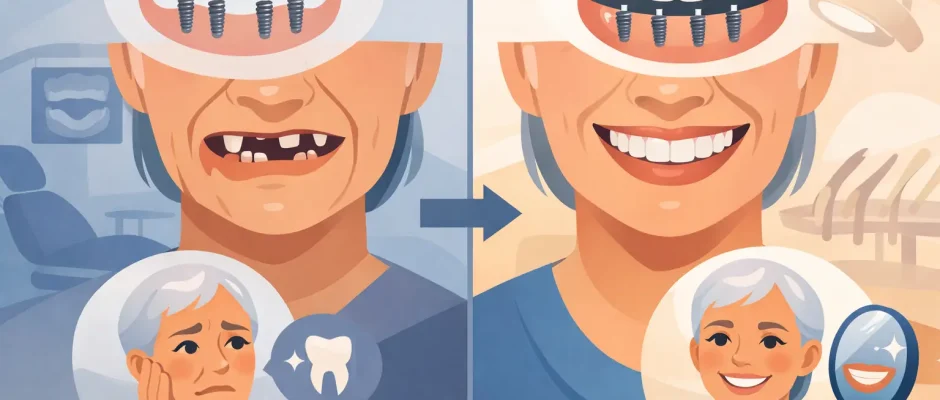
All-on-4 Before and After: What to Expect
Most patients who search for all-on-4 before and after are not just looking for dramatic photos. They want to know what actually changes – in the mouth, in daily life, in healing, and in confidence. That is the right question, because the real value of All-on-4 is not a single day result. It is the transition from failing teeth or removable dentures to a fixed, functional restoration with a predictable surgical plan.
A good before-and-after discussion should be honest. Some changes are immediate. Others take months. Some patients are candidates for same-day fixed teeth, while others need a modified protocol because of infection, severe bone loss, bite issues, or medical factors. The best outcomes come from careful planning, not from promising the same timeline to everyone.
What “before” usually looks like
Before All-on-4 treatment, patients usually fall into one of several clinical groups. Some have multiple broken, mobile, or heavily restored teeth that can no longer be maintained predictably. Others already wear full dentures and are tired of movement, pressure spots, poor chewing efficiency, and reduced confidence in social situations. A third group has advanced periodontal disease, progressive bone loss, and a bite that has been collapsing for years.
The esthetic problems are often obvious, but the functional problems are usually more significant. Patients may avoid certain foods, chew only on one side, or stop smiling naturally. Speech may change. The lower third of the face can look collapsed when back teeth are missing for a long time. In many cases, the goal is not simply to replace teeth. It is to rebuild support, stability, and a comfortable bite.
That is why a true all-on-4 before and after assessment starts with diagnosis, not with the prosthetic arch alone. A CBCT scan, intraoral evaluation, periodontal status, bone volume, smile line, facial proportions, and parafunctional habits all matter. If this part is rushed, the final result may look acceptable in photos but perform poorly in real life.
What changes immediately after All-on-4
One reason this concept became so popular is that patients can often leave surgery with fixed provisional teeth on the same day or shortly after implant placement. For someone who has lived with loose dentures or severely damaged teeth, that immediate shift can feel dramatic.
The first visible change is stability. Instead of a removable prosthesis or failing dentition, the patient has a fixed provisional restoration attached to implants. This often improves appearance right away because tooth position, arch form, and lip support can be corrected more predictably than with a worn natural dentition or unstable denture.
Function improves too, but this is where expectations need to be realistic. Immediate fixed teeth are not the same as the final prosthesis. They are designed to support healing and allow controlled function. Patients still need to follow a soft diet and protect the implants during osseointegration. The mouth may look transformed quickly, but biology still follows its own timetable.
Swelling, tenderness, and temporary speech adaptation are common in the early phase. That does not mean the treatment is failing. It means surgery happened, tissues are healing, and the patient is learning to use a new bite relationship. Good preparation helps patients understand this part, which reduces anxiety after surgery.
The first week after surgery
During the first several days, most patients notice swelling and a sense of tightness more than severe pain. When surgery is planned carefully and performed with an atraumatic technique, postoperative discomfort is usually manageable. The degree of swelling depends on how many extractions were required, the condition of the tissues before treatment, and whether additional procedures were needed.
At this stage, the “after” does not yet look polished. The gums are healing. Facial expression may still be guarded. Speech may sound slightly different, especially with certain sounds. This is normal. The early goal is not perfection. The goal is stable healing with a fixed interim restoration that protects the implants and allows daily life to continue with far more comfort than many patients expect.
All-on-4 before and after: esthetics vs function
Patients often focus first on appearance, but the strongest long-term before-and-after difference is usually functional. A successful case improves chewing efficiency, confidence in speaking, and day-to-day comfort. Esthetics matter, but if the bite is unstable or hygiene is impossible, the result will not remain successful.
A well-designed All-on-4 case should support the lips, restore facial proportions, and create a natural smile line that fits the patient rather than looking artificially uniform. Tooth shape, midline, incisal display, and gum transition zone all need attention. This is especially important in patients with high smile lines, where the junction between prosthesis and tissue may become visible.
Function requires equal attention. Implant position, angulation, prosthetic space, opposing dentition, and jaw relationship affect how the patient will chew and how forces will be distributed over time. In complex cases, digital planning and surgical guides help increase precision and reduce the gap between the planned result and the actual surgical outcome.
Why some before-and-after results look better than others
The quality of the result depends on more than the implant brand or the number of implants. The biggest difference usually comes from planning discipline. If the surgeon and restorative team work backward from the final tooth position, the implants are placed to support esthetics, hygiene access, and biomechanics. If treatment is driven only by available bone without proper prosthetic planning, compromises show up later.
There is also the question of case selection. All-on-4 is a powerful solution, but not every full-arch patient is the same. Some need adjunctive procedures. Some may benefit from more than four implants depending on bone quality, anatomy, or load distribution. “All-on-4” is a concept, not a shortcut.
The real timeline from surgery to final teeth
This is the part many patients are not told clearly enough. The provisional phase and the final phase are different chapters of treatment.
After implant placement, the implants need time to integrate with bone. During this healing period, the temporary fixed bridge helps maintain appearance and function, but it is still a controlled phase. The soft tissues mature, inflammation settles, and the bite can be refined based on how the patient adapts.
Only after stable healing does the final prosthesis make sense. This final restoration is typically stronger, more refined in shape and bite, and designed for long-term wear. The exact timeline varies, but several months is common. If there was significant infection, poor bone quality, or a need for staged treatment, the process may take longer. That is not a complication by itself. Often, it is simply the safer path.
What patients usually notice months later
Several months after treatment, the before-and-after difference becomes more meaningful. Patients usually report that eating feels more natural, social anxiety drops, and oral hygiene becomes easier than managing failing teeth or unstable dentures. Many also notice that facial support improves and they no longer think constantly about their teeth.
This stage is also where poor planning becomes obvious if corners were cut. Speech problems that never resolved, chronic food trapping, repeated fracture of the provisional, or difficulty cleaning under the prosthesis are signs that the case needs closer evaluation. A successful result should feel stable, maintainable, and biologically calm.
The healthiest before-and-after stories are not the most dramatic ones online. They are the cases where the patient can function comfortably, maintain the restoration properly, and return for routine follow-up without ongoing inflammation or repeated emergency visits.
Who is a good candidate for a strong before-and-after result
The best candidates are not only those with enough bone for implant placement. They are also patients who are ready to follow instructions during healing, maintain hygiene carefully, and attend follow-up visits. Smoking, uncontrolled diabetes, active periodontal infection, severe clenching, and neglected oral hygiene all affect the predictability of the outcome.
This does not automatically exclude treatment. It means the plan may need to be adjusted. In some cases, additional preparation is required before surgery. In others, a staged approach is safer than immediate loading. Honest treatment planning protects the result.
For patients considering treatment in Israel, especially in a setting focused on surgical precision and digital planning, the practical advantage is often a more controlled workflow from diagnosis to guided implant placement to monitored healing. That matters more than marketing language because full-arch rehabilitation is a surgical and prosthetic project, not just a cosmetic service.
When you look at all-on-4 before and after, try to look beyond the smile photo. Ask what the tissues looked like before, how the implants were planned, whether the patient received immediate temporaries or a staged protocol, and how the final bite was managed. The best result is the one that still works well long after the photo was taken.


