Can Implants Support Dentures? What to Expect
A denture that shifts while speaking, traps food, or needs adhesive every morning can make eating and social situations feel unnecessarily stressful. So, can implants support dentures? Yes. Dental implants can stabilize a removable denture or support a fixed full-arch bridge, often improving comfort, chewing efficiency, and confidence. The right solution, however, depends on the bone, bite, medical history, and expectations of the individual patient.
How Can Implants Support Dentures?
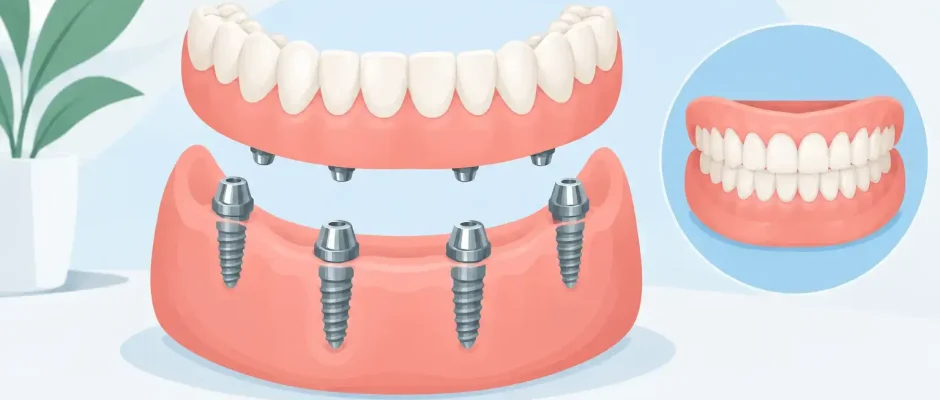
An implant is a titanium fixture placed in the jawbone to act as an artificial tooth root. After healing and integration with the bone, it can provide a stable anchor for a denture. Instead of relying only on suction, gum tissue, and denture adhesive, the prosthesis attaches to implants through a planned connection system.
There are two main approaches. An implant-retained denture is removable by the patient for cleaning. A fixed implant-supported bridge is attached by the dentist and remains in place during daily life. Both options can be excellent, but they are designed for different clinical situations and lifestyles.
The key distinction is not merely whether a denture is “on implants.” It is how the implants are positioned, how forces are distributed during chewing, what type of prosthesis is used, and whether the surrounding bone and soft tissue can support predictable long-term results.
Implant-Retained Dentures: A Secure Removable Option
An implant-retained overdenture looks similar to a conventional denture but connects to implants using attachments. Depending on the case, these may be individual stud attachments or a bar that joins the implants together. The patient can remove the prosthesis at night and clean around the implants directly.
For the lower jaw, two implants can often provide a major improvement over a conventional full denture. The lower denture is especially prone to movement because there is limited surface area for suction and the tongue constantly affects its position. Even a two-implant overdenture may reduce rocking, improve stability, and make chewing more comfortable.
The upper jaw is different. Bone quality is often softer, and the palate may be involved in the design of a traditional denture. Depending on the anatomy, four or more implants may be recommended to create reliable support. A smaller number can be appropriate in selected cases, but it should not be chosen simply to reduce the initial cost if it compromises long-term function.
A removable implant-retained denture is often a practical choice for patients who want greater stability without the complexity of a fixed bridge. It can also make hygiene easier for patients with reduced hand dexterity, provided they are able to remove and reinsert the denture comfortably.
What patients usually notice
Most patients notice that the denture feels more secure while talking and eating. Adhesives may no longer be needed, or their use may be significantly reduced. Because the denture is stabilized, pressure on the gums can also become more evenly distributed.
Still, an overdenture is not the same as having fixed teeth. It has acrylic components that can wear over time, attachment inserts may need periodic replacement, and regular professional maintenance remains necessary. It is a durable treatment, not a maintenance-free one.
Fixed Implant-Supported Dentures and Full-Arch Bridges
A fixed full-arch restoration is sometimes called a fixed implant bridge or fixed implant-supported denture. It replaces a full row of teeth and is secured to several implants. Only the dental team removes it during maintenance visits.
Protocols such as All-on-4 are designed to support a full arch with strategically placed implants, often using angled implants in the back of the jaw to make better use of available bone. This can be particularly valuable when posterior bone volume is limited or when avoiding more extensive grafting is a reasonable clinical goal.
However, “All-on-4” is not automatically the best answer for every patient. Some cases benefit from five or six implants, especially where bone conditions, bite forces, parafunction such as clenching, or prosthetic design call for additional support. Treatment should be based on diagnostics rather than a one-size-fits-all protocol.
A fixed bridge can feel closer to natural teeth because it does not move and remains in the mouth. For many patients, that sense of stability is its greatest advantage. At the same time, cleaning requires commitment. Special brushes, flossing tools, and sometimes an oral irrigator are needed to clean under the bridge and around the implants every day.
How Many Implants Are Needed for Dentures?
There is no responsible universal number. The lower jaw may be treated with two implants for a removable overdenture, while a fixed lower full-arch bridge usually requires more. In the upper jaw, four, five, or six implants may be considered depending on the anatomy and the planned restoration.
The number alone does not determine success. Implant length and diameter, bone density, implant distribution, the angle of placement, the bite, and the design of the final prosthesis all matter. A bridge supported by implants that are poorly positioned for the planned teeth can create hygiene difficulties or overload certain components, even if the implant count sounds impressive.
This is why three-dimensional imaging and digital planning are valuable. A CBCT scan allows the surgeon to evaluate bone volume, sinus position, nerve anatomy, and potential implant sites. When appropriate, a surgical guide helps transfer the virtual plan into precise clinical placement. The prosthetic plan should guide surgery from the beginning, rather than being considered only after implants have healed.
Is Bone Loss a Barrier to Implant-Supported Dentures?
Not necessarily. Bone loss is common after teeth have been missing for years, particularly in the back of the upper jaw and the lower jaw near the nerve canal. It may limit implant placement, but it does not always rule it out.
In some situations, implants can be placed in the available bone using an angled or short-implant strategy. In others, bone grafting, guided bone regeneration, or a sinus lift may provide the foundation needed for a more favorable implant position. The appropriate choice depends on the extent and location of the deficiency, as well as the patient’s health, timeline, and treatment goals.
For patients needing extractions, immediate implant placement may occasionally be possible. This means placing an implant at the time a tooth is removed. It can shorten the overall treatment sequence, but it is not appropriate in every socket. Active infection, thin bone walls, limited primary stability, and the intended final restoration must all be assessed carefully.
What Does Treatment Involve?
Treatment begins with a clinical examination, imaging, and a discussion of the desired result. The dentist evaluates the gums, remaining teeth, bone anatomy, smile line, bite, and medical factors such as smoking, diabetes control, medications, and a history of periodontal disease.
If teeth need to be removed, the plan should address more than the extraction itself. It should explain whether grafting is needed, whether temporary teeth will be provided, and when the final denture or bridge can be delivered. Some patients can receive a fixed temporary restoration shortly after surgery. Others need a healing period before loading the implants. The safer route depends on implant stability and the quality of the available bone.
Implant surgery is performed under local anesthesia, with sedation options considered when appropriate. A careful surgical protocol, atraumatic technique, and close postoperative follow-up help reduce discomfort and support healing. In selected cases, PRF, made from the patient’s own blood, may be used as an adjunct to support soft-tissue and bone healing.
Once integration is complete, the restorative dentist fabricates the final prosthesis. This stage is as important as surgery. The shape of the teeth, bite relationship, lip support, phonetics, and ability to clean the restoration should all be checked before the definitive work is delivered.
Who May Need a Different Approach?
Implants are highly successful, but they are not a shortcut around every oral health issue. Uncontrolled diabetes, heavy smoking, untreated gum disease, certain medications, and poor daily hygiene can increase risk. Severe nighttime grinding may require a protective nightguard and a stronger prosthetic design.
A patient who cannot maintain hygiene under a fixed bridge may be better served by a removable implant-retained denture. Conversely, a patient who strongly dislikes removing a denture and can maintain meticulous home care may prefer a fixed solution. The best choice is the one that fits both the anatomy and the person who will live with it every day.
For patients seeking treatment in Tel Aviv, a consultation with an implant surgeon should result in a clear sequence of care: what is possible now, what requires preparation, what temporary phase is needed, and how the final result will be maintained. A well-planned implant-supported denture should not just stay in place – it should be comfortable, cleanable, and built to function predictably for years.


