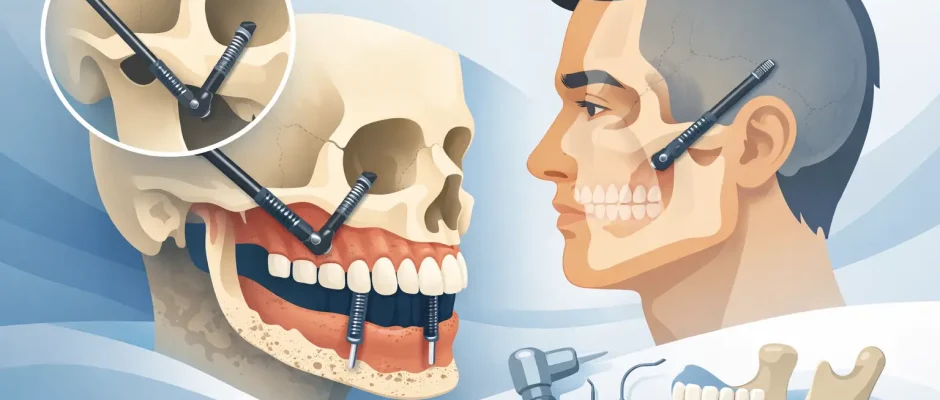
Guide to Zygomatic Implants for Severe Bone Loss
When the upper jaw has lost a significant amount of bone, being told that conventional implants are not possible can feel like a dead end. A guide to zygomatic implants explains why that is not always the case. For selected patients, these specialized implants can create a stable foundation for fixed teeth by using the cheekbone rather than relying only on the weakened bone of the upper jaw.
Zygomatic implant treatment is not a shortcut and it is not appropriate for every patient. It is an advanced surgical protocol that requires careful diagnosis, three-dimensional planning, and an experienced surgeon who understands the anatomy of the maxillary sinus, orbit, and cheekbone. The goal is not simply to place implants, but to restore function with a plan that is safe, biologically sound, and predictable.
What Are Zygomatic Implants?
Zygomatic implants are longer dental implants designed to anchor in the zygomatic bone, commonly called the cheekbone. This bone is denser and usually remains stable even when the posterior upper jaw has undergone major resorption after tooth loss.
Conventional implants are placed within the alveolar bone, the part of the jaw that once held the teeth. In severe upper-jaw atrophy, there may not be enough bone height or width for standard posterior implants. Traditionally, treatment could involve sinus lifting and extensive bone grafting before implant placement. Those procedures remain valuable in many cases, but they can require several healing stages and months of treatment.
With zygomatic implants, the surgeon uses a different anchorage strategy. One or two long implants may be placed on each side of the upper jaw, depending on the anatomy and restorative plan. They can be combined with conventional implants in the front of the upper jaw or, in certain full-arch protocols, used as the main support for a fixed prosthesis.
Who May Be a Candidate for Zygomatic Implants?
The most common indication is severe bone loss in the upper jaw, particularly in the back sections near the maxillary sinuses. Candidates may have worn removable dentures for years, lost teeth because of periodontal disease, experienced failed implant treatment, or have undergone prior grafting that did not produce enough stable bone.
Zygomatic implants may be considered when a patient wants a fixed full-arch restoration but wishes to avoid extensive grafting or when grafting is not clinically favorable. They can also be useful in complex reconstructive cases after trauma, infection, or tumor-related surgery. Each of these situations has different risks and planning requirements.
A healthy cheekbone on a scan does not automatically mean that this treatment is suitable. The surgeon must assess sinus health, gum condition, bite forces, oral hygiene, general medical history, smoking status, and the design of the future prosthesis. Active sinus disease, uncontrolled diabetes, heavy smoking, untreated periodontal inflammation, or unrealistic expectations may require treatment first or may change the recommended approach.
The central question is not, “Can a zygomatic implant be placed?” It is, “Which treatment plan offers the best long-term balance of safety, comfort, hygiene, and stable function?” For some patients, conventional implants with grafting remain the better choice.
Guide to Zygomatic Implants: Planning Before Surgery
The safety of zygomatic implant surgery begins well before the procedure. A panoramic X-ray alone is not sufficient for this type of treatment. Planning normally requires cone beam CT imaging, which provides a three-dimensional view of the upper jaw, sinuses, nasal cavity, cheekbones, and nearby anatomical structures.
The scan is evaluated together with a clinical examination and the restorative plan. The position of the future teeth matters because implants should support a prosthesis that is comfortable, cleansable, and properly balanced in the bite. Placing implants without first considering the final teeth can lead to poor access for hygiene, excessive load, or an unfavorable smile line.
Digital planning software helps the surgical team measure bone volume, choose implant length and angulation, and assess the path of placement. In selected cases, a surgical guide may be used to transfer the digital plan accurately to the clinical setting. A guide does not replace surgical judgment, especially in complex anatomy, but it can improve control and communication between the surgeon and restorative dentist.
At Implantolog.co.il, complex implant planning is approached as a complete surgical and restorative task, not as an isolated implant procedure. This distinction matters because a technically placed implant is only successful if the patient can use and maintain the final restoration comfortably over time.
What the consultation should clarify
A thorough consultation should give the patient a clear answer about the diagnosis, alternatives, expected sequence of treatment, and likely temporary restoration. It should also cover anesthesia or sedation options, the need for extractions, the condition of the sinuses, and whether immediate loading with fixed temporary teeth is appropriate.
Immediate teeth can be possible in many cases, but they depend on primary implant stability, bite conditions, bone quality, and the patient’s ability to follow dietary instructions. It is a clinical decision, not a feature that should be promised before planning is complete.
What Happens During Surgery?
Zygomatic implant surgery is performed under local anesthesia with appropriate sedation options or under general anesthesia when indicated by the case and clinical setting. The approach depends on the patient’s medical status, surgical complexity, anxiety level, and the planned extent of treatment.
After preparing the surgical area, the surgeon places the implants through a planned trajectory toward the zygomatic bone. Several placement approaches exist, including techniques that position the implant in relation to the sinus differently. The choice is guided by individual anatomy, sinus condition, and the need to create a prosthetic position that can be cleaned and restored effectively.
If remaining teeth are hopeless, they may be removed during the same appointment. In a full-arch protocol, the implants may then support a fixed provisional bridge. This temporary bridge allows the patient to leave with teeth rather than a removable denture, but it still needs protection while healing takes place.
The final prosthesis is usually made after a period of healing and assessment. It should be designed with access for daily cleaning and regular professional maintenance. The final stage is as important as the surgery itself: the shape, bite, materials, and fit of the bridge influence comfort and implant longevity.
Recovery: What Patients Can Realistically Expect
Most patients experience swelling, bruising, pressure, and fatigue for several days after surgery. Discomfort is usually managed with a prescribed medication plan, cold compresses during the early period, and clear postoperative instructions. Recovery varies according to whether extractions, sinus procedures, or other surgeries were performed at the same time.
A soft diet is typically required during the initial healing phase. Even if the provisional bridge feels secure, it should not be used to bite hard foods. Excess force can compromise the healing interface between bone and implant before integration is complete.
Nasal congestion or minor nasal bleeding can occur in some cases, particularly when surgery involves the sinus region. Patients are often instructed to avoid forceful nose blowing, smoking, strenuous exercise, and activities that increase sinus pressure during early healing. Any persistent bleeding, worsening swelling, fever, foul taste, severe pain, or visual symptoms requires prompt contact with the surgical team.
Follow-up appointments are not administrative formalities. They allow the surgeon to monitor soft-tissue healing, hygiene, bite contacts, provisional bridge stability, and signs of sinus-related complications. Good follow-up is part of the treatment protocol.
Risks and Trade-Offs to Discuss Openly
Zygomatic implants have shown strong outcomes in experienced hands, but they involve more complex anatomy than routine implant placement. Potential complications include sinusitis, soft-tissue inflammation around the implant, infection, implant failure, numbness, prosthetic problems, and, rarely, complications involving neighboring structures.
The risk profile depends on anatomy, surgical technique, medical factors, smoking, hygiene, and the experience of the clinical team. This is why patients should be cautious about treatment plans based only on a short remote review or a promise of fixed teeth in one day. A fast protocol can be appropriate, but it must be based on complete diagnostics.
There are also practical trade-offs. Zygomatic implant surgery can reduce or eliminate the need for major bone grafting, potentially shortening the overall timeline. On the other hand, it is a more specialized operation and may not be the least invasive option for a patient who still has enough bone for standard implants and a limited grafting procedure.
Questions Worth Asking Your Surgeon
Before proceeding, ask whether zygomatic implants are necessary in your specific case and what alternatives are realistic. Ask to see the CT-based explanation of your bone condition and the proposed implant positions. You should understand whether the plan includes immediate fixed teeth, how long the temporary phase will last, and who is responsible for the final prosthetic restoration.
It is also reasonable to ask about the surgeon’s training and experience with complex upper-jaw cases, the protocol for managing sinus complications, and the schedule of postoperative visits. Clear answers help replace uncertainty with informed consent.
A good treatment plan should make you feel neither pressured nor confused. The right decision is the one that respects your anatomy, your health, your priorities, and the level of long-term care you can realistically maintain.


