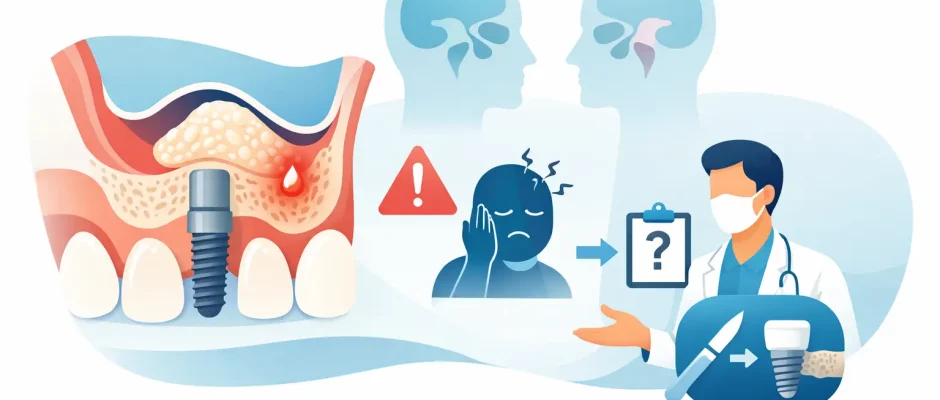
Can Sinus Lift Fail? Risks, Signs, and Next Steps
A sinus lift is often the step that makes implant treatment possible in the back of the upper jaw when bone height is limited. But patients are right to ask: can sinus lift fail? Yes, complications and unsuccessful outcomes are possible, although they are not inevitable and do not always mean that implant treatment has been lost. The key is to distinguish normal healing from a true problem, then respond early and methodically.
Can a Sinus Lift Fail? What “Failure” Actually Means
A sinus lift, also called maxillary sinus floor augmentation, creates additional bone volume beneath the maxillary sinus. The surgeon gently elevates the sinus membrane and places grafting material in the newly created space. After healing, this augmented area may support one or more dental implants.
The word “failure” can describe several different situations. The graft may not mature into stable bone as expected. An infection can develop around the grafted area. The sinus membrane may tear during surgery, changing the plan for that day. In other cases, the graft heals adequately but a later implant does not integrate with the bone.
These are different clinical events with different solutions. A small membrane perforation, for example, is a recognized surgical complication, not automatically a failed sinus lift. When identified during treatment, it can often be repaired or protected with an appropriate membrane, and the grafting procedure may still proceed. Larger tears, significant bleeding, or unfavorable anatomy may make postponing the graft the safer choice.
A careful evaluation also separates graft-related complications from ordinary postoperative effects. Mild swelling, bruising, tenderness, and slight nasal congestion can occur after surgery. They should gradually improve rather than become more severe.
Why a Sinus Lift Can Fail
Successful healing depends on biology, surgical technique, and the patient’s ability to follow the recovery protocol. No surgeon should promise a risk-free procedure, especially when treatment involves limited native bone, prior surgery, or active inflammation. What can be offered is a precise plan designed to reduce avoidable risk.
Anatomy and sinus health matter
The maxillary sinus is not identical in every patient. Internal bony partitions called septa can make membrane elevation more complex. The membrane itself may be very thin or scarred from previous inflammation. A narrow sinus, unusual blood vessel position, retained roots, or previous surgical changes can also affect the approach.
Preoperative 3D imaging is therefore more than a formality. A CBCT scan helps assess residual bone height and width, sinus anatomy, septa, existing pathology, and the most predictable access point. If there are signs of sinus disease, persistent blockage, or a history suggesting chronic sinusitis, treatment may need coordination with an ENT specialist before augmentation.
Infection and graft exposure can compromise healing
Bacteria introduced from an untreated tooth infection, periodontal disease, poor oral hygiene, or a sinus infection can interfere with graft healing. Infection after a sinus lift may lead to pain, swelling, drainage, loss of graft material, or changes in sinus function. In some cases, the graft must be partially or completely removed, the area allowed to heal, and augmentation reconsidered later.
Smoking and nicotine exposure raise the risk because they impair blood supply and tissue healing. Uncontrolled diabetes, immune disorders, certain medications, and poor nutritional status may also affect recovery. These factors do not automatically exclude a patient from treatment, but they must be discussed honestly when selecting timing and technique.
Implant timing is a clinical decision
Some sinus lifts are performed together with implant placement. Others are staged: the graft heals first, and implants are placed several months later. Simultaneous placement can reduce the number of surgical visits, but it is appropriate only when the implant can achieve adequate primary stability in the remaining native bone.
When bone height is very limited, forcing an implant into the same appointment may create unnecessary risk. A staged protocol can be the more predictable option. The best choice depends on CBCT findings, bone quality, the planned implant position, bite forces, and the overall restorative plan.
Normal Healing vs. Signs That Need Prompt Care
Most patients feel better day by day. Discomfort is usually most noticeable during the first few days, while swelling often peaks around day two or three and then subsides. Your surgeon will provide individual instructions regarding medication, hygiene, diet, and follow-up visits.
Contact the treating clinic promptly if you notice any of the following:
- Pain or swelling that becomes worse after initially improving
- Fever, chills, or a general feeling of illness
- Persistent bad taste, pus-like drainage, or a foul smell from the nose or mouth
- One-sided nasal blockage, pressure, or discharge that does not improve
- Graft particles repeatedly coming out through the nose or surgical site
- New mobility of an implant, if an implant was placed at the same time
Do not try to inspect the site aggressively, blow your nose, or rinse forcefully to “clear” a sensation in the sinus. These actions can increase pressure and disturb the surgical area. A clinical examination, and sometimes repeat imaging, is the right way to determine whether healing is on track.
What Happens If a Problem Is Found
Management depends on the cause and severity. A minor postoperative concern may only require closer monitoring and adjustment of home care. If infection is suspected, the surgeon evaluates the surgical site, the sinus, and the patient’s overall condition before determining whether medication, drainage, graft removal, or referral to an ENT specialist is needed.
When graft integration is incomplete but the area is healthy, a revision procedure may be possible after a period of healing. This may involve removing nonintegrated material, treating scar tissue or inflammation, and repeating augmentation with a modified approach. A previous unsuccessful sinus lift does not automatically rule out future implant treatment, but it does require a more detailed reassessment of why the first attempt did not heal as planned.
If an implant fails to integrate after an otherwise successful graft, the surgeon must evaluate implant position, bone quality, loading forces, infection, and healing conditions. Often, the implant can be removed carefully, the site allowed to regenerate, and a new implant considered later. The timing should be based on tissue health, not on pressure to finish treatment quickly.
How Careful Planning Reduces Risk
A predictable sinus lift begins before surgery. The treatment plan should connect the final tooth position to the implant position and then to the available bone. This restorative-first thinking helps avoid grafting more bone than necessary or placing an implant where it cannot be restored properly.
Digital planning and CBCT analysis allow the surgeon to identify anatomical limitations in advance. In complex cases, a surgical guide can improve the accuracy of implant placement. Microsurgical principles, careful soft-tissue handling, and stable closure help protect the grafted area during early healing.
Grafting material and barrier membranes are selected according to the defect, the planned healing period, and the need for volume stability. PRF may be used as a biologic adjunct in appropriate cases to support soft-tissue healing and handling, but it is not a substitute for correct diagnosis, atraumatic technique, or proper infection control.
The patient’s role is equally practical. Avoid smoking and nicotine, follow sinus precautions exactly, attend postoperative examinations, and report unusual symptoms without waiting for the next scheduled visit. The period after surgery is not passive waiting. It is a monitored healing phase in which early intervention can protect the result.
Questions to Ask Before a Sinus Lift
Before agreeing to treatment, ask how much native bone is present, whether the procedure will be staged or performed with immediate implant placement, and what the CBCT shows about your sinus anatomy. It is also reasonable to ask what symptoms should prompt an urgent call and how a complication would be managed.
For patients with a history of sinus surgery, chronic sinus symptoms, severe allergies, smoking, diabetes, or previous failed grafting, these details should be part of the consultation from the start. A thorough medical and dental history is not paperwork. It is part of surgical risk control.
A sinus lift is a precise reconstructive procedure, not a routine add-on to an implant. With appropriate diagnostics, a protocol matched to the anatomy, and attentive follow-up, many complex upper-jaw cases can be treated safely and predictably. The most useful next step is a consultation that replaces uncertainty with a clear, individualized surgical plan.


Comments (0)