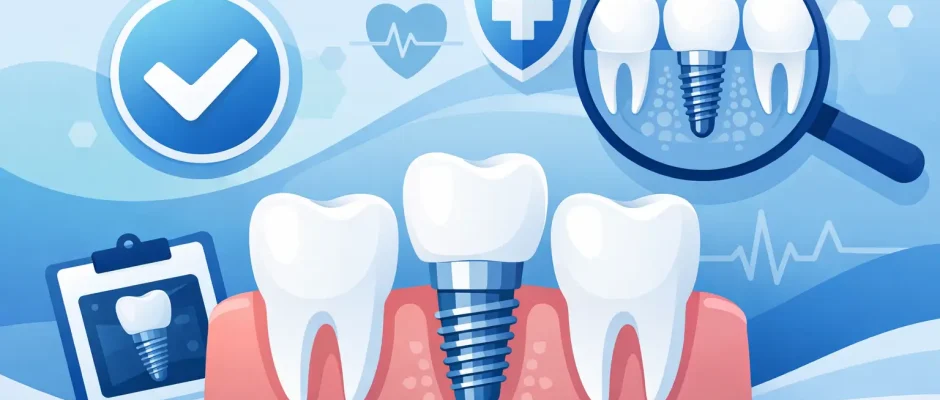
Most patients are not really asking whether titanium is dangerous. They are asking something more practical: Could something go wrong in my case, and how do I lower that risk?
The short answer is yes, dental implants are generally safe when they are planned correctly, placed with proper surgical technique, and used in the right patient. They have a long clinical track record and high success rates. But safe does not mean automatic. An implant is a surgical procedure, and like any surgery, it depends on anatomy, diagnosis, healing ability, and the discipline of the treatment protocol.
That is why a useful conversation about safety should move past marketing language. Patients deserve a clear explanation of where the real risks are, who needs extra caution, and what makes treatment more predictable.
Are dental implants safe for most adults?
For most healthy adults, the answer is yes. Modern implantology is built on well-studied materials, detailed imaging, and protocols designed to protect important structures such as nerves, neighboring teeth, and the maxillary sinus. When case selection is correct, implants are one of the most reliable ways to replace missing teeth.
The key point is that safety is not only about the implant itself. It is about the whole process: medical history, CBCT imaging when indicated, bite analysis, gum condition, bone volume, surgical planning, sterility, and follow-up. If one of these steps is rushed, risk goes up even if the implant brand is excellent.
This is especially true in complex situations such as bone loss, long-standing missing teeth, previous infections, sinus proximity in the upper jaw, or immediate implant placement after extraction. These cases can still be treated safely, but they require more experience and a more precise protocol.
What actually makes dental implants safe?
Safety comes from control. The more variables the surgeon can evaluate before treatment, the more predictable the procedure becomes.
Accurate diagnosis before surgery
A high-quality implant case starts before the first injection of anesthetic. The surgeon needs to know the exact bone dimensions, the position of nerves and sinus cavities, the condition of adjacent teeth, and whether there is active infection or periodontal disease. Two-dimensional X-rays are sometimes enough for simple situations, but in many cases three-dimensional imaging provides a much safer map.
This is one reason patients should be cautious with treatment plans that feel too quick. If no one has carefully assessed anatomy and risk factors, reassurance alone is not a safety protocol.
Proper surgical technique
Implants need to be placed in the correct position, depth, and angulation. Too close to a nerve, too close to another tooth, or too far outside the available bone, and the chance of complications rises. Good technique also means gentle tissue handling, controlled drilling, temperature management to protect bone, and stable primary fixation when appropriate.
In many cases, digital planning and surgical guides improve precision. They do not replace surgical judgment, but they can reduce guesswork and help transfer the plan accurately to the mouth.
Respect for healing biology
Bone and soft tissue healing are not details. They are central to implant safety. If the site has poor blood supply, unresolved infection, uncontrolled inflammation, or too much mechanical load too early, even a perfectly placed implant can fail.
This is where evidence-based adjuncts such as PRF, careful flap design, or staged treatment can make a real difference. They are not magic solutions, but they support more stable healing in selected cases.
The real risks patients should know
A safe procedure is not the same as a risk-free procedure. Honest treatment planning includes discussing what can go wrong.
Early complications
The short-term risks are similar to those of other oral surgery procedures: swelling, bruising, bleeding, temporary discomfort, and limited mouth opening. These are expected to some degree and usually manageable.
Less common but more important risks include infection, damage to adjacent structures, sinus involvement in the upper jaw, or nerve irritation in the lower jaw. Nerve injury is uncommon in properly planned cases, but it is one of the reasons accurate imaging and experience matter so much.
Failure of osseointegration
An implant is considered successful when it integrates with the bone. Sometimes that does not happen. The implant may become mobile or fail to heal properly, requiring removal and later replacement. This is disappointing, but it is not usually dangerous when handled promptly and correctly.
Failure can happen even when the surgeon does everything right, because biology is never fully programmable. Smoking, uncontrolled diabetes, poor bone quality, overload, or infection can all contribute.
Long-term complications
One of the most underestimated risks is peri-implant disease – inflammation and bone loss around an implant. This is more likely when oral hygiene is poor, maintenance is irregular, or gum disease already exists. In other words, implant safety does not end on the day of surgery.
A well-placed implant still needs a healthy environment. That includes professional follow-up, proper home care, and restoration design that allows cleaning.
Who needs extra caution?
The question “are dental implants safe” becomes more nuanced in patients with medical or anatomical risk factors.
Smokers can receive implants, but healing is less predictable and complication rates are higher. Patients with uncontrolled diabetes may also face delayed healing and increased infection risk. People taking certain medications that affect bone metabolism need individualized assessment. A history of periodontal disease, teeth grinding, previous radiation therapy, or severe bone loss also changes the plan.
None of these automatically rule out implants. They mean the case should not be treated casually. Sometimes the safest path is to stabilize gum health first, improve glucose control, stop smoking before surgery, or stage treatment rather than rushing into immediate placement.
This is where experience matters most. Straightforward cases are not the only measure of a surgeon. The real test is knowing when to proceed, when to modify the plan, and when not to place an implant at all.
Are dental implants safe in patients with bone loss?
Often yes, but not by pretending the missing bone is not a problem. Bone deficiency is one of the main reasons implant cases become complex.
If there is not enough width or height of bone, the surgeon may need guided bone regeneration, sinus lift surgery, or a different implant strategy altogether. In some cases, shorter or narrower implants can be appropriate. In others, they would be a compromise with a higher mechanical or biological risk.
The safe approach is not always the fastest approach. It is the one that matches the anatomy and long-term load demands.
What patients can do to make implants safer
Patients have more influence on outcomes than they sometimes realize. Choosing a surgeon who explains the diagnosis clearly, uses proper imaging, and discusses alternatives already lowers risk. So does being honest about smoking, medications, medical history, and previous dental problems.
After surgery, following instructions matters. That includes taking prescribed medications correctly, avoiding unnecessary pressure on the implant site, keeping the area clean, and attending follow-up visits. If something feels wrong – persistent numbness, worsening pain, unusual swelling, mobility, fever – early evaluation is always safer than waiting.
Long-term, implant maintenance is part of treatment, not an optional extra. Implants do not get cavities, but they can lose bone support if plaque control is poor or inflammation is ignored.
A good safety conversation should include alternatives
An implant is often an excellent option, but it is not the only option. Depending on the case, a bridge, removable prosthesis, orthodontic space management, or even delaying treatment may be more appropriate.
That may sound less exciting, but it is a sign of a responsible surgical approach. Safety improves when the treatment recommendation is based on anatomy, function, and prognosis rather than a one-size-fits-all sales script.
In practice, the safest implant cases are rarely the ones that feel rushed. They are the ones where the patient understands the plan, the anatomy has been studied carefully, and every step – from extraction to grafting to final restoration – has a reason behind it. If you are considering treatment, do not look only for reassurance. Look for precision, transparency, and a surgeon who is calm enough to explain both the benefits and the limits.


