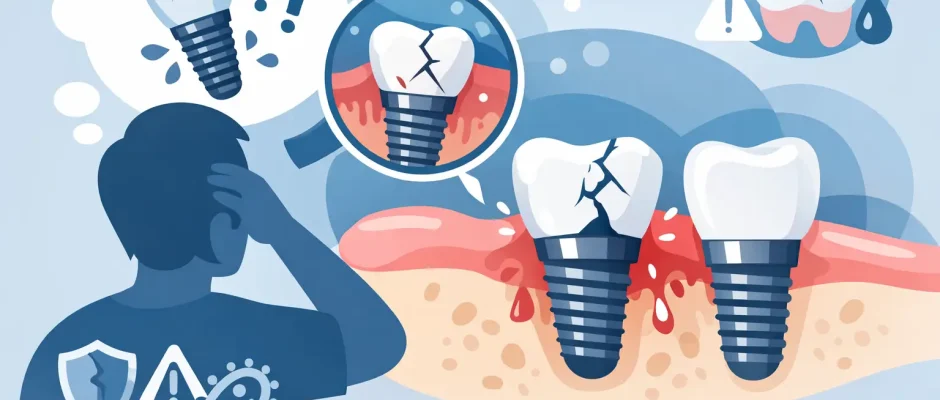
A dental implant is designed to be a long-term solution, so when patients ask, can dental implants fail, they are usually asking a deeper question – how predictable is this treatment in real life? The honest answer is that implants have a high success rate, but failure is possible. What matters most is understanding why it happens, how risk is reduced, and what can be done if a problem develops.
For most patients, implant treatment is not a gamble. With proper diagnosis, careful surgical protocol, and the right restorative plan, implants are one of the most reliable options in modern dentistry. At the same time, no serious surgeon should promise that failure is impossible. Medicine does not work that way.
Can dental implants fail after placement?
Yes. An implant can fail early, during healing, or later, after it has already been functioning under load for months or years. These are not the same problem, and they should not be discussed as if they are.
Early failure usually means the implant did not integrate with the bone as expected. In other words, osseointegration did not occur or was lost before the implant became stable enough for long-term use. This may happen because of infection, overheating of bone during drilling, poor primary stability, uncontrolled systemic factors, smoking, or excessive pressure on the implant too soon.
Late failure is different. In these cases, the implant may have integrated initially, functioned well, and then begun to fail because of bone loss around it, peri-implantitis, overload, poor prosthetic design, untreated gum disease, or changes in the patient’s health over time. A crown on an implant can also have mechanical problems without the implant itself failing. That distinction matters, because treatment options are very different.
Why dental implants fail
Implant failure is rarely caused by one factor alone. More often, it is a chain of small risks that were not identified early enough or not controlled well enough.
One of the most common issues is infection. If bacteria accumulate around the implant and the surrounding tissues become inflamed, bone support can begin to decrease. This condition may start as mucositis, which affects the soft tissues, and progress to peri-implantitis, where bone loss becomes part of the picture. Once bone support is lost, the implant may become mobile and eventually need to be removed.
Bone quality and quantity also matter. An implant needs enough healthy bone in the correct three-dimensional position. If bone is very thin, very soft, or significantly resorbed, the implant may still be possible, but the surgical plan becomes more demanding. In these cases, guided bone regeneration, sinus lift procedures, or staged treatment may be necessary to create a predictable foundation rather than forcing an implant into a compromised site.
Excessive mechanical load is another major reason implants fail. This can happen in patients who clench or grind, in restorations with poor force distribution, or when implant position is not prosthetically ideal. A technically integrated implant can still be placed under stress it was never meant to carry. Over time, that stress can affect screws, abutments, prosthetic components, and even the surrounding bone.
Systemic health influences outcomes as well. Poorly controlled diabetes, active periodontal disease, heavy smoking, certain medications, immune compromise, and a history of radiation therapy to the jaws can all increase risk. None of these factors automatically rule out implant treatment, but they do change the protocol. A good plan is not just about placing an implant. It is about deciding when to place it, where, with what preparation, and under what conditions.
Early signs that a dental implant may be failing
Patients often worry about the wrong symptoms and miss the more meaningful ones. Some soreness after surgery is normal. Mild swelling, temporary discomfort, and tenderness during healing are expected. That does not mean the implant is failing.
What deserves attention is mobility. An implant should not feel loose. Persistent pain that worsens rather than improves, swelling that returns after the initial healing phase, pus, bleeding around the implant, a bad taste, gum recession, or increasing discomfort during chewing should be evaluated promptly.
On X-rays or CBCT imaging, the more concerning finding is progressive bone loss around the implant. This is why follow-up matters. Patients do not always feel early bone loss, and by the time symptoms become obvious, treatment may be more complex.
Who is at higher risk?
Some risk factors are modifiable, and some are not. That is why implant consultation should be individualized rather than reduced to a generic quote and a surgery date.
Patients with active gum disease are at higher risk because the bacterial environment that damaged the natural teeth can also threaten implants. Smokers also face a less favorable healing environment, especially heavy smokers. Bruxism increases the mechanical burden. Bone deficiency increases technical difficulty. A history of repeated dental infections, poor oral hygiene, or multiple failed restorations can also signal that the mouth needs stabilization before implant placement.
Age alone is usually not the problem people think it is. A healthy 70-year-old with good bone management and proper maintenance may be a better implant candidate than a younger patient with uncontrolled periodontal disease and smoking habits. The real issue is not chronological age. It is biological and functional risk.
How careful planning lowers the chance of failure
The most effective way to prevent implant failure starts before surgery. Diagnosis must be precise. That means not only identifying missing teeth, but evaluating bone volume, bone density, soft tissue quality, bite dynamics, neighboring teeth, sinus anatomy, and the long-term prosthetic goal.
Digital planning helps because implant position should be driven by the final restoration, not just by where bone appears available at first glance. In more demanding cases, guided surgery can improve positional accuracy and reduce avoidable errors. When bone volume is insufficient, regeneration procedures may create better conditions for a stable result rather than accepting a compromised position.
Technique matters too. Atraumatic extraction, infection control, respect for blood supply, proper drilling protocol, adequate primary stability, and tension-free soft tissue closure are not minor details. They are the difference between a procedure that looks straightforward on paper and one that heals predictably.
This is also where experience matters. Complex cases are often not impossible. They are simply less forgiving. Immediate implantation, full-arch rehabilitation, and implants in the esthetic zone can work very well, but only when case selection and execution are disciplined.
Can a failed implant be replaced?
Often, yes. But not always immediately, and not always in the same way.
If an implant fails early and is removed, the next step depends on the reason for failure and the condition of the site. Sometimes the area can heal first and then receive a new implant later. In other situations, additional bone grafting is needed before another attempt is made. If the problem was overload or prosthetic design, simply placing a second implant without correcting the original cause would be a mistake.
When late failure is related to peri-implantitis, treatment becomes more nuanced. The priority is to assess how much bone support remains, whether the implant surface can be decontaminated effectively, and whether the implant is still salvageable. Some cases can be treated. Others are more predictably managed by removing the implant, reconstructing the site, and planning a new restoration under better conditions.
Patients often hear the word failure and assume the entire treatment plan has collapsed. In reality, a failed implant is a complication, not the end of care. The key is a methodical response based on diagnosis rather than guesswork.
What patients can do to protect their implants
The patient is not a passive part of implant success. Daily hygiene matters. Regular maintenance visits matter. Night guards matter in patients who grind. Smoking reduction or cessation matters. So does reporting changes early instead of waiting until discomfort becomes severe.
Implants do not get cavities, but they are not maintenance-free. The surrounding tissues can still become inflamed, and neglected inflammation around implants can progress quietly. A well-made implant restoration still depends on a healthy biological environment.
For that reason, the best implant treatment is not the fastest one or the cheapest one. It is the one built on a clear diagnosis, realistic timing, stable soft and hard tissues, and a follow-up plan that continues after the surgery is finished. That is the difference between simply placing an implant and delivering a predictable result.
If you are considering implant treatment and wondering whether the risk is acceptable, the right question is not just can dental implants fail. The better question is whether your case has been planned in a way that makes success as controlled and predictable as possible.


