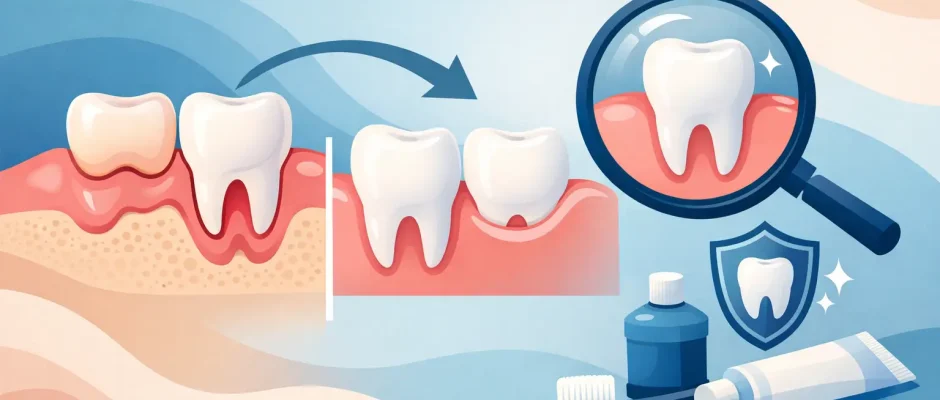
A tooth can look longer over a few months, sensitivity may appear suddenly, and brushing can start to cause a sharp pain near the gumline. These are common reasons patients ask, can receding gums be reversed? The honest answer is nuanced: inflammation can often be controlled and the progression of recession can be stopped, but gum tissue that has already moved down the root does not usually grow back on its own.
In selected cases, periodontal plastic surgery can restore gum coverage and improve the thickness of the tissue around a tooth. The right approach depends on why the recession occurred, how much supporting bone remains, and whether the goal is comfort, protection, appearance, or preparation for restorative treatment.
What gum recession actually means
Gum recession is the apical movement of the gum margin away from the crown of the tooth, exposing part of the root surface. Unlike enamel, root cementum is relatively soft and less resistant to wear and acid. Exposed roots may become sensitive, develop root cavities more easily, or show a visible difference in color at the gumline.
Recession is not always a sign of active gum disease. Some patients have healthy gums with a naturally thin tissue type, prominent tooth roots, or a tooth positioned slightly outside the bone envelope. Others have recession related to periodontitis, aggressive brushing, plaque accumulation, orthodontic movement, clenching, a high muscle attachment, or previous dental treatment.
That distinction matters. Covering a root without first addressing the cause can produce an unstable result. A predictable treatment plan begins with diagnosis, not with a procedure.
Can receding gums be reversed without surgery?
If by reversed we mean regrowing the original gumline naturally, the answer is generally no. Commercial products, mouth rinses, and supplements may reduce irritation or improve comfort, but they cannot reliably rebuild lost gum tissue and bone.
What non-surgical care can do is highly valuable. When recession is associated with gingivitis or periodontitis, professional cleaning, control of bacterial deposits, and a personalized home-care routine can reduce bleeding and swelling. Once inflammation settles, the gums often look healthier and firmer. Because swollen tissue shrinks as it heals, the recession may even appear more obvious initially. This does not mean treatment failed. It means the tissues are becoming clinically stable.
For mild, stable recession, the practical goal may be prevention rather than surgery. A soft toothbrush, low-abrasion toothpaste when appropriate, and a gentle technique at the gumline can prevent repeated trauma. The brush should be guided rather than pressed into the gums. Electric toothbrushes with pressure sensors can be useful for people who tend to scrub forcefully.
Sensitivity can often be managed with desensitizing products, fluoride treatment, or protective bonding over exposed root areas. These measures address symptoms, but they do not reposition the gum margin.
When gum grafting may restore coverage
Gum grafting is considered when recession is progressing, roots are sensitive, the exposed surface is difficult to keep clean, decay risk is high, or the appearance of the gumline is a concern. It may also be recommended before certain restorative or orthodontic treatments when the tissue is too thin to tolerate additional stress.
The most established procedures use the patient’s own connective tissue, usually obtained from the palate, or tissue repositioned from an adjacent area. In many cases, a microsurgical tunnel or flap technique allows the surgeon to place graft material beneath the existing gum and advance the tissue over the exposed root. Fine instruments, magnification, delicate sutures, and careful tissue handling are central to healing.
A graft does not promise identical results in every mouth. Root coverage is more predictable when the bone and soft-tissue support between neighboring teeth are intact, the tooth is favorably positioned, and inflammation is absent. Deep recession, loss of interdental bone, smoking, uncontrolled diabetes, and ongoing traumatic brushing can limit what surgery can achieve.
Sometimes the best outcome is not complete root coverage. A meaningful increase in tissue thickness and stability may still reduce sensitivity, make hygiene easier, and lower the risk of further recession. Setting that expectation clearly before treatment is part of responsible surgical planning.
What happens during and after a graft
Gum grafting is typically performed under local anesthesia. For patients with significant anxiety or complex treatment needs, additional comfort measures can be discussed in advance. The procedure is planned around the specific tooth, the thickness of the existing tissues, and the desired position of the gum margin.
After surgery, patients usually follow a protected healing period. Brushing directly on the treated area is temporarily avoided, and a surgeon may prescribe a gentle rinse and provide specific instructions for diet, hygiene, and activity. Mild swelling and discomfort are expected in the first days, while the final maturation of the tissue takes several months.
The result depends as much on healing discipline as on technique. Pulling the lip to inspect the area, brushing too early, smoking, or missing follow-up visits can compromise delicate tissue adaptation.
Why an accurate diagnosis changes treatment
A recession assessment should include more than a quick visual check. The clinician evaluates the depth and width of the recession, gum thickness, root prominence, tooth position, bite forces, attachment level, and signs of active periodontal disease. Probing around the teeth helps distinguish a shallow recession defect from more extensive loss of attachment.
Radiographs may be needed to evaluate bone support and root anatomy. Three-dimensional imaging is useful in selected surgical or implant-related cases, but it is not automatically necessary for every isolated recession. The objective is to collect enough information for a safe, proportionate plan while avoiding unnecessary procedures.
A cracked tooth, cervical root wear, an old restoration with an overhanging edge, or an unfavorable bite can contribute to persistent symptoms. If those factors are ignored, even excellent soft-tissue surgery may be placed under avoidable stress.
Recession around implants is different
Gum recession can also occur around dental implants, although the tissue around an implant differs biologically from the gum attachment around a natural tooth. A visible gray shadow, exposed implant surface, or changing gumline near an implant should be assessed promptly. It may be an esthetic issue, but it can also reflect tissue inflammation, inadequate soft-tissue volume, bone remodeling, or the position of the implant and restoration.
Treatment around implants requires particular caution. Cleaning protocols, crown contour, bite forces, and the surrounding bone must be assessed before considering soft-tissue augmentation. In complex cases, digital planning and a surgical approach that respects the available bone and gum volume help reduce compromise from the start.
For patients considering implant treatment after losing teeth to periodontal disease, stabilizing the gums first is essential. Implantation does not erase the need for periodontal maintenance. Healthy, cleanable tissue and regular follow-up remain part of long-term success.
When to schedule an examination
Do not wait for severe pain. An examination is appropriate when a tooth looks longer than before, cold sensitivity persists, the gumline is uneven, roots are visible, gums bleed, or recession seems to be advancing. Earlier assessment often provides more conservative options and makes outcomes more predictable.
At a consultation, the aim should be clarity: identify the cause, determine whether the condition is active, and decide whether monitoring, periodontal therapy, restorative protection, or microsurgical grafting is justified. At Implantolog.co.il, this type of planning is approached as a clinical sequence, with attention to tissue biology, comfort, and the long-term stability of each tooth.
Receding gums are not a problem to solve with a single universal product. They are a signal to understand what is happening around the tooth. When the cause is controlled and treatment is selected carefully, it is often possible to protect the exposed root, improve comfort, and preserve a healthier gumline for years to come.


