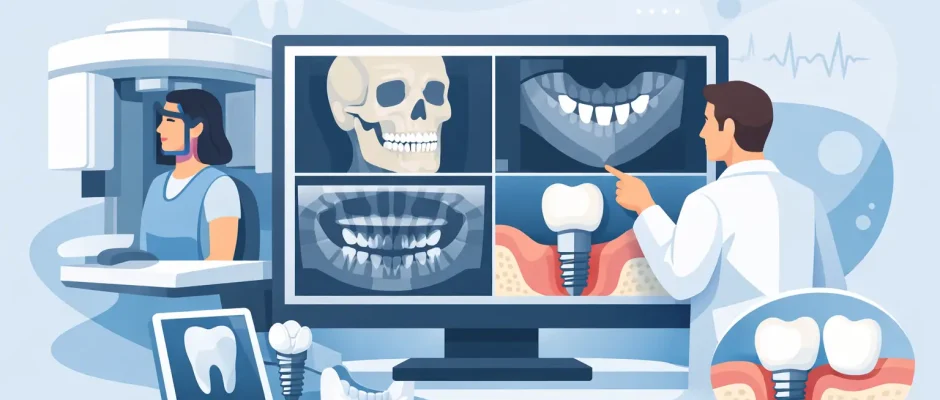
CT Scan Before Dental Implants: Computer Diagnostics and Planning
If you are being told that an implant can be placed “without much preparation,” that is usually the wrong place to save time. CT-based computer diagnostics and planning before implant placement are what turn implant surgery from an estimate into a controlled medical procedure. For the patient, this means fewer surprises, a clearer treatment plan, and a much better understanding of what can realistically be done in your specific anatomy.
Why CT matters before implant placement
A regular dental X-ray is useful, but it shows a flat image of a three-dimensional problem. Implant placement depends on bone width, bone height, bone density, the position of adjacent roots, the maxillary sinus in the upper jaw, and the mandibular nerve in the lower jaw. A CT scan, usually cone beam CT in dentistry, allows the surgeon to assess these structures in detail.
That detail changes decisions. On a standard X-ray, bone may appear sufficient, while the CT shows a narrow ridge that cannot safely accept an implant of the required diameter. In another case, the available height under the sinus may be borderline, so the treatment plan shifts toward sinus augmentation, shorter implants, angled implants, or a staged approach. These are not minor technicalities. They affect safety, long-term stability, and the final esthetic result.
For patients, the most valuable part of CT is not the image itself. It is what the image prevents – nerve injury, sinus complications, implant malposition, and avoidable bone grafting when a better implant position is available.
CT-based computer diagnostics and implant planning in practice
Good planning starts before the scan is even taken. The surgeon needs to understand what is missing, what teeth remain, how you bite, whether the case is a single tooth, a free-end gap, or a full-arch reconstruction such as All-on-4. The CT is then interpreted in the context of prosthetics, not just surgery. In other words, the key question is not only “Where can I place an implant?” but “Where should the implant be placed so the future tooth works properly and looks natural?”
This distinction matters. Implants placed only where bone seems easiest can create restorative compromises later – crowns that are difficult to clean, poor emergence profile, off-axis loading, food traps, or esthetic limitations in the smile zone. Proper planning means working backward from the final restoration to the implant position.
That is why digital planning often combines CT data with an intraoral scan or a digital model. The bone is evaluated together with the planned tooth position. When this is done carefully, the surgery becomes more predictable because the surgeon is not improvising on the day of treatment.
What the surgeon evaluates on CT
A CT scan is not just a confirmation that bone exists. It is a map. The surgeon evaluates the ridge dimensions, bone contours, sinus anatomy, inferior alveolar nerve location, mental foramen, undercuts, root proximity, residual infection, previous extraction sites, and any asymmetries that may affect implant angulation.
In immediate implant cases, CT also helps assess whether the socket walls are intact and whether primary stability is likely. In delayed cases, it shows how much remodeling has already occurred after extraction. In patients with long-term tooth loss, CT often reveals atrophy that is more significant than expected from a routine exam.
The scan can also identify findings that change the plan entirely – retained root fragments, chronic periapical lesions, sinus pathology, severe buccal bone loss, or anatomic variants that make a standard approach unsafe.
Planning is about prosthetics as much as surgery
One of the most common misunderstandings is that implant surgery and the future crown are separate topics. They are not. A well-placed implant supports hygiene, load distribution, soft tissue stability, and esthetics. A poorly positioned implant, even if it integrates, can create a long-term problem.
For this reason, planning includes the mesiodistal position, buccolingual position, depth, and angulation of the implant. Each of these affects the final crown and the health of surrounding tissues. In the front teeth, even a small error can become visible in the gum line. In the posterior area, a minor positional compromise may still function, but it can make cleaning harder and increase mechanical stress.
This is also where surgical guides become relevant. When digital planning is translated into a guide, the implant can be placed according to the pre-approved position rather than by visual estimation alone. A guide does not replace surgical judgment, but in properly selected cases it improves precision and reduces variability.
When CT planning changes the treatment plan
Sometimes the patient expects a straightforward implant, but the digital workup shows that a different sequence is safer. This happens often after traumatic extraction, in cases of bone loss from infection, or when a tooth has been missing for years.
For example, the plan may shift from immediate implant placement to staged treatment with bone grafting first. In another patient, CT may show that immediate placement is possible, but only with simultaneous guided bone regeneration and careful implant angulation. In full-arch cases, the planning may determine whether fixed immediate loading is realistic or whether a delayed protocol will be more predictable.
This is where experience matters. Technology gives information, but it does not make decisions by itself. The same scan can lead to different recommendations depending on soft tissue quality, occlusion, parafunctional habits, smoking history, systemic risks, and the patient’s goals. A fast solution is not always the best solution.
Not every case needs the same protocol
It depends on the clinical situation. A single implant in a healed posterior site with abundant bone is usually more straightforward than replacing a front tooth in the esthetic zone. A patient with severe atrophy, previous failed implants, or sinus proximity requires a different level of planning. Full-arch rehabilitation requires another level again, because implant position affects the entire prosthetic design.
That is why a responsible surgeon does not use one universal algorithm for every patient. The CT is interpreted alongside the clinical exam, photographs, periodontal condition, medical history, and restorative goals.
What patients should expect from a proper planning appointment
A useful consultation should leave you with more than “yes, we can place an implant.” You should understand whether the bone is sufficient, whether grafting is likely, whether the implant can be immediate or delayed, what risks are specific to your anatomy, and what kind of restoration is planned afterward.
You should also hear about limitations. If the bone is narrow, if the sinus is low, if the nerve is close, or if the soft tissues are thin, that should be explained directly. Clear medicine reduces anxiety better than vague reassurance.
In a digitally planned workflow, patients can often see the anatomy and the proposed implant position on screen. This is not a marketing feature. It helps make the plan understandable. Once the unknown becomes visual and measurable, decision-making gets easier.
CT-based computer diagnostics before implant placement: planning for safety
Safety in implantology is not only about sterile technique and anesthesia. It starts with selecting the right case, the right timing, and the right implant position. CT-based computer diagnostics before implant placement and planning allow the surgeon to anticipate difficulty before surgery starts.
This is especially important in complex cases – upper jaw posterior implants near the sinus, lower jaw implants close to the nerve canal, immediate placement after extraction, and full-arch reconstructions where several implants must work together prosthetically. In these situations, guessing is not a protocol.
In my approach, digital planning is valuable because it supports calm, precise surgery. The goal is not to make treatment look high-tech. The goal is to reduce variables, preserve tissue whenever possible, and create conditions for a predictable restorative outcome.
A note on radiation and practicality
Some patients worry about CT because of radiation exposure. That is a reasonable question. In dental implant planning, cone beam CT is typically used because it provides detailed three-dimensional information with a focused field and a dose that is justified when the scan changes treatment decisions. The point is not to order imaging routinely without reason. The point is to use the right imaging when it affects safety and accuracy.
A CT also does not guarantee that every implant case will be simple. It may show that treatment is more complex than expected. That can be disappointing in the short term, but it is far better than discovering limitations mid-surgery.
The best implant treatment usually begins with a very unglamorous step – careful measurement, honest planning, and respect for anatomy. That is what gives patients confidence before surgery and stability after it.


