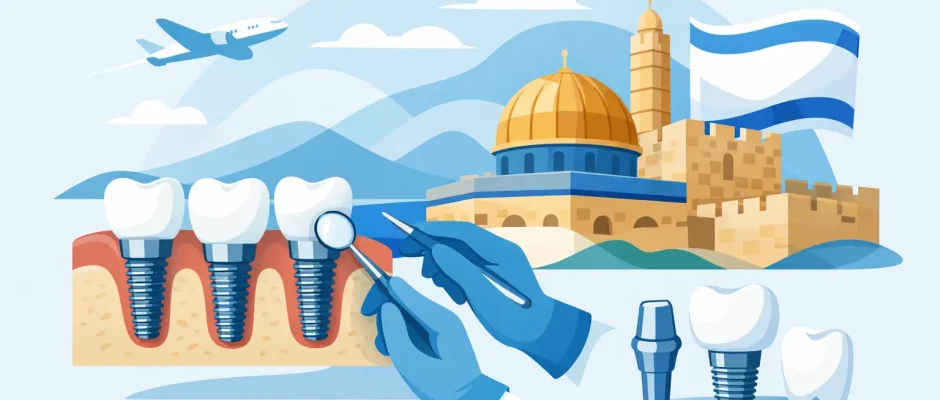
Losing a tooth is rarely just a cosmetic problem. It changes how you chew, how neighboring teeth carry load, and over time, how the bone in that area behaves. That is why patients searching for dental implants in Israel – complete guide are usually not looking for theory. They want clear answers: Am I a candidate, how long will treatment take, what happens if bone is missing, and how do I choose a surgeon without guessing?
What dental implants actually replace
A dental implant is a titanium fixture placed into the jawbone to act as an artificial tooth root. After healing and integration with bone, it supports a crown, bridge, or full-arch prosthesis. The key point is that an implant replaces the root as well as the visible tooth, which is why it feels different from a removable option.
This matters because when a tooth is lost, the jaw in that area no longer receives normal functional stimulation. Bone volume can gradually decrease, sometimes slowly and sometimes quite quickly. In straightforward cases, implant placement is direct. In more advanced cases, the quality and quantity of bone determine whether additional procedures are needed first or at the same time.
Who is a good candidate for dental implants in Israel
Most healthy adults can be considered for implant treatment, but the real decision is clinical, not generic. The surgeon evaluates bone volume, gum condition, bite forces, medical history, smoking status, and the cause of tooth loss.
A patient with a recently fractured tooth and intact bone is very different from a patient who has worn a removable denture for years. Both may receive implants, but the protocol, timeline, and complexity are not the same. This is where proper planning makes treatment more predictable.
Good candidates often include patients with one missing tooth, several missing teeth, or failing teeth that cannot be saved. Patients with bone loss can also be candidates, but they may need bone grafting, sinus lift procedures, or staged treatment. Even in complex scenarios, modern implantology often allows solutions that were difficult to offer a decade ago.
The diagnostic stage: where good treatment starts
Before any implant is placed, diagnosis should be precise. A proper consultation typically includes a clinical exam, imaging, and a discussion of goals, limitations, and alternatives. In implant surgery, details matter. Millimeters matter.
Three-dimensional imaging helps assess bone width, height, anatomical structures, and the ideal implant position. Digital planning can also support the use of surgical guides, which improve accuracy in selected cases. This is especially valuable when space is limited, when esthetics are important, or when a full-arch case requires exact angulation for a fixed solution.
For anxious patients, this step often brings relief. Once the case is mapped out clearly, treatment stops feeling vague. It becomes a sequence with logic behind it.
Immediate vs delayed implants
One of the most common questions in any dental implants in Israel complete guide is whether the implant can be placed immediately after extraction. The honest answer is: sometimes.
Immediate implant placement can reduce treatment time and help preserve tissues in the right case. It is often considered when infection is controlled, bone walls are adequate, and implant stability can be achieved. Sometimes a temporary restoration is also possible.
Delayed placement is better in other situations, especially when there is significant infection, bone deficiency, or soft tissue conditions that need time to stabilize. Faster is not always better. The right timing is the one that gives the most predictable long-term result.
What if there is not enough bone?
Bone deficiency is common, particularly in areas where teeth have been missing for a long time or where infection destroyed supporting structures. This does not automatically mean implants are off the table.
Modern surgical protocols include guided bone regeneration, sinus lift procedures in the upper jaw, and other augmentation techniques that rebuild volume where needed. The choice depends on the defect: horizontal, vertical, combined, or related to the maxillary sinus.
This is also where experience matters. Treating a case with limited bone is not only about placing graft material. It is about understanding incision design, tension-free closure, blood supply, membrane selection, healing biology, and prosthetic planning. When these elements are coordinated, difficult cases become much more manageable.
Single implants, bridges, and full-arch treatment
Not every missing-tooth situation should be treated the same way. A single missing tooth is often best restored with a single implant and crown, assuming neighboring teeth are healthy. If several teeth are missing, implants may support a bridge rather than replacing every root individually.
For patients with multiple failing teeth or complete tooth loss, full-arch concepts such as All-on-4 may be appropriate. These protocols use a limited number of strategically placed implants to support a fixed full-arch restoration. They can be life-changing for the right patient, but they are not a shortcut that fits everyone.
Bone anatomy, bite, parafunction, esthetic expectations, and hygiene ability all affect the treatment plan. A good surgeon explains not only what can be done, but why one option is better than another in your case.
Surgery, comfort, and recovery
Many patients expect implant surgery to be much worse than it actually is. In reality, with proper anesthesia, careful technique, and a clear postoperative plan, the procedure is usually more manageable than people fear.
Comfort depends on several factors: atraumatic extraction when needed, flap design, implant position, soft tissue handling, and whether additional procedures such as grafting are performed. Microsurgical principles and biologic support protocols such as PRF can help improve healing conditions in appropriate cases.
Recovery is not identical for everyone. A single straightforward implant may involve mild discomfort and a short recovery. A case with multiple extractions, bone grafting, or sinus elevation requires more downtime and closer follow-up. What matters is not promising an easy recovery to everyone. It is preparing the patient honestly for their specific procedure.
How long treatment takes
Treatment can range from same-day extraction and implant placement in selected cases to several months in staged rehabilitation. Osseointegration, the process by which the implant bonds with bone, takes time. Rushing the restorative phase before stability is adequate can compromise the result.
If bone grafting is performed first, healing may extend the timeline. If immediate placement and immediate provisionalization are possible, treatment may feel much faster. The visible part of the process and the biologic part are not always the same. A temporary tooth does not mean the case is already fully healed.
Patients should ask for a realistic schedule that separates surgery, healing, and final restoration. That is how expectations stay aligned with biology.
Risks and where judgment matters most
Implants have high success rates, but they are not risk-free. Complications can include failure of integration, soft tissue recession, peri-implant inflammation, prosthetic issues, sinus complications in upper jaw cases, or esthetic compromise when planning is poor.
The biggest preventable problems often begin before surgery. Wrong implant position, underestimating bone loss, ignoring bite dynamics, or overpromising in a high-risk case can create long-term trouble. This is why surgeon selection should focus on diagnostic rigor and surgical judgment, not just on whether implants are offered.
A strong treatment plan also includes maintenance. Implants still require hygiene, follow-up, and monitoring of the surrounding tissues. They do not get cavities, but they can develop biologic and mechanical complications if neglected.
Cost in Israel: what affects the price
Cost varies widely because implant treatment is not one procedure. It is a sequence that may include consultation, imaging, extraction, implant placement, grafting, membrane use, PRF, temporary restoration, uncovering, and the final prosthetic phase.
A simple single implant in a healthy site is different from an upper posterior implant with sinus lift, or from a full-arch rehabilitation with surgical guides and immediate loading. Lower prices can reflect a simpler case. They can also reflect a stripped-down protocol. Patients should understand what is included rather than comparing a single number.
In Israel, many patients value the combination of advanced diagnostics, modern surgical planning, and access to clinicians experienced in complex cases. If you are comparing options, ask for a written treatment plan with stages clearly separated.
How to choose the right implant surgeon
Credentials matter, but not as a marketing slogan. For implant surgery, look for a clinician with strong surgical training, experience with complex extractions and bone-deficient cases, and a planning style that is specific rather than generic. It is reasonable to ask how often similar cases are treated, what imaging is used, when guides are indicated, and what happens if grafting is needed.
Communication matters just as much. A good consultation should lower anxiety, not increase it. You should leave understanding the diagnosis, the proposed sequence, the alternatives, and the main risks. If the explanation is vague, the treatment plan usually is too.
For patients considering care in Tel Aviv, this is one area where a focused surgical practice can be an advantage. A clinician who works routinely with difficult extractions, immediate implant protocols, sinus lift procedures, and guided bone regeneration is often better equipped to build a treatment plan around biology rather than convenience.
A final thought before you decide
Implant treatment works best when it is planned backward from the final result and forward from the biology at the same time. If your case is simple, that protects you from unnecessary treatment. If your case is complex, it gives you a path that is realistic, safe, and worth doing right the first time.


