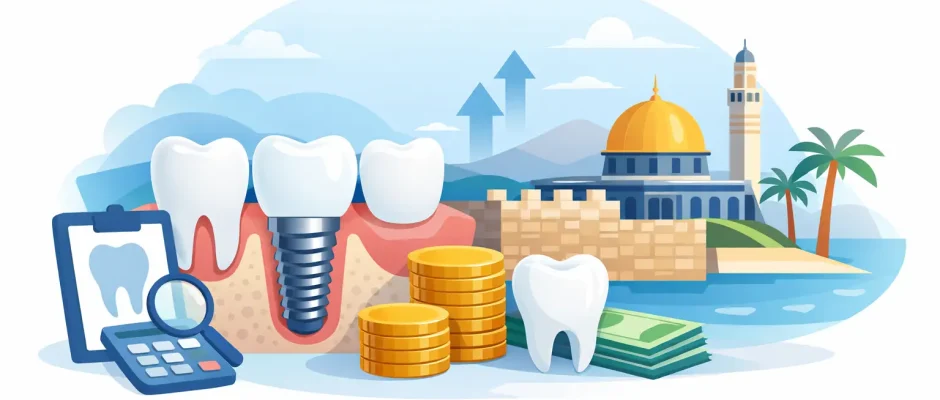
When patients ask about dental implant cost in Israel, they are usually not asking for a single number. They are asking why two quotes for the same tooth can differ so widely — bone volume, imaging, grafting needs — and what a complete plan should include before surgery starts. That is the right question: implant treatment is not one product on a shelf. It is a surgical and restorative process, and the details of that process matter.
A low quote can look attractive until it turns out to exclude imaging, bone grafting, a surgical guide, temporary restoration, follow-up visits, or even the final crown. A higher quote may reflect a more controlled protocol, better planning, and a case design aimed at long-term stability rather than short-term savings. In implant dentistry, price only makes sense when attached to a diagnosis and a treatment plan.
What shapes dental implant cost in Israel
The biggest factor is not geography. It is case complexity. Replacing a single tooth in a healthy patient with adequate bone is very different from rebuilding a severely worn dentition, treating advanced bone loss, or placing implants immediately after extraction in the esthetic zone.
In straightforward cases, the fee typically reflects diagnostic imaging, surgical placement of the implant, the implant system itself, and the restorative phase. Once complexity increases, the price rises for good reasons. Bone augmentation, sinus lift procedures, soft tissue management, PRF use, or guided surgery all add time, materials, and clinical planning.
The number of specialists involved also matters. Some clinics separate the surgical and prosthetic phases between different providers. Others coordinate everything within one treatment plan. Neither model is automatically better, but patients should understand who is responsible for each stage and whether the quote covers the full sequence from diagnosis to final restoration.
Single implant cost versus full-mouth treatment
For a single missing tooth, patients often expect a simple answer. In reality, even a single implant case can vary considerably in price. If the tooth has been missing for a long time, bone may have resorbed and require augmentation. If the failing tooth must be extracted first, the surgeon may recommend immediate implant placement or delayed placement depending on infection, bone condition, and gum architecture.
The restorative component also changes the total. A posterior implant crown is usually less demanding than an anterior tooth in the smile line, where symmetry, soft tissue contour, and shade matching are more exacting. The difference is not cosmetic only. Esthetic-zone implant treatment often requires tighter surgical control to achieve a stable result.
For multiple missing teeth or full-arch solutions such as All-on-4, the discussion changes entirely. Here, the cost reflects a full rehabilitation strategy, not just several implants multiplied by a unit price. Temporary fixed teeth, digital planning, angulation of implants, bone anatomy, and the design of the final prosthesis all influence the final fee. In these cases, the cheapest plan may also be the one with the most biological or mechanical compromises.
What should be included in the price
This is where many misunderstandings begin. When comparing clinics, patients should ask for a clear breakdown of what is included and what is not. A quote for an implant alone is not the same as a quote for completed treatment.
A well-structured estimate usually clarifies whether it includes consultation, CBCT imaging, tooth extraction if needed, implant placement, healing abutment, impression or digital scan, abutment, crown, anesthesia, sutures, postoperative visits, and management of complications if they arise within the expected healing period. If bone grafting or sinus lift is only a possibility, that should also be discussed in advance so the patient understands what may change after imaging.
This kind of transparency reduces anxiety. It also allows patients to compare plans fairly. A lower number without the crown, grafting, or imaging is not truly a lower price. It is an incomplete figure.
Why technology can change the fee
Some patients notice that digitally planned implant treatment costs more. Often, that increase is justified. Digital workflows are not marketing decoration when used properly. They can improve precision, reduce intraoperative guesswork, and help the surgeon plan implant position based on the future restoration rather than bone alone.
For example, surgical guides may add cost, but in selected cases they support more accurate angulation and depth control. That can be especially valuable in limited bone volume, esthetic areas, or full-arch treatment. PRF may also add expense, yet in some surgical situations it can improve soft tissue support and postoperative comfort. The key point is not that every case needs every technology. It is that each tool should have a clinical reason.
A careful clinic will explain that reason. If a patient hears only technical terms without understanding how they improve safety, comfort, or predictability, the conversation is incomplete.
Cheap implant treatment can become expensive later
Implants are expected to function for years. Because of that, initial price should never be separated from long-term cost. A poorly positioned implant may still integrate in bone and yet create serious restorative problems later. An unstable gum contour around a front tooth may require additional surgery. A bargain restoration may wear, loosen, or trap plaque if the prosthetic design is weak.
This does not mean the most expensive option is automatically the best. It means value depends on planning, execution, and follow-up. Patients should look at the entire treatment pathway: diagnosis, surgical protocol, prosthetic phase, maintenance, and who is available if something needs adjustment.
A clinic that treats many complex surgical cases often prices differently because the protocols are different. More advanced imaging, more meticulous soft tissue handling, microsurgical techniques, and bone regeneration procedures require experience and time. For the patient, those details are not abstract. They affect healing, comfort, and the likelihood of a stable result.
Dental implant cost in Israel and medical complexity
Israel attracts patients who want a high clinical standard and modern treatment planning, but even within the same city, dental implant cost in Israel can vary widely. The most important reason is that two cases with the same diagnosis on paper may not carry the same surgical difficulty.
Consider two patients who both need one implant in the upper jaw. One has preserved bone, thick gum tissue, and no infection. The other has a fractured root, an inflammatory lesion, a thin facial bone wall, and a high esthetic demand. These are not equivalent procedures, and pricing them as if they were would be misleading.
This is why a serious consultation matters. The surgeon assesses bone volume, neighboring teeth, bite forces, gum biotype, general health, smoking status, and whether the prosthetic outcome can be achieved predictably. Only then does the treatment plan become meaningful.
Questions worth asking before you agree to treatment
Patients do not need to speak like clinicians to make a good decision. They do need a few direct answers. Ask whether the quote covers the full treatment or only the surgical stage. Ask whether bone grafting is likely. Ask what implant system is being used and why. Ask who will make the final crown and who follows you after surgery.
It is also reasonable to ask what happens if the case changes during treatment. Sometimes the CBCT shows that the original plan needs adjustment. Sometimes an extraction site cannot support immediate placement safely, and a staged protocol becomes the better choice. Good care includes the willingness to change the plan when biology requires it.
That kind of flexibility is not a red flag. It is often a sign that the clinic is prioritizing outcome over convenience.
How to think about cost without losing sight of outcome
The best way to evaluate price is to think in layers. First comes diagnosis. Then surgical execution. Then restoration. Then maintenance. If one layer is weak, the total treatment can still fail the patient even when the implant itself survives.
This is especially relevant for people with bone loss, failed previous dental work, or a need for full-arch reconstruction. In these cases, surgical experience has real economic value because it may reduce the need for avoidable revisions. A precisely planned operation is not only about elegance. It is about reducing biological and prosthetic risk.
At Implantolog.co.il, this is why the conversation starts with diagnosis and planning rather than a generic price promise. Patients deserve to know what is being proposed, why it fits their anatomy, and what is included at each stage. That clarity is often what turns a stressful decision into a manageable one.
If you are comparing treatment options, do not ask only what an implant costs. Ask what result the plan is designed to deliver, how predictable that result is in your case, and what the clinic is doing to make the surgery as controlled and comfortable as possible. That is usually where the real value becomes visible.


