Who Qualifies for Immediate Load Dental Implants?
A missing front tooth can change far more than a smile. Patients often worry about appearing in public, speaking clearly, or leaving an extraction appointment with a visible gap. Immediate load dental implants may allow a temporary tooth to be placed on the implant shortly after surgery, sometimes on the same day. But speed is never the real goal. The goal is a stable implant, healthy tissue, and a restoration that can function predictably for years.
This approach can be an excellent solution in the right clinical situation. It is not, however, a universal shortcut, and it should not be confused with placing a final permanent crown immediately after surgery. Careful diagnostics, surgical precision, and control of the bite determine whether immediate loading is appropriate.
What are immediate load dental implants?
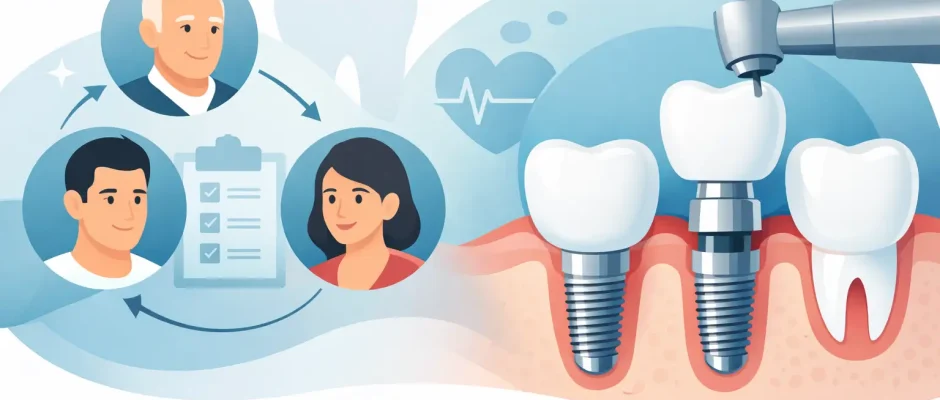
An immediate load implant is an implant that receives a temporary crown, bridge, or full-arch prosthesis shortly after placement. In many cases, the natural tooth is removed, the implant is placed into the extraction site, and a temporary restoration is fixed the same day or within a few days.
The implant itself still needs time to integrate with the jawbone. This biological process, called osseointegration, cannot be rushed. The temporary restoration is designed to protect the surgical site and guide the gums while avoiding excessive pressure on the implant during early healing.
For a single tooth in the smile zone, the temporary crown may be shaped to support the gum contour without fully contacting the opposing teeth. For a full arch, such as an All-on-4 treatment concept, a fixed temporary bridge can often be attached to several strategically positioned implants. These are different protocols, but both depend on achieving strong initial implant stability.
Same-day teeth does not always mean same-day final teeth
The phrase “same-day implants” is easy to misunderstand. It may describe surgery and the placement of a temporary fixed tooth on the same day. It does not automatically mean the final ceramic crown or final full-arch bridge is delivered immediately.
A final restoration is usually produced after the bone and soft tissues have healed and stabilized. This allows the dentist to refine the emergence profile, gum line, bite, color, and tooth shape. Rushing the definitive restoration can compromise both esthetics and long-term maintenance.
For many patients, this staged approach is reassuring: the visible gap is addressed promptly, while the final work is completed when the biological conditions are favorable.
Who is a candidate for immediate loading?
Candidacy is determined by the clinical situation, not by a patient’s desire to finish treatment quickly. A thorough consultation includes an examination, digital imaging, and usually a cone beam CT scan. The scan helps evaluate bone volume, bone density, the anatomy of the sinuses and nerves, and signs of infection around the failing tooth.
Immediate loading is more likely to be considered when the implant can be placed with high primary stability. In practical terms, this means the implant grips the surrounding bone securely at the time of surgery. Bone quality, implant length and diameter, implant position, and the extraction technique all affect this stability.
The condition of the gums also matters. A patient with a healthy, thick gum biotype and an intact facial bone wall may have a more favorable esthetic prognosis in the front of the mouth. If infection has caused significant bone loss, the site may require grafting, staged healing, or a different treatment sequence.
The bite is equally relevant. Heavy clenching, grinding, an unstable bite, or a habit of biting hard foods can overload a newly placed implant. In these cases, a temporary restoration may need to be kept out of direct contact, modified carefully, or delayed. A night guard may be recommended after healing for patients with bruxism.
Smoking, uncontrolled diabetes, active periodontal disease, and poor oral hygiene do not always make implant treatment impossible. They do increase risk and require honest discussion, risk reduction, and more intensive maintenance. A predictable result begins with choosing a protocol that matches the patient’s biology and daily habits.
When immediate loading may not be the safest choice
There are situations where delaying the restoration is the more responsible decision. If the implant does not achieve sufficient initial stability, placing a temporary crown or bridge can create unnecessary micromovement during healing. Even if the tooth looks good on the day of surgery, instability can interfere with osseointegration.
A delayed approach may also be preferable when there is extensive infection, major bone deficiency, thin soft tissue, or a need for guided bone regeneration or sinus lifting. In these cases, bone graft materials, membranes, PRF, and precise wound closure may be used to create a better foundation before the restoration phase.
This is not a failure of planning. It is often evidence of good clinical judgment. The safest treatment is not always the fastest treatment, especially in complex surgical cases.
Why digital planning changes the procedure
Immediate loading demands accurate three-dimensional implant positioning. An implant placed too far toward the lip, tongue, or palate may be difficult to restore attractively or clean properly, even if it initially integrates with bone.
Digital planning combines CBCT data with an intraoral scan or detailed model of the teeth. It allows the surgical and restorative teams to plan from the desired final tooth position backward, rather than placing an implant based only on the available bone. When indicated, a surgical guide can transfer this plan to the clinical setting with greater precision.
This planning is especially valuable in the esthetic zone, in patients with limited bone, and in full-arch rehabilitation. It also helps the clinician anticipate whether temporary teeth can be placed without harmful bite contacts and whether additional procedures will be required.
What happens during treatment?
The sequence varies by case. For a tooth that cannot be saved, treatment may begin with an atraumatic extraction intended to preserve as much surrounding bone and gum tissue as possible. The socket is carefully cleaned, the implant is placed in the planned position, and stability is measured clinically.
If the implant is stable and the tissue conditions are appropriate, a temporary crown can be attached. In the front of the mouth, it is often designed primarily for appearance and soft-tissue support, with minimal or no direct biting contact. In a full-arch case, the temporary bridge is designed to distribute forces across multiple implants.
After surgery, the first weeks are a period of controlled healing. Patients are generally advised to follow a soft-food diet, avoid biting directly on the temporary restoration, maintain meticulous hygiene, and attend scheduled reviews. The exact instructions depend on the surgical site and type of restoration.
The role of the temporary restoration
A well-designed temporary tooth is not simply cosmetic. It can preserve confidence during treatment, support the gum architecture, and provide a blueprint for the final restoration. At the same time, it must be easy to clean and carefully shaped to avoid excessive pressure.
Patients should treat it as a healing restoration, not as a permanent natural tooth. Biting an apple with a temporary front tooth, chewing hard crusts, or using teeth to open packaging can jeopardize the result. The temporary stage is a partnership between clinician and patient: precise treatment in the office must be matched by careful behavior at home.
Questions to ask before choosing immediate loading
A useful consultation should provide more than a promise of teeth in one day. Ask whether the planned restoration will be temporary or final, how implant stability will be assessed, and what alternatives are available if the surgical conditions are less favorable than expected.
It is also reasonable to ask about bone preservation, grafting needs, the anticipated healing timeline, and how the bite will be managed. For complex cases, a treatment plan should explain the sequence clearly: surgery, temporary restoration, healing, final prosthetic work, and long-term maintenance.
At Implantolog.co.il in Tel Aviv, treatment planning is based on digital diagnostics and the individual surgical situation rather than a one-size-fits-all protocol. For some patients, immediate loading is the right choice. For others, a staged plan provides the safer path to the same long-term goal.
The best result is not defined by how quickly a temporary tooth is attached. It is defined by a treatment plan that protects the bone, respects healing, and gives your future implant the conditions it needs to last.


