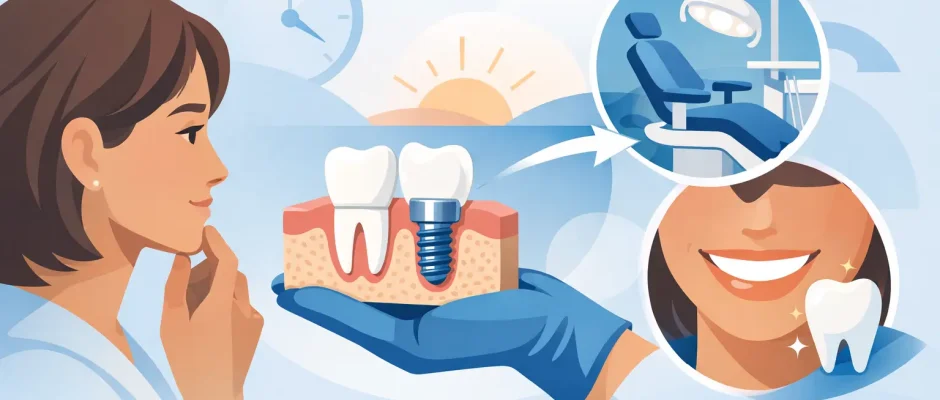
Are Same Day Dental Implants Right for You?
A tooth that has fractured below the gumline, become painful from infection, or cannot be restored often creates an urgent question: can it be removed and replaced in one appointment? Same day dental implants can make that possible in selected cases. However, the speed of treatment is not the goal by itself. The goal is a stable implant, healthy tissues, and a restoration that looks and functions naturally for years.
For some patients, placing an implant immediately after extraction is the safest and most efficient option. For others, allowing the site to heal or rebuilding lost bone first produces a more predictable result. The right decision comes from three-dimensional diagnostics, careful surgical planning, and an honest assessment of biology.
What “same day dental implants” actually means
The phrase can describe two different protocols. The first is immediate implant placement: a failing tooth is removed and an implant is placed into the extraction socket during the same surgical visit. A temporary crown may or may not be attached that day.
The second is immediate loading: a temporary tooth or a fixed temporary bridge is connected to the implant immediately or within a few days. This is common in full-arch protocols such as All-on-4, where several implants are splinted together by a provisional bridge. It may also be possible for a single front tooth when the implant achieves excellent primary stability and the patient can avoid biting forces on it.
These are related but not identical decisions. An implant can be placed on the day of extraction and remain protected beneath the gum or with a healing cap. Conversely, a temporary crown can be provided only when the surgical conditions support it. A temporary tooth is designed to preserve appearance and guide soft-tissue healing. It is not permission to bite normally on the implant during early healing.
When immediate placement can be a good option
A favorable case often includes adequate bone around the socket, healthy or controllable soft tissues, and sufficient bone volume to anchor the implant firmly. The shape and position of the roots matter, as does the planned position of the future crown. The implant must be placed where the final tooth needs support, not simply where the old root used to be.
Immediate treatment can be particularly valuable in the visible front region. With atraumatic extraction, precise three-dimensional positioning, and a properly designed temporary restoration, the protocol may help maintain the natural contour of the gum and reduce the number of surgical stages.
It can also be appropriate for molars, although the anatomy is different. Molar sockets are wide and often have multiple roots, so obtaining primary stability may require engaging bone beyond the socket or using a carefully selected implant design. In these cases, a temporary crown is not always advisable because chewing forces in the back of the mouth are substantial.
A cone beam CT scan is central to the decision. It allows the surgeon to assess bone thickness, the proximity of the maxillary sinus or mandibular nerve, root anatomy, hidden infection, and the optimal implant position. Digital planning can be transferred to surgery with a surgical guide when indicated, improving precision and helping make the procedure more controlled.
When waiting is the safer choice
Not every extraction site should receive an implant immediately. Severe loss of the outer bone wall, extensive inflammation, uncontrolled periodontal disease, or insufficient bone for stable fixation can make an immediate protocol less predictable. This does not mean that implantation is impossible. It means that the treatment plan should respect the condition of the tissues rather than force a faster timeline.
Sometimes the best approach is extraction, thorough cleaning of the socket, preservation or regeneration of bone, and implant placement after healing. In other situations, bone grafting or a sinus lift is performed before or together with implantation. A staged plan may take longer, but it can provide a more stable foundation and a more natural esthetic result.
General health also matters. Poorly controlled diabetes, heavy smoking, active gum disease, certain medications affecting bone metabolism, and untreated nighttime grinding can increase complications. These factors do not automatically exclude implant treatment, but they require risk reduction and individualized planning.
How the treatment is planned and performed
The process begins with a clinical examination, periodontal assessment, and imaging. The surgeon evaluates not only the tooth being removed but also the bite, adjacent teeth, gum thickness, smile line, and the condition of the entire mouth. For a full-arch restoration, planning includes the relationship between the jaws, facial support, and the design of the future fixed bridge.
If same-day placement is appropriate, the tooth is removed as gently as possible to preserve the thin bone and gum tissues around it. The socket is meticulously cleaned. The implant is then placed in the planned three-dimensional position, often slightly away from the original root pathway to gain stable contact with native bone.
A gap may remain between the implant and the socket wall. Depending on its size and the quality of surrounding tissues, it may be managed with bone graft material, a membrane, or biologic support such as PRF, a platelet-rich fibrin prepared from the patient’s own blood. These measures are selected for a clinical reason, not added automatically.
After placement, the surgeon checks implant stability. This measurement, together with bone quality and bite conditions, determines whether a temporary crown or bridge can be attached. When immediate loading is selected, the temporary restoration is adjusted to minimize contact during biting and chewing. For a single tooth, especially in the front, it may be kept out of direct bite entirely during the initial healing phase.
What healing requires from the patient
The surgical visit may be completed in one day, but biological integration takes time. The jawbone must form a stable connection with the implant, a process called osseointegration. Most patients experience manageable swelling or soreness for several days, especially when extraction, grafting, or multiple implants are involved. Prescribed medication, cold compresses during the first day, and clear postoperative instructions help keep recovery comfortable.
For the first weeks, a soft diet and careful hygiene are essential. Patients should avoid chewing hard food on a temporary implant crown, smoking, and actions that place unnecessary pressure on the surgical area. Follow-up visits are not a formality. They allow the clinical team to monitor gum healing, control plaque, check the temporary restoration, and identify concerns early.
Final crowns are usually fabricated after the implant has healed sufficiently. This stage is where function, esthetics, and cleanability are refined. A successful implant is not defined only by an X-ray or the absence of pain. It should support a restoration that fits the bite, can be cleaned effectively, and maintains healthy surrounding gums.
The main advantage is planning, not speed
Same-day protocols can reduce the number of surgeries, shorten the period without a tooth, and in the right case help preserve bone and soft-tissue contours. For a patient facing a visible tooth extraction, leaving the office with a natural-looking temporary tooth can also reduce anxiety and make everyday life easier.
The trade-off is that immediate treatment demands more from diagnosis and technique. A shortcut in extraction, implant positioning, grafting decisions, or temporary crown design can compromise the very tissues the protocol aims to preserve. The most responsible answer to “Can this be done today?” is sometimes yes, sometimes not yet, and occasionally no.
At Implantolog.co.il in Tel Aviv, treatment planning is built around that distinction: digital diagnostics and microsurgical principles are used to choose the protocol that provides the safest long-term foundation, including in complex cases with bone loss or challenging anatomy.
If an extraction is being recommended, ask whether immediate implantation is clinically appropriate in your specific case, whether a temporary tooth can be safely placed, and what conditions are needed for long-term success. A calm, detailed plan is often the most reassuring part of implant treatment – and the best first step toward a result that feels like your own tooth.


