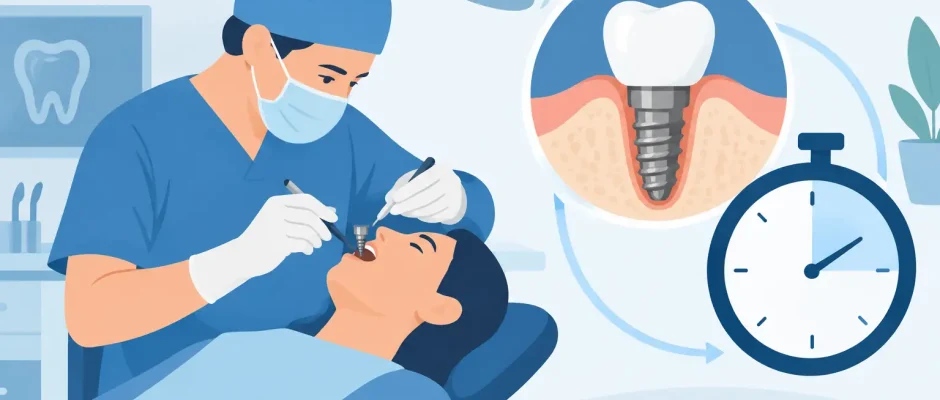
Implant Surgery Duration: What Takes Time?
A patient may hear that an implant takes “an hour” and assume the whole treatment will be finished that day. In reality, implant surgery duration has two meanings: the time spent in the surgical chair and the full timeline until the final crown or bridge is placed. These are very different intervals, and understanding the distinction makes treatment feel far more predictable.
For a straightforward single implant, the surgery itself is often relatively brief. But a missing tooth may be accompanied by infection, insufficient bone, gum recession, or a tooth that still needs to be removed. In these situations, the safest plan is not necessarily the fastest one. The goal is stable bone support, healthy soft tissue, and a restoration that functions and looks natural for years.
Implant surgery duration: the procedure itself
The surgical phase begins long before the implant is placed. A proper appointment includes preparation, local anesthesia, sterile setup, and a review of the planned position. If digital planning and a surgical guide are used, the implant can be placed with a high level of positional control. This is particularly valuable near the maxillary sinus, the inferior alveolar nerve, or adjacent tooth roots.
For one implant in favorable conditions, the active placement may take approximately 20 to 40 minutes. The full visit is commonly longer because anesthesia must take effect, the surgical field must be prepared, and postoperative instructions should never be rushed.
Placing several implants can take one to two hours or more. Full-arch treatment, including protocols such as All-on-4, may require several hours, especially when extractions, bone contouring, immediate temporary teeth, or sedation are part of the same visit. Duration alone does not measure difficulty. A shorter procedure performed according to a precise plan is preferable to a prolonged procedure caused by uncertainty during surgery.
Immediate implant placement after extraction
When a tooth must be removed, an implant can sometimes be placed in the same appointment. This is called immediate implant placement. It may reduce the number of surgical stages and preserve the shape of the surrounding tissues, but it is not appropriate for every case.
The decision depends on the condition of the socket, the amount of remaining bone, the ability to achieve primary implant stability, the position of the implant, and the presence of acute infection. Careful, minimally traumatic extraction is essential. In some cases, it is safer to remove the tooth, preserve the socket with bone graft material, and place the implant after healing.
Why the total treatment timeline varies
After an implant is placed, the bone needs time to form a stable biological connection with its surface. This process, called osseointegration, cannot be accelerated simply by scheduling the crown earlier. Healing usually takes several months, although the exact timeframe differs between the upper and lower jaw and depends on bone quality, implant stability, and the planned restoration.
The lower jaw often has denser bone and may allow a shorter healing period. The back of the upper jaw can be more complex because the bone is frequently less dense and the maxillary sinus may limit available height. A final crown is placed only when the implant and surrounding tissues meet the clinical requirements for long-term function.
In selected cases, an immediate temporary crown or bridge can be attached on the day of surgery. This is not the same as receiving the final restoration. Immediate loading requires excellent primary stability, controlled bite forces, and strict planning between the surgeon and restorative dentist. It can be an excellent option, but it is a protocol-driven decision rather than a standard promise.
Bone grafting and sinus lift add healing stages
When there is not enough bone to support an implant in the correct position, bone augmentation may be needed. This can involve guided bone regeneration with graft material and a membrane, a block graft, or a sinus lift in the upper posterior jaw.
Sometimes augmentation and implant placement can be performed together. In other cases, the graft must heal first, then the implant is placed in a second procedure. A staged approach lengthens treatment, but it can prevent a far more serious compromise: placing an implant where bone support is inadequate or positioning it unfavorably just to avoid grafting.
Depending on the procedure and the patient’s healing response, graft maturation may take several months. PRF, prepared from the patient’s own blood, can be used as part of selected regenerative protocols to support soft-tissue healing and wound management. It does not replace sound surgical technique or the time required for bone maturation.
What determines how long implant treatment takes?
The most influential factor is the starting condition of the mouth. A single missing tooth with intact bone and healthy gums follows a very different path from a case involving periodontal disease, long-term tooth loss, a failing bridge, or multiple infected teeth.
The timing is also shaped by the quality of diagnostic planning. Three-dimensional imaging allows the surgeon to assess bone volume, anatomical structures, and the restorative space before surgery. Digital planning makes it possible to determine not just whether an implant can be placed, but where it should be placed for the future crown or bridge. When indicated, a surgical guide transfers that plan into the clinical procedure.
General health and daily habits matter as well. Smoking, uncontrolled diabetes, active periodontal inflammation, poor oral hygiene, and heavy clenching can increase risk and may change the timing or protocol. These factors do not automatically rule out implant treatment, but they require an honest discussion and a treatment plan designed around risk reduction.
A realistic timeline for common situations
A simple single-tooth implant case may involve a consultation and CT-based planning visit, an implant placement appointment, a healing period of several months, and then the final crown. If the existing tooth is healthy enough to remain until surgery, the aesthetic zone can sometimes be managed especially carefully to preserve soft-tissue contours.
If extraction and immediate placement are possible, the surgical phase may be completed in one visit. If the socket needs to heal or requires grafting first, treatment may take longer. This is not a failure of the process. It is often the correct response to the biology of the site.
For multiple missing teeth or a full arch, treatment may move faster in one sense because several problems are addressed during a coordinated plan. A provisional fixed bridge may be delivered shortly after surgery in appropriate cases. Yet the final prosthetic phase still requires follow-up, healing assessment, bite adjustment, and precise laboratory work.
How to make the process more predictable
Predictability starts with diagnosis, not with the surgical appointment. A detailed consultation should clarify whether the proposed treatment includes extraction, grafting, sinus lift, temporary teeth, final restorations, follow-up visits, and who coordinates each stage. Patients should know what happens if the bone condition seen during surgery differs from the scan, although thorough planning reduces this possibility.
After surgery, following instructions protects the timeline. Avoiding smoking, taking prescribed medications as directed, maintaining careful hygiene, attending postoperative checks, and avoiding excessive pressure on a temporary restoration all support uncomplicated healing. Mild swelling and discomfort are common after surgery, particularly when grafting or multiple implants are involved. Worsening pain, persistent bleeding, fever, or swelling that increases after the first few days should be assessed promptly.
At Implantolog.co.il in Tel Aviv, complex implant cases are planned with digital diagnostics, microsurgical principles, and a focus on the final restorative result rather than the speed of a single appointment. This approach is especially relevant when bone volume is limited or when an immediate protocol is being considered.
The best question is not only, “How long will my implant surgery take?” It is, “What sequence gives this implant the strongest chance of lasting?” A clear, individualized plan replaces vague timelines with informed decisions and gives each stage the attention it deserves.


