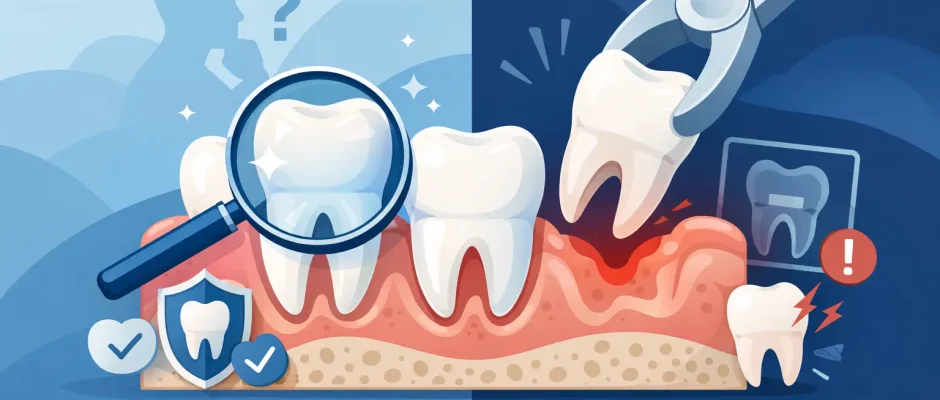
Is Tooth Extraction Always Necessary?
A patient hears, “This tooth may need to come out,” and the first reaction is often the same: can it still be saved? That question matters because is tooth extraction always necessary is not just a technical issue. It affects chewing, appearance, cost, recovery time, and sometimes the long-term condition of the bone and gums.
The short answer is no. Tooth extraction is not always necessary. In many cases, a tooth can be treated and kept for years with the right diagnosis and a well-planned approach. But there are also situations where trying to save the tooth creates more risk, more discomfort, and a less predictable result than removing it and rebuilding properly.
Is tooth extraction always necessary in every damaged tooth?
No, and this is where good surgical and restorative planning matters. A badly decayed, cracked, infected, or loose tooth is not automatically a hopeless tooth. The key question is not whether the tooth looks bad on an X-ray or causes pain today. The real question is whether it can function safely and predictably after treatment.
A tooth may often be preserved with a filling, crown, root canal treatment, periodontal therapy, or a microsurgical procedure such as apicoectomy. In other cases, the visible damage is only part of the story. If decay extends too far below the gumline, if the root is vertically fractured, or if there is not enough healthy structure left to support a restoration, saving the tooth may not be realistic.
This is why a proper consultation should not end with a quick yes-or-no answer. It should include clinical examination, imaging, evaluation of the surrounding bone and gum support, and a discussion of what the tooth will look like not just next month, but several years from now.
When saving the tooth makes sense
Whenever a tooth can be preserved with a predictable outcome, that option usually deserves serious consideration. Natural teeth still have advantages. They transmit bite forces in a natural way, maintain the patient’s own anatomy, and avoid surgery related to extraction and replacement.
A tooth can often be saved when the infection is localized and treatable, the root structure is intact, and enough healthy tooth remains above or just below the gumline to support a final restoration. This is common with deep cavities, failed old fillings, or teeth that need retreatment after a previous root canal.
Periodontal problems can also look worse than they are. Some teeth with bone loss can remain stable for years if inflammation is controlled and the tooth is strategically important. The same applies to some endodontic lesions, where treatment of the root canal system or microsurgical correction can resolve the problem without extraction.
The trade-off is time, cost, and prognosis. Saving a tooth is worthwhile when the effort leads to a strong, maintainable result. It is less worthwhile when treatment becomes a chain of temporary fixes.
Tooth preservation is not the same as delaying the inevitable
This distinction is important. Keeping a tooth for the sake of keeping it is not always good medicine. If a tooth has repeated infections, recurrent fractures, or severe structural loss, preserving it at all costs can mean ongoing pain, repeated emergency visits, and progressive bone destruction.
A conservative approach is valuable when it is biologically sound. It becomes a problem when it only postpones a more definitive solution.
When extraction is the better choice
There are clinical situations where removal is not aggressive treatment, but the safer and more predictable one. A classic example is a vertical root fracture. These teeth usually cannot be repaired in a durable way. Another common reason is extensive decay below the bone level, where proper restoration is no longer feasible.
Advanced periodontal destruction may also make extraction necessary. If the tooth is severely mobile, has lost most of its support, and cannot contribute to stable chewing, saving it may not improve the patient’s quality of life. The same applies to impacted or displaced wisdom teeth that repeatedly cause inflammation, pain, decay in the neighboring tooth, or cystic changes.
Sometimes extraction is chosen because it improves the overall rehabilitation plan. For example, a tooth with poor prognosis in a patient preparing for implant treatment or full-arch rehabilitation may compromise the long-term result if it is retained. In these cases, removing the problem tooth early can protect bone, simplify treatment, and reduce the number of surgeries later.
Is tooth extraction always necessary before implants?
No. An implant does not replace the value of a healthy natural tooth. If a tooth is restorable and has a good long-term prognosis, extraction just to place an implant is usually not the first choice.
At the same time, a failing tooth should not be maintained simply because patients are understandably attached to it. Implants can be an excellent solution, especially when the tooth is no longer predictable. In skilled hands, extraction can be combined with bone preservation techniques, PRF, and in selected cases immediate implant placement, which helps maintain tissue architecture and shorten the treatment path.
The decision should be based on prognosis, not emotion alone and not marketing. A well-treated natural tooth is often worth keeping. A non-restorable tooth should not be defended beyond reason.
The factors that determine the right decision
A responsible recommendation is based on several variables at once. The amount of remaining tooth structure matters. So does the condition of the root, the presence of infection, the quality and volume of surrounding bone, gum health, bite forces, and whether the tooth is in an esthetic or high-load area.
Patient factors are equally important. Smoking, uncontrolled diabetes, grinding, previous failed dental work, and oral hygiene habits all influence prognosis. A tooth that might survive in one patient may fail much sooner in another.
Technology also changes what is possible. High-quality imaging, magnification, microsurgical techniques, and digital planning improve diagnostic accuracy. They help distinguish between a tooth that is difficult to save and one that truly cannot be saved. That difference matters because unnecessary extraction has a cost, but so does overtreatment of a hopeless tooth.
Why second opinions are sometimes reasonable
If extraction is recommended quickly, especially for a front tooth or a strategically important chewing tooth, a second opinion can be sensible. This is not about distrust. It is about making sure the diagnosis is complete and the treatment plan accounts for both immediate relief and long-term function.
A careful second opinion may confirm that extraction is the best option. Just as often, it clarifies whether there is a realistic tooth-saving alternative. The most helpful consultations are the ones that explain the prognosis of each path clearly, including the limitations.
Patients should be cautious with absolute statements in either direction. “This tooth must come out” can be too simplistic. “Every tooth can be saved” is equally unreliable. Good dentistry lives in the space between those two extremes.
What patients should ask before agreeing to extraction
Before moving forward, it is reasonable to ask whether the tooth is restorable, what the expected lifespan would be if it is treated, and what the risks are if it is kept. It is also worth asking what happens to the bone and gum tissue after extraction, and whether grafting or immediate implant placement may be recommended.
These questions do not challenge the doctor. They improve decision-making. A good treatment plan should make the next steps understandable: diagnosis, whether the tooth can be preserved, what extraction would involve if needed, and how the missing tooth would be replaced.
This step-by-step clarity often reduces anxiety more effectively than reassurance alone.
The best treatment is the one with the most predictable future
For some patients, the best outcome is preserving the natural tooth with careful restorative or microsurgical treatment. For others, extraction is the point where repeated problems finally stop and a more stable reconstruction begins. Neither option is automatically better in every case.
At Implantolog, complex surgical decisions are approached with exactly this mindset: preserve what can be predictably preserved, and when extraction is necessary, perform it with a plan to protect bone, soft tissue, comfort, and the final restorative result.
If you are facing this decision, the right question is not simply whether the tooth can stay today. It is whether keeping it gives you a healthy, comfortable, and dependable result tomorrow.


