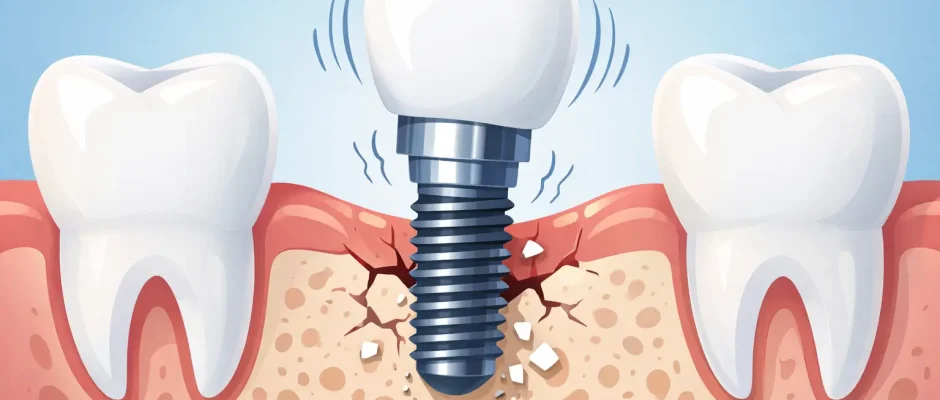
What Causes Dental Implant Loosening?
A patient usually does not say, “I think my implant has lost osseointegration.” They say, “Doctor, my implant feels loose when I chew.” That distinction matters, because what causes dental implant loosening is not always failure of the implant itself. In many cases, the problem is in the crown, the abutment screw, or the surrounding tissue – and each scenario requires a different response.
The first priority is simple: do not ignore movement around an implant. A dental implant should feel stable. If something shifts, clicks, rotates, or becomes uncomfortable under load, it needs a clinical evaluation. The earlier the cause is identified, the more predictable the treatment usually is.
What causes dental implant loosening in practice
When patients use the phrase “loose implant,” they are often describing one of three situations. The visible crown may be mobile while the implant fixture in the bone remains stable. The abutment connection may have loosened. Or the implant itself may have lost support in the bone and truly become mobile.
These scenarios can feel similar to the patient, but clinically they are very different. A loose crown or screw is often repairable with relatively straightforward treatment. A mobile implant fixture is more serious and may require removal, site management, and delayed re-implantation after healing.
That is why diagnosis comes before solutions. The treatment is not based on the sensation of looseness alone. It is based on where the movement is occurring and why.
The most common reasons an implant feels loose
A loose abutment screw
This is one of the most common mechanical causes. The implant crown is connected to the implant fixture through an abutment, and that connection is often secured by a screw. If the screw loses preload over time, the restoration may begin to move slightly.
Patients may notice a subtle wobble, a clicking feeling, or discomfort when biting on harder foods. Sometimes there is no pain at all. In many cases, the implant in the bone is still fully stable. The problem is the prosthetic connection, not the implant surgery itself.
Screw loosening can happen because of bite overload, an unfavorable direction of chewing forces, limited space, wear of components, or inaccuracies in fit. It can also occur when the restoration has been under repeated stress for a long time.
A loose crown on a stable implant
Some implant crowns are screw-retained, while others are cement-retained. If a crown becomes detached or partially debonded, it may feel like the implant is loose even though the implant body is secure.
This distinction is reassuring for many patients, but it still needs prompt attention. A moving crown changes the way force is transmitted during chewing and can create secondary problems if left untreated.
True implant mobility from loss of bone support
This is the situation both patient and surgeon want to avoid. A true implant should be fused to bone through osseointegration. If that bond fails or is lost later, the implant fixture itself can become mobile.
When this happens, the issue is no longer just a loose part. It is a biological failure of support. Depending on the cause and extent of bone loss, the implant may not be salvageable.
Why implants lose bone support
Peri-implantitis
Peri-implantitis is an inflammatory condition affecting the tissues around an implant, with progressive bone loss. It is one of the most important biological causes of late implant loosening.
It usually starts with bacterial plaque accumulation and inflammation in the soft tissues. In susceptible patients, especially when oral hygiene is inconsistent or maintenance is irregular, the inflammation can progress deeper and affect the supporting bone.
Typical warning signs include bleeding during brushing, swollen gum tissue, bad taste, recurrent tenderness, or pus. Sometimes the process is surprisingly quiet, and the first obvious symptom is mobility. That is why regular follow-up matters even when the implant seems fine.
Early failure of osseointegration
Not every implant that loosens has functioned successfully for years. Some never integrate properly from the beginning. In that setting, the implant may become mobile during the healing phase or soon after loading.
This can happen when initial stability was insufficient, when bone quality was poor, when the implant was overloaded too early, or when healing was disrupted. Smoking, uncontrolled diabetes, active infection, and certain systemic factors can also reduce the predictability of integration.
With modern planning, CBCT-based evaluation, and careful surgical protocols, this risk can be reduced significantly – but not to zero. Good medicine is about risk control, not unrealistic promises.
Overload and unfavorable bite forces
Implants do not have the same shock-absorbing ligament that natural teeth have. They tolerate load well, but they tolerate overload poorly if the force distribution is wrong.
A heavy bite, nighttime clenching, bruxism, a poorly balanced prosthetic design, or missing support from adjacent teeth can create excessive stress at the implant-restoration interface and in the surrounding bone. Sometimes this first appears as repeated screw loosening. In other cases, it contributes to marginal bone loss over time.
This is one reason prosthetic planning is as important as surgical placement. The implant has to be in the right position not only for insertion, but for long-term force control.
Bone deficiency or challenging anatomy
Some patients start with limited bone volume, low bone density, or anatomic constraints in the posterior maxilla or other complex areas. Implant treatment can still be very successful in these cases, but the margin for error is smaller.
If an implant is placed in compromised bone without proper augmentation, or if the original plan does not adequately account for the anatomy, long-term stability may be affected. In advanced cases, bone grafting, sinus augmentation, guided surgery, and staged treatment are not “extras.” They are part of making the result more predictable.
What increases the risk of dental implant loosening
Certain factors do not directly cause failure on their own, but they increase the chance of mechanical or biological complications.
Smoking remains one of the clearest examples. It impairs healing, affects blood supply, and increases the risk of peri-implant tissue problems. Poor plaque control is another major factor. A history of periodontitis also matters, because patients who have lost bone around teeth may be more vulnerable around implants if maintenance is not strict.
Systemic conditions can play a role too. Diabetes, if poorly controlled, can impair healing and increase inflammatory risk. Severe bruxism adds repeated functional stress. Low-quality components or prosthetic mismatches can contribute mechanically. Even a well-placed implant can struggle in a poorly controlled environment.
How a surgeon determines what is actually loose
Clinical examination comes first
The evaluation starts with a careful physical exam. Is the crown moving, or is the implant fixture mobile in the bone? Is there inflammation around the gum? Is there pain on percussion or function? Is there a history of repeated screw loosening or recent trauma?
These details often narrow the diagnosis quickly. A surgeon will also assess the bite, the condition of the prosthetic components, and the health of the surrounding soft tissue.
Imaging and component assessment
X-rays help identify crestal bone loss, radiolucency, excess cement, or mechanical misfit. In more complex cases, 3D imaging may be useful, especially if re-treatment is being considered.
The prosthetic parts themselves also need inspection. A worn or damaged screw, a fractured component, or a poorly fitting crown can all create symptoms that patients describe as implant loosening.
Can a loose implant be saved?
It depends on what is loose.
If the problem is a crown or abutment screw, treatment is often conservative. The restoration may be removed, the components checked, the screw replaced or retightened to the correct torque, and the bite adjusted if needed.
If there is peri-implant inflammation with limited bone loss, early intervention may help control the disease. That may involve decontamination, improved hygiene protocols, surgical access, or regenerative treatment in selected cases. Outcomes vary because peri-implantitis is not a single uniform problem.
If the implant fixture itself is mobile, removal is frequently the correct option. This is understandably frustrating for patients, but delayed replacement after site preparation can still lead to an excellent result. The key is not to force a failing implant to remain in place when biology is no longer supporting it.
When to seek urgent evaluation
Do not wait if the implant moves visibly, hurts when chewing, starts to rotate, or is associated with swelling, bleeding, or discharge. These signs do not always mean implant loss, but they do mean something is wrong.
Prompt assessment usually gives more treatment options. Waiting tends to convert smaller problems into larger ones – especially when bone loss is involved.
How to reduce the chance of loosening
The best prevention starts long before the implant is placed. Accurate diagnosis, prosthetically driven planning, stable primary placement, and thoughtful management of bone and soft tissues all improve long-term predictability. In more demanding cases, guided surgery and microsurgical protocols can help reduce avoidable variables.
After treatment, maintenance becomes the patient’s part of the partnership. Good hygiene, regular follow-up, control of clenching or bruxism, and fast response to any unusual movement or discomfort make a real difference.
A dental implant is designed to be a stable long-term solution. If it feels loose, that is not something to monitor at home for a few months. It is a reason to get clarity. And in implant dentistry, clarity early usually means simpler treatment and a better outcome.


