Best Options for Missing Back Teeth
You may not notice a missing molar every time you smile, but you will notice it when you chew, clench, or start favoring one side. That is why the best options for missing back teeth are not just about filling a gap. They are about restoring chewing efficiency, protecting neighboring teeth, and preventing a slow chain of changes in the bite and jawbone.
Back teeth carry most of the chewing load. Premolars and molars are designed to absorb force, keep the bite balanced, and maintain the vertical support of the face. When one is missing, the effects are often gradual rather than dramatic. Food gets trapped more easily, the opposing tooth may over-erupt, nearby teeth can tilt, and the jaw joint may start working under less stable conditions. In some patients, the first complaint is not the gap itself but sensitivity, uneven chewing, or repeated fracture of other teeth that are now overloaded.
Best options for missing back teeth: what actually works
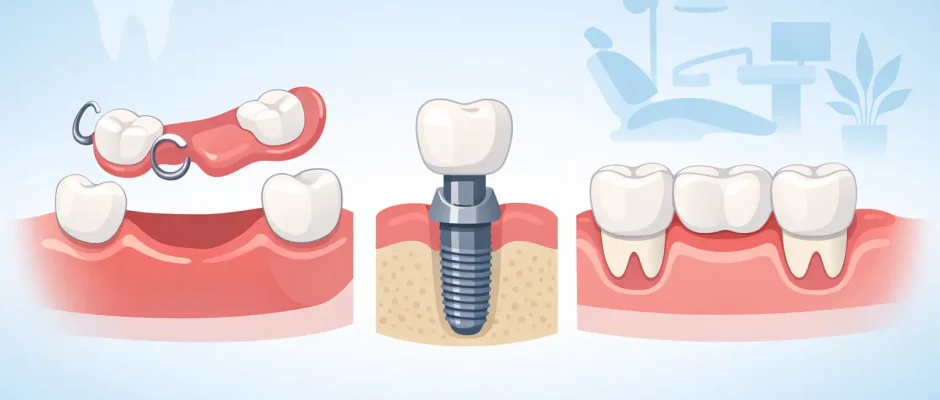
In most real clinical situations, there are three main ways to replace a missing back tooth: a dental implant with a crown, a fixed bridge, or a removable partial denture. Each can be the right choice. Each also has limitations.
The best treatment depends on several factors: how long the tooth has been missing, the condition of the surrounding teeth, the amount of available bone, the bite forces, smoking status, gum health, and the patient’s expectations regarding comfort, maintenance, treatment time, and budget. This is where a proper surgical and prosthetic plan matters more than the name of the procedure.
Dental implant with a crown
For a single missing molar or premolar, an implant is often the most physiologic solution. A titanium implant is placed in the jawbone to replace the root, and after healing it supports a crown. The main advantage is that the neighboring teeth usually do not need to be drilled down, which is especially valuable if they are healthy.
Implants also help preserve bone in the area. Bone tends to resorb after tooth loss because it no longer receives functional loading through the root. An implant cannot stop every biological change, but it does provide stimulation that a removable option cannot.
That said, implant treatment is not always immediate or simple. If the tooth has been missing for a long time, bone volume may be insufficient. In the upper back jaw, the maxillary sinus often limits vertical bone height, and sinus augmentation may be needed. In other areas, guided bone regeneration may be part of the plan. Patients with untreated gum disease, uncontrolled diabetes, heavy smoking habits, or very high bite forces may also need risk correction before treatment.
In experienced hands, digital planning and surgical guides improve precision, especially in areas close to the sinus or nerve canal. In more complex cases, these details are not marketing extras. They are part of making treatment safer and more predictable.
Fixed dental bridge
A bridge replaces the missing tooth by using the neighboring teeth as support. The classic version involves preparing the teeth on either side of the gap and placing connected crowns with an artificial tooth in the middle.
A bridge can be a reasonable choice when the adjacent teeth already have large fillings, root canal treatment, or existing crowns and are likely to need restoration anyway. In that scenario, using them as abutments may be both efficient and clinically sound.
The main trade-off is biological cost. Healthy neighboring teeth must usually be reduced, sometimes substantially. Bridges also do not preserve bone at the missing root site in the same way an implant can. Over time, cleaning under the bridge requires diligence, and if one supporting tooth develops a problem, the whole restoration may be affected.
For some patients, though, a bridge remains the best balance of speed, cost, and practicality. A treatment plan should not be built around ideology. It should be built around the mouth in front of the doctor.
Removable partial denture
A removable partial denture is usually the most budget-conscious option. It can replace one or several missing back teeth and may be useful when surgery is not desired, not medically advisable, or must be postponed.
Its limitations are comfort, stability, and chewing efficiency. Many patients tolerate a partial denture, but fewer would describe it as feeling like a natural tooth. It may move under function, collect food, and place load on the gums and remaining teeth in ways that are less ideal over time.
Still, dismissing it entirely would be a mistake. For a patient with multiple missing teeth, limited bone, or a need for an interim solution before definitive treatment, a well-made partial denture can have real value. The key is to present it honestly as a compromise, not as the equivalent of a fixed solution.
When the best options for missing back teeth depend on timing
Timing changes the treatment possibilities. If a tooth was recently lost or must be removed because of fracture, failed root canal treatment, or advanced infection, immediate implant placement may sometimes be considered. In the right case, this can shorten treatment and reduce the number of surgical stages.
But immediate implant placement is not automatically better. It depends on infection control, the integrity of the socket walls, soft tissue condition, primary stability, and bite risk. In posterior regions, where chewing forces are high, a rushed protocol can create avoidable complications. Predictability matters more than speed.
If the tooth has been missing for years, the conversation may include bone loss, sinus expansion in the upper jaw, and drifting of adjacent teeth. This does not mean implant treatment is impossible. It means the plan has to be more precise. Sometimes orthodontic correction, bone grafting, or staged treatment is the difference between a compromised result and a durable one.
Which option lasts longest?
Patients often ask for the longest-lasting solution, but longevity is tied to maintenance and case selection. Well-planned implants can perform very well for many years, but they are not maintenance-free. Peri-implant inflammation, overload, and poor hygiene can shorten survival.
Bridges can also last a long time, especially when the supporting teeth are healthy and the bite is stable. Their weak point is often not the bridge material itself but decay or endodontic problems in the abutment teeth.
Partial dentures generally have the lowest long-term comfort and function, but they may still serve patients well when other options are not realistic. The correct question is not only Which lasts longest? It is Which solution gives this patient the best long-term function with acceptable risk?
Cost matters, but so does what you are paying for
An implant usually has a higher upfront cost than a bridge or removable denture. That is true. But cost should be viewed in context. If a bridge requires sacrificing healthy teeth, future retreatment on those teeth may become part of the real price. If a removable denture is poorly tolerated and later replaced, the lower initial cost may not mean lower total cost.
This is also why proper diagnostics matter. A plan based on clinical examination and 3D imaging is different from giving a generic price for a missing tooth. The anatomy of the sinus, the width of the ridge, the distance to the mandibular nerve, and the condition of the gums all affect what is possible and what is predictable.
For patients considering treatment in Tel Aviv, where many seek advanced implant care for both routine and complex cases, choosing a surgeon who works with digital planning, bone augmentation protocols, and clear staging can reduce uncertainty. That matters most when the case is not straightforward.
How to choose wisely
If the neighboring teeth are healthy and bone is adequate, an implant is often the preferred option for a single missing back tooth. If those teeth already need crowns, a bridge may be entirely reasonable. If surgery is contraindicated, delayed, or outside the patient’s budget, a removable partial denture may be the practical answer.
There is also the question of how many teeth are missing. Replacing one molar is different from rebuilding a shortened dental arch or treating several missing posterior teeth in a row. In more extensive cases, implant-supported solutions can often restore function much more effectively than removable appliances, but only if the bite is planned carefully.
A good consultation should leave you with more than a price. It should explain why one option fits your anatomy, your bite, and your long-term goals better than another. The best dentistry is rarely the fastest pitch. It is the treatment that makes sense before surgery, during healing, and years after the crown is placed.
If you are deciding what to do about a missing back tooth, do not focus only on replacing the visible gap. Focus on restoring stable chewing, protecting the teeth you still have, and choosing a plan that remains predictable under real life, real bite force, and real time.


