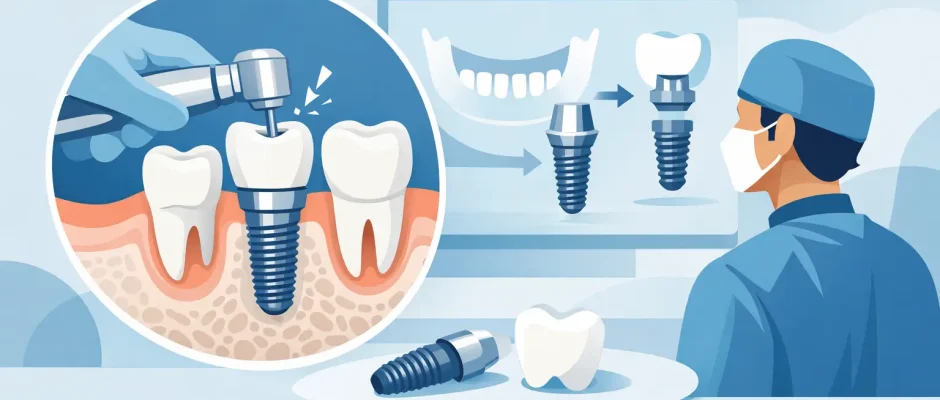
A dental implant that does not feel right is rarely something to “watch and wait” for long. If there is pain when chewing, mobility, recurring swelling, gum recession, or an esthetic result that keeps getting worse, dental implant revision surgery may be the step that protects both your bone and your long-term result.
Revision surgery is not one single procedure. It is a treatment strategy used when an existing implant, the surrounding bone and gum, or the prosthetic design is failing functionally, biologically, or esthetically. Sometimes the problem is limited to inflamed tissue around an implant. Sometimes the implant itself is malpositioned, partially integrated, or associated with bone loss. In more complex cases, the original treatment plan was compromised by thin bone, an unfavorable bite, or a prosthetic design that made hygiene difficult.
That distinction matters because successful revision starts with diagnosis, not with rushing into replacement. In clinical practice, patients often arrive expecting that the old implant simply needs to be removed and a new one placed immediately. Sometimes that is possible. Often, it is not the safest option.
When dental implant revision surgery is needed
The most common reason for revision is peri-implant disease – inflammation around the implant with progressive bone loss. Early cases may present as bleeding, tenderness, or bad taste. More advanced cases can include suppuration, deep pockets, and radiographic bone loss. If the implant remains stable and the defect is treatable, the goal may be to preserve it through surgical decontamination and regenerative procedures. If stability is lost, removal is usually the more predictable choice.
A second group of cases involves implant malposition. The implant may be too far facial, too deep, too angled, or placed in a position that compromises the crown, speech, hygiene, or gum contour. These cases are frustrating because the implant may be technically integrated and yet still produce a poor result. Revision here is often about predictability rather than salvage at any cost.
Mechanical complications also lead to revision. A fractured screw, repeated loosening, implant body fracture, or overload from an unstable bite can create a cycle of prosthetic repair without addressing the underlying cause. If the implant platform or surrounding tissues are already compromised, repeated small fixes tend to delay the definitive solution.
Then there are esthetic failures. In the front of the mouth, even a stable implant can look unnatural if the gum margin is uneven, the papillae are missing, or the crown emerges at the wrong angle. Not every esthetic complaint requires surgery, but when the implant position or soft tissue architecture is fundamentally wrong, revision may be the only realistic path to a natural appearance.
What a proper revision workup should include
Before planning dental implant revision surgery, the case should be evaluated on three levels: biology, mechanics, and esthetics. If only one level is considered, the same problem often returns.
The biological assessment looks at inflammation, probing depths, keratinized tissue, mobility, bone levels, and risk factors such as smoking, uncontrolled diabetes, previous periodontitis, or poor plaque control. The mechanical assessment reviews implant position, occlusion, prosthetic design, screw access, and the forces placed on the implant. The esthetic assessment focuses on smile line, soft tissue thickness, adjacent teeth, and whether a realistic improvement is achievable.
This is where three-dimensional imaging and digital planning become especially valuable. A CBCT scan can show residual bone, buccal plate deficiency, proximity to neighboring structures, and the morphology of a defect after implant removal. Digital planning also helps determine whether immediate replacement is safe or whether staged bone grafting will produce a more stable outcome.
In complex cases, the best plan is often more conservative than the fastest plan. That may mean removing a failing implant, reconstructing the site, allowing healing, and placing a new implant later using a surgical guide. Patients do better when expectations are set clearly from the beginning.
What dental implant revision surgery can involve
The procedure itself depends on the reason for failure. If the implant is stable and the problem is limited to peri-implant bone loss, revision may involve flap surgery, implant surface decontamination, defect management, and in selected cases guided bone regeneration. The result depends on defect shape, implant surface characteristics, hygiene access, and whether the prosthetic design can be corrected afterward.
If the implant must be removed, the technique matters. Atraumatic explantation preserves bone and makes the next stage more predictable. In some cases, a counter-torque technique can remove the implant with minimal trauma. In others, a trephine or more extensive surgical approach is required. The less collateral damage during removal, the better the options for immediate or delayed reconstruction.
Bone grafting is frequently part of revision. When an implant has caused or accompanied buccal bone loss, simply placing another implant into the same compromised site is risky. Guided bone regeneration, particulate grafts, membranes, and biologic support such as PRF may be used to improve healing conditions. In the posterior maxilla, sinus augmentation may also be relevant if vertical height is limited.
Soft tissue correction can be just as important as bone. Thin tissue, recession, or lack of keratinized mucosa increases the chance of inflammation and esthetic compromise. Connective tissue grafting or soft tissue augmentation may be recommended either before implant replacement or at the time of the new implant, depending on the defect and tissue quality.
When immediate replacement is possible, it should be because the site allows it – not because it is more convenient. Primary stability, infection control, and defect morphology all matter. Immediate placement can shorten treatment, but staged treatment is often the safer choice in infected or structurally deficient sites.
Can a failed implant always be saved?
No – and trying too hard to save the unsalvageable can waste time, bone, and money.
An implant with advanced mobility, severe bone loss, unfavorable position, or recurrent complications after previous treatment usually has a poor prognosis. In these situations, removal and reconstruction are more predictable than repeated rescue procedures. On the other hand, a stable implant with localized inflammation and a treatable defect may respond well to revision therapy if the prosthetic design and hygiene conditions are corrected.
This is one of the most important “it depends” decisions in implant dentistry. Saving an implant is not automatically better than replacing it. The real goal is a stable, maintainable result that will still look and function well years from now.
Recovery after revision surgery
Recovery varies with the extent of treatment. A minor surgical decontamination around a stable implant is different from removal, bone grafting, and delayed replacement. Most patients can expect mild to moderate swelling and tenderness for several days, with sutures commonly removed after about one to two weeks.
The more significant timeline is biological healing. Soft tissue may look improved relatively quickly, while bone maturation takes months. If grafting was performed, your surgeon may delay new implant placement until the site has developed enough volume and density for stable positioning. That waiting period is not a setback – it is part of making the next surgery more predictable.
Temporary tooth replacement during healing also deserves discussion. In visible areas, patients understandably want an immediate cosmetic solution, but the temporary restoration must avoid pressure on the healing graft or implant site. A well-designed provisional can protect both appearance and biology.
How to reduce the risk of needing another revision
The biggest predictor of long-term success is not just the surgery. It is the combination of diagnosis, planning, execution, prosthetic design, and maintenance.
That means the new implant position should be restoratively driven, not simply placed wherever bone happens to remain. It means bite forces should be controlled. It means the crown or bridge should be cleanable. It means thin tissue or missing bone should be treated rather than ignored. And it means regular maintenance is part of treatment, not an optional extra.
For patients with previous implant problems, this careful approach matters even more. A revision case is rarely a standard case. Scar tissue, altered anatomy, residual defects, and understandable anxiety all change the way treatment should be planned. In experienced hands, digital planning, microsurgical technique, and a stepwise protocol can make a major difference in safety and predictability.
If you are considering dental implant revision surgery, the most useful question is not “Can this implant be fixed?” but “What gives me the best chance of a stable result five years from now?” That shift in thinking usually leads to better decisions, less repeated treatment, and a much calmer treatment experience.


