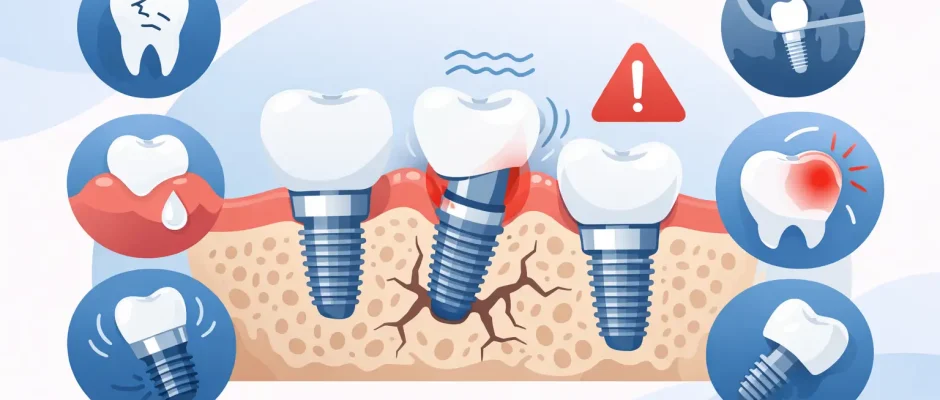
7 Signs of Dental Implant Failure
A dental implant should not gradually become something you “get used to” despite pain, swelling, or a strange feeling when you bite. One of the most common reasons patients delay care is assuming these symptoms are part of healing. In reality, some signs of dental implant failure are subtle at first, and early attention often makes the difference between a manageable complication and loss of the implant.
Implants have very high long-term success rates, but success is never just about placing titanium in bone. It depends on diagnosis, bone quality, surgical precision, bite forces, gum health, healing capacity, and how the final restoration is designed and maintained. That is why an implant can look acceptable at first and still begin to fail later – either biologically, mechanically, or both.
What dental implant failure actually means
Patients often use the word “failure” for any discomfort after surgery. Clinically, that is too broad. Some postoperative soreness, mild swelling, and temporary sensitivity in the first days are expected. Failure means the implant is not integrating properly with bone, has lost previously stable integration, or cannot function predictably because of infection, overload, or structural complications.
There are two broad patterns. Early failure happens before or during osseointegration, when the implant never becomes stable in bone. Late failure happens after an implant has already been functioning, sometimes months or years later. Late problems are often linked to peri-implantitis, bone loss, excessive occlusal load, parafunction such as clenching, or a prosthetic design that is difficult to clean.
This distinction matters because the warning signs can look different. An implant that fails early may remain painful or mobile during healing. A late failing implant may seem fine for a long time, then develop bleeding, deeper pockets, gum changes, or discomfort when chewing.
1. Mobility is never normal
A natural tooth has a periodontal ligament, so it can have microscopic physiologic movement. An implant does not. A properly integrated implant should feel solid. If the implant itself moves, even slightly, that is one of the clearest signs of dental implant failure.
Patients sometimes describe this as a clicking sensation, a feeling that the implant “gives” under pressure, or the impression that the tooth is loose. One nuance is important here: sometimes the implant is stable, but the crown or abutment screw is loose. That is still a problem, but it is not the same as loss of osseointegration. The difference can only be confirmed clinically and radiographically. From the patient’s perspective, any new looseness deserves prompt evaluation.
2. Pain that increases instead of improving
Discomfort after implant placement is normal for a limited period. What raises concern is pain that intensifies after the first few days, returns after an initially quiet recovery, or appears mainly when biting.
Pain can signal several different issues. It may reflect pressure from overload, inflammation around the implant, infection, impingement on adjacent structures, or micromovement that prevents stable integration. The exact cause depends on timing, anatomy, and the treatment protocol used.
A common misconception is that a failing implant must be severely painful. Not always. Some failing implants are only mildly sore, especially in the early stage. Others produce pain only when chewing harder foods. Persistent or worsening pain is more meaningful than dramatic pain alone.
3. Swelling, redness, or bleeding around the implant
Healthy peri-implant tissue should look calm. Some initial inflammation after surgery is expected, but once healing progresses, the gums around the implant should not remain puffy, tender, or prone to bleeding.
Bleeding during brushing, redness at the gum margin, bad taste, or recurring swelling may point to mucositis or peri-implantitis. Mucositis is inflammation limited to the soft tissues and is often reversible when treated early. Peri-implantitis is more serious because it involves inflammatory bone loss around the implant.
This is one reason regular follow-up matters. Bone loss does not always cause immediate pain. A patient may notice only occasional bleeding or mild puffiness, while radiographs show progressive loss of support. When these changes are caught early, the treatment options are broader and the prognosis is better.
4. Pus, bad taste, or persistent bad breath
If you notice discharge from the gum around an implant, a foul taste, or localized bad breath that does not improve with brushing, think of infection until proven otherwise. Pus is not part of normal healing.
Infection around an implant may result from bacterial contamination, residual cement, poor cleansability, deep peri-implant pockets, or bone loss that has created a sheltered area for plaque accumulation. In some cases, food trapping around a poorly contoured crown contributes to chronic inflammation.
Patients sometimes wait because the implant is “not really hurting.” That is risky. An active infection can destroy supporting bone quietly and reduce the chance of saving the implant.
5. Gum recession or a longer-looking crown
A subtle but important sign is a visible change in the gum line. If the implant crown starts to look longer, metal becomes visible, or the tissue contour collapses, that can indicate soft tissue recession, underlying bone loss, or both.
Not every esthetic change means the implant is failing. Thin gum tissue, implant position, and healing pattern all affect appearance. But when recession is new, progressive, or paired with bleeding or food trapping, it should be assessed carefully. Around implants, esthetic changes are often biologic changes in disguise.
This is especially relevant in the front of the mouth, where even a small loss of tissue support becomes obvious. In posterior areas, the same process may be missed until function is affected.
6. Difficulty chewing or a bite that suddenly feels wrong
An implant restoration should feel stable and coordinated with your bite. If you start avoiding chewing on that side, feel pressure on one point, or notice that the implant “hits first,” the problem may be mechanical, biologic, or both.
Sometimes the issue is simply an occlusal adjustment that is needed. Sometimes it reflects screw loosening, fracture of a prosthetic component, or overload that is stressing the implant-bone interface. Patients who grind or clench are at higher risk of these complications, particularly when protective planning or maintenance has been inconsistent.
This is one of the classic it-depends situations. A bite problem does not automatically mean implant loss is imminent, but ignoring it can turn a manageable correction into a larger complication.
7. Bone loss on X-rays
Some of the most important signs of dental implant failure are not felt at all. Progressive bone loss seen on radiographs may be the earliest objective evidence that an implant is in trouble.
Small remodeling changes after placement can be normal, especially depending on implant design and tissue characteristics. What is not normal is ongoing or accelerating loss of bone support. When bone levels drop, the implant becomes more vulnerable to infection, mobility, and eventual loss.
That is why follow-up imaging is not just a formality. A stable implant is confirmed by clinical findings and radiographic stability together. One without the other is not enough.
What can cause an implant to fail?
There is rarely a single explanation. Smoking, uncontrolled diabetes, previous periodontitis, poor oral hygiene, low bone volume, overheating during osteotomy, lack of primary stability, overload, untreated bruxism, and difficult implant positioning can all contribute. In complex cases, the interaction between factors matters more than any one item on the list.
For example, a patient with reduced bone volume may still do very well when planning is precise, augmentation is done correctly, and the prosthetic load is controlled. On the other hand, an implant placed in adequate bone can still develop late complications if maintenance is poor and inflammation is ignored.
This is where experience and protocol discipline matter. Digital planning, guided surgery when indicated, careful management of soft tissues, and close control of loading are not marketing extras. They improve predictability, especially in challenging anatomy and esthetic zones.
When to call your implant dentist
If you have mobility, pus, fever, rapidly increasing swelling, or significant pain when biting, do not wait for a scheduled hygiene visit. Those symptoms justify prompt assessment. Even milder issues such as bleeding, a new bad taste, or a crown that feels different should not be left for months.
An implant that is evaluated early may be treatable with decontamination, occlusal adjustment, soft tissue management, screw replacement, or other targeted intervention. A delayed visit often means fewer conservative options.
For patients receiving care in complex surgical settings, including bone grafting or immediate implantation, structured follow-up is particularly important. At clinics such as Implantolog in Tel Aviv, that follow-up is part of making implant treatment predictable rather than reactive.
If something around an implant feels off, trust that signal. The goal is not to panic at every sensation, but to separate normal healing from the early signs that deserve a careful clinical look.


