Flapless Implant Surgery Benefits Explained
Some patients come to an implant consultation with one very specific question: can this be done with less cutting and a faster recovery? That is exactly why flapless implant surgery benefits get so much attention. In the right case, this technique can reduce surgical trauma, preserve soft tissue architecture, and make the postoperative period noticeably easier. But it is not a shortcut, and it is not the right choice for every mouth.
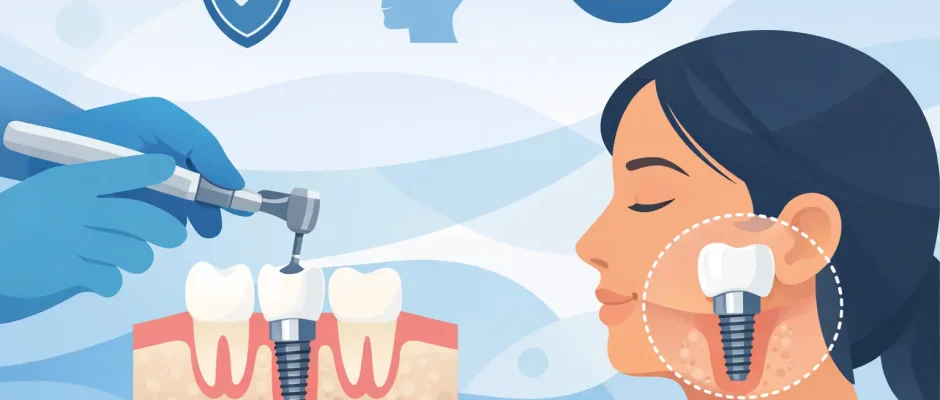
A flapless implant approach means the implant is placed without raising a full gum flap to expose the bone. Instead of reflecting the tissue away from the implant site, the surgeon prepares the osteotomy through a small tissue opening, often guided by digital planning and, when indicated, a surgical guide. The main appeal is clear: less disruption to the tissues can mean less swelling, less bleeding, and a more comfortable recovery.
What flapless implant surgery benefits really mean
The phrase sounds simple, but the real value is clinical. When the periosteum is not widely lifted from the bone, blood supply to the area is better preserved. That matters because implant surgery is not only about placing a titanium fixture in the right position. It is also about maintaining healthy bone and stable soft tissue around it over time.
In practical terms, patients often notice a smoother first few days after surgery. There may be less postoperative swelling and less soreness compared with a traditional open-flap procedure. Sutures may be minimal or unnecessary, which many patients appreciate. For someone anxious about surgery, this can make the experience feel more controlled and less intimidating.
There is also an esthetic dimension. In selected cases, flapless placement can help preserve the natural gingival contour, especially in areas where soft tissue stability matters. That does not automatically make it the best approach for every front tooth, but when anatomy is favorable and planning is precise, tissue preservation can be a real advantage.
Why a smaller approach can improve recovery
A minimally invasive surgery is valuable only if it remains accurate. That is the central point. The reason flapless surgery may feel easier afterward is that fewer tissues are manipulated. When a broad flap is elevated, the body responds to that surgical exposure with inflammation, edema, and healing demands. With a smaller entry point, that response may be reduced.
Patients often describe the recovery as more manageable. Eating soft foods, speaking, and returning to routine activities may feel easier. This is especially relevant for professionals who do not want a prolonged visible recovery, or for patients who are already facing multiple stages of treatment and want each stage to be as tolerable as possible.
Another potential benefit is shorter chair time in well-planned cases. If the anatomy is clear, the implant position is digitally planned, and the surgeon can work through a guided or carefully controlled protocol, the procedure can be efficient without sacrificing precision. Still, efficiency should never be confused with rushing. Good flapless surgery depends on preparation, not speed.
The role of digital planning
Flapless surgery is far more predictable when it starts long before the day of the procedure. A CBCT scan, clinical examination, assessment of soft tissue thickness, occlusion, neighboring roots, and prosthetic planning all matter. The surgeon needs to know not only where bone exists, but also whether it exists in the right volume and orientation for a stable implant.
This is where digital workflows and surgical guides can be extremely useful. They help transfer the planned implant position to the clinical setting with greater control. In a practice focused on microsurgical principles and guided protocols, this technology is not a marketing extra. It is part of reducing guesswork.
When flapless implant surgery works best
The best candidates are usually patients with adequate bone volume, favorable soft tissue conditions, and a clearly defined implant site. If the ridge is wide enough and there is no need to visualize or modify the bone extensively, flapless placement can be a very reasonable option.
Single-tooth replacement in a healed site is a common scenario. Some immediate implant cases may also be suitable, but only when the socket anatomy, infection status, and primary stability allow it. The presence of enough keratinized tissue and a prosthetically driven plan also improve the odds of a good result.
For some patients, preserving tissue and reducing recovery time are especially important. That includes people with demanding work schedules, those who are highly anxious about oral surgery, and patients who value minimally invasive treatment but still want a disciplined, evidence-based approach.
When a traditional flap is the better choice
This is the part many glossy articles skip. A flapless technique is not superior simply because it is less invasive. If visibility is limited and the anatomy is complex, a traditional flap may be safer and more accurate.
If bone volume is deficient, if guided bone regeneration is needed, if the ridge shape is uncertain, or if important anatomical structures are nearby, direct visualization can be essential. In these situations, raising a flap gives the surgeon better access to assess the site, correct defects, place grafting materials, and manage the tissues properly. The goal is long-term implant success, not the smallest possible incision.
This is also true in some esthetic cases. Although flapless placement may preserve tissue, there are scenarios where soft tissue management and contour augmentation require open access to build a more stable and attractive result. A minimally invasive approach is only better when it does not compromise implant position, tissue quality, or restorative planning.
The main trade-off
The trade-off is visibility. With flapless surgery, the surgeon does not directly expose the bone across the whole area. That means case selection and planning have to be stricter. If there is any meaningful doubt about angulation, defect morphology, or the need for simultaneous augmentation, opening a flap may be the more responsible decision.
Patients usually appreciate this when it is explained clearly. The most comfortable surgery is not always the one with the smallest opening. It is the one that gives the best chance of stable healing and a predictable prosthetic result.
Flapless implant surgery benefits in daily life after treatment
From the patient perspective, the benefits are often felt in ordinary moments rather than technical details. Less swelling can mean fewer changes in facial appearance. Less tissue trauma can mean less need for pain medication. Minimal suturing can make oral hygiene feel simpler in the first days after surgery.
That said, expectations should remain realistic. Even a flapless implant is still surgery. Some soreness, pressure, and activity restrictions are normal. Healing also depends on smoking status, systemic health, bone quality, implant stability, and how well postoperative instructions are followed.
A careful surgeon will discuss not only the appeal of flapless treatment, but also the limits. If a patient hears only that recovery will be easy, that is incomplete counseling. Good medicine requires a more honest conversation.
What patients should ask before choosing this approach
Rather than asking whether flapless surgery is better, ask whether it is appropriate for your case. That shifts the discussion in the right direction. A meaningful consultation should cover bone availability, gum condition, implant positioning, need for grafting, and whether a surgical guide is planned.
It is also reasonable to ask what happens if the plan changes during surgery. Sometimes a procedure begins with the intention of being minimally invasive, but clinical findings require conversion to an open approach. That is not a failure. It is sound surgical judgment.
In more advanced implant practices, including those treating complex cases in Tel Aviv, the decision is usually based on imaging, prosthetic planning, and risk control rather than patient preference alone. Patients often find that reassuring. It means the technique is chosen to fit the anatomy, not the other way around.
The real promise of flapless implant surgery is not that it is trendy or gentler in every case. It is that, when the anatomy and plan support it, a precise minimally invasive approach can reduce trauma without compromising standards. That balance matters more than any buzzword, and it is what makes treatment feel both modern and trustworthy.


