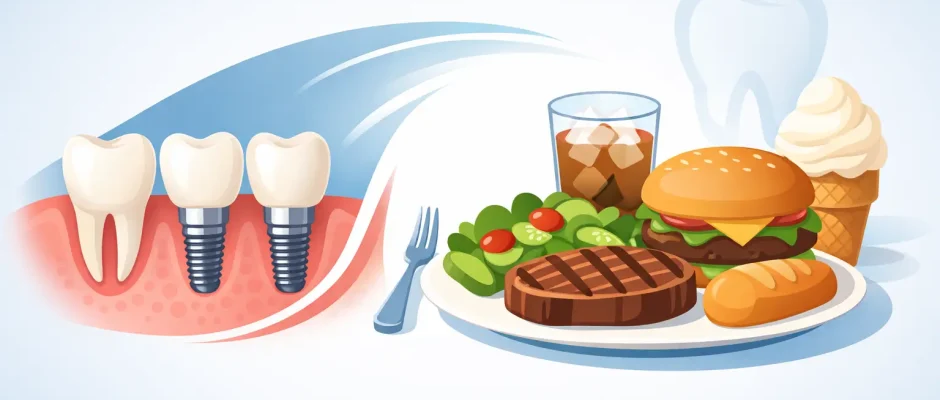
When Can You Eat Normally After Dental Implants?
The question patients usually ask is not about the implant itself. It is about dinner. More specifically: when can you eat normally after dental implants without risking pain, bleeding, or a problem with healing? The honest answer is that most people return to a fairly normal diet within 1 to 2 weeks, but a truly unrestricted diet depends on what was done, how stable the implant is, and whether you already have a crown or are still healing before the final restoration.
That distinction matters. An implant is a titanium fixture placed into bone. It still needs time to integrate with the jaw, even if you feel well after a few days. Feeling normal and chewing without restrictions are not always the same thing.
When can you eat normally after dental implants in real life?
For a straightforward single implant with good primary stability and no major grafting, the first 24 hours are the most restrictive. During that period, a cool, soft diet is the safest approach. Think yogurt, smoothies eaten with a spoon, mashed potatoes, eggs, soft fish, oatmeal at a lukewarm temperature, and soups that are not hot.
By days 2 to 7, many patients can expand their diet, but food should still be soft enough that chewing does not load the surgical site heavily. Pasta, rice, ground meat, soft cooked vegetables, tofu, cottage cheese, and tender chicken are usually reasonable options if they are comfortable.
Around 1 to 2 weeks, many patients feel close to normal. If the gums are calm, swelling is down, and the surgeon confirms healing is on track, a broader diet is often possible. But that does not automatically mean biting into crusty bread, nuts, steak, or raw carrots on the implant side is a good idea.
A more complete answer is this: you can often eat comfortably long before the implant is ready for full chewing forces. If a healing abutment or temporary restoration is present, there may be specific limits even when pain is minimal.
What affects how soon you can eat normally?
The biggest factor is the type of procedure. A single uncomplicated implant is very different from full-arch treatment, immediate implant placement after extraction, or implant surgery combined with bone grafting or a sinus lift.
Simple implant placement
If the implant was placed into healed bone with good stability and without extensive augmentation, recovery is usually faster. Soft foods for several days and cautious chewing for 1 to 2 weeks is typical.
Immediate implant after tooth extraction
This is more technique-sensitive. The implant may be stable, but the tissues around it are also recovering from extraction. In these cases, chewing too aggressively too early can irritate the site and compromise comfort. Patients often need a more careful diet for longer, especially if there was infection, bone loss, or a large extraction socket.
Bone grafting or sinus lift
If grafting was performed, the timeline can become more conservative. The goal is not only gum healing but stable bone regeneration around the implant. Crunchy, hard, or pressure-heavy foods may need to wait longer because the surgical area is doing more biological work.
Full-arch or All-on-4 treatment
This is where patients can be surprised. You may leave surgery with fixed temporary teeth and look functionally restored right away, but the diet is often intentionally restricted. Even with an immediately loaded full-arch prosthesis, the bone-implant interface needs protection during osseointegration. That usually means a soft diet for several weeks, and sometimes longer, depending on the protocol.
The timeline most patients can follow
There is no universal calendar, but this is a practical framework.
First 24 hours
Stick to cool or lukewarm soft foods. Avoid hot food, alcohol, spicy dishes, and anything with seeds or small particles that can get into the wound. Do not chew directly over the surgical site if possible. Also avoid straws, because suction can disturb early clot stability.
Days 2 to 3
You can usually continue with soft foods that require minimal chewing. Swelling often peaks during this window, so choose comfort over ambition. If chewing feels awkward, that is normal.
Days 4 to 7
Most patients can tolerate more texture, but still not hard or brittle foods. If you had sutures, tissue manipulation, or grafting, you may still need to stay cautious. Pain is not the only guide. Some harmful chewing habits do not hurt immediately.
After 1 to 2 weeks
This is the point when many patients ask if they are “done.” Soft tissues are often much better by then, and regular daily eating becomes easier. But if you do not yet have the final crown or bridge, the implant may still need protection from full force. Follow the specific instructions for your restoration stage, not just how you feel.
After final restoration
Once osseointegration is confirmed and the final crown, bridge, or prosthesis is delivered, most patients can return to a normal diet. Even then, normal does not mean careless. Ice chewing, opening packages with teeth, and very hard foods remain risky for natural teeth and implants alike.
Foods that commonly cause trouble
Patients rarely run into problems with soft scrambled eggs. Trouble usually starts with foods that are hard, sticky, sharp, or require strong biting.
Nuts, chips, crusty bread, popcorn, steak, raw apples, raw carrots, tough pizza crust, sticky candy, and seeded foods are the usual offenders. They can either traumatize the soft tissue, become trapped around the site, or generate too much force too early.
Temperature also matters. Very hot foods and drinks can increase discomfort during the early healing phase. That does not mean every meal must be cold, but it is wise to avoid extremes at first.
Why eating “normally” too early can be a mistake
Implants heal in stages. The gum can appear acceptable while the deeper bone integration is still immature. This is why a patient may feel almost back to normal and still be advised not to chew hard on that side.
Micromotion is one concern. An implant needs relative stability while bone cells attach and remodel around its surface. Repeated overload during the wrong phase can interfere with that process. The risk is not the same in every case, which is why precise surgical planning, implant position, primary stability, and prosthetic design all matter.
This is also where a digitally planned approach and controlled surgical protocol make a practical difference. The more predictable the implant position and load management, the clearer the post-op instructions can be.
Signs you should slow down
A little tenderness while returning to a broader diet can be normal. Increasing pain is not. The same applies to new bleeding, a bad taste, swelling that worsens rather than improves, or the sense that something is moving when you chew.
If food consistently packs around the area or a temporary tooth feels high or unstable, it is better to call your surgeon than to keep testing the area. Small adjustments early can prevent bigger problems later.
How to make eating easier during recovery
Patients do best when they prepare for the first week instead of improvising after surgery. Soft protein sources, easy-to-chew carbohydrates, and foods that are gentle but filling make recovery simpler. Eating small meals is often more comfortable than trying to manage a large one when anesthesia has worn off and the area feels tight.
Oral hygiene matters too. Eating is only half the issue. Cleaning the area properly after meals reduces irritation and lowers the chance that food debris will inflame the tissues. Use the exact cleaning protocol your surgeon recommends, especially if sutures, graft material, or a temporary restoration are involved.
A few scenarios patients ask about
If you had one implant and no graft, you may be eating most everyday foods within a week or two, while still avoiding heavy chewing on that side until your surgeon clears it.
If you had multiple implants, grafting, or a sinus lift, expect the timeline to be longer and more individual.
If you have immediate temporary teeth, do not assume that fixed teeth mean unrestricted chewing. In many full-arch cases, the temporary is designed for appearance and function, but within a protected diet.
If you wear a removable temporary denture over the area, food choices matter even more. Pressure from the appliance can irritate healing tissue, so the fit and the diet need to work together.
The answer patients usually need
So, when can you eat normally after dental implants? For many patients, everyday eating becomes much easier after the first week, and a broader diet is possible after 1 to 2 weeks. But full, unrestricted chewing is tied less to the calendar and more to the biology of healing, the presence of grafting, the stability of the implant, and whether the final restoration is already in place.
If you treat the first weeks as part of the surgery rather than an afterthought, you give the implant the best chance to heal quietly and predictably. A careful diet for a short period is a small trade for a stable long-term result.


