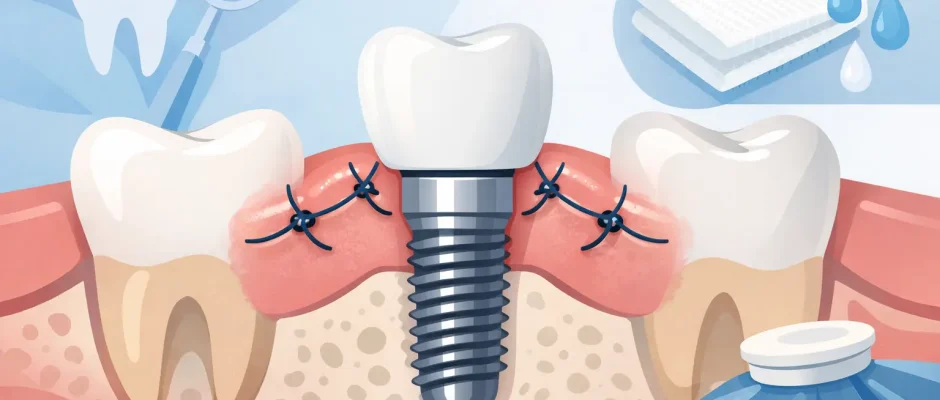
Dental Implant Stitches: What to Expect
The first time patients look in the mirror after implant surgery, the stitches usually get more attention than the implant itself. That is understandable. Dental implant stitches: what to expect is one of the most common questions after surgery, because sutures are visible, unfamiliar, and easy to overthink. In most cases, they are simply part of controlled healing – they hold the gum in the right position, protect the surgical site, and help your tissues close with less tension.
What you should expect depends on the exact procedure. A straightforward implant placed into healthy bone may require only a few small sutures. If the treatment included tooth extraction, bone grafting, guided bone regeneration, or a sinus lift, the stitches may be more noticeable and may stay in place longer. The surgical plan determines the healing pattern.
Why stitches are used after implant surgery
Sutures are not just there to close a hole. In implant dentistry, they help stabilize the soft tissue around the implant, support the blood clot, and protect any grafting material if augmentation was performed. Good suturing is part of good implant surgery. It affects comfort, cleanliness of the wound, and the predictability of healing.
In microsurgical and implant protocols, the goal is not only closure, but controlled closure. The gum should sit in the planned position without excessive pulling. When tissues are handled gently and closed precisely, swelling and irritation are often less pronounced, and the risk of wound opening can be reduced.
That is why two patients can have the same implant placed and a very different experience afterward. Technique matters. Tissue quality matters. Whether PRF, grafting material, or a membrane was used also matters.
Dental implant stitches: what to expect in the first few days
On the day of surgery, the stitched area may look more dramatic than it feels. A small amount of oozing is normal during the first hours. The saliva can appear pink, which often looks worse than it is. Mild to moderate swelling is common, usually peaking around day two or three.
The stitches themselves may feel like thin threads or tiny knots against the cheek or tongue. Some patients barely notice them. Others feel irritation when speaking or chewing, especially if the sutures are placed near a mobile area of the gum. That sensation is usually mechanical rather than a sign of a problem.
Pain is usually described more as soreness or pressure than sharp pain. If bone grafting was done, or if the implant was placed immediately after extraction, the area can feel tighter and more tender. A clean, stable wound with stitches can still feel uncomfortable for several days. That alone does not suggest a complication.
The appearance may also change from day to day. The gum can look white, yellowish, pink, or slightly bruised. A thin white film on the incision line is often part of normal healing, not pus. Patients often confuse healthy fibrin with infection. True infection usually comes with increasing pain, swelling, bad taste, drainage, or fever rather than color change alone.
What kinds of stitches are used
Some sutures dissolve on their own. Others need to be removed by the surgeon. Both options are common in implant dentistry.
Dissolvable stitches often soften and loosen over several days or a couple of weeks. Sometimes they do not fully disappear as neatly as patients expect. A small thread may hang down or detach unevenly. That can feel strange, but it is usually not dangerous.
Non-dissolvable stitches are chosen when the surgeon wants more precise or longer-lasting tissue support. They are often removed at a follow-up visit once the soft tissue is stable enough. Removal is typically quick and much easier than placement.
The type of suture is only one part of the story. Thickness, knot placement, tension, flap design, and the underlying procedure all influence healing. A patient should not judge the quality of surgery by whether the stitches dissolve or need removal.
How long do dental implant stitches stay in?
There is no single answer, and this is where expectations should stay flexible. In a routine case, sutures may be removed in about 7 to 14 days. In more complex surgery, they may stay longer, or different sutures may be used in layers.
If the site involved bone regeneration or membrane coverage, the surgeon may prefer more extended support for the soft tissue. If the tissue is thin or under tension, earlier removal may not be ideal. On the other hand, if a stitch starts trapping plaque or irritating the cheek, the timing may be adjusted.
Patients sometimes worry when a stitch falls out early. If the wound remains closed and there is no bleeding or opening of the gum, that may not be a problem. But if the site starts to separate, feels suddenly more painful, or exposes graft material or metal, it should be checked.
What feels normal, and what does not
Normal healing is not always comfortable, but it is usually steady. The area may feel tight, mildly swollen, and sensitive when eating or brushing nearby teeth. The stitches may pull slightly when you smile or open wide. A little blood on the toothbrush near the surgical site can happen.
What is less normal is worsening pain after the first few days, increasing swelling after day three, persistent active bleeding, foul-smelling drainage, or a bad taste that does not improve. A loose stitch by itself is usually minor. A wound that is opening is more important.
Numbness that lingers beyond the expected anesthetic period should also be reported, especially if it is not gradually improving. The same applies to difficulty swallowing, significant facial swelling, or fever.
Patients often ask whether they should worry if they can see part of the implant. Sometimes they are actually seeing a healing abutment, cover screw, or reflective suture. Sometimes exposure is real. The difference is not always obvious at home. If something looks new or unusual, a follow-up photo or exam is reasonable.
Eating, cleaning, and daily life with stitches
The first rule is simple: do not traumatize the site. Food should be soft and not too hot for the first days. Hard crusts, seeds, chips, and sticky foods can catch on sutures or press directly into the wound. Chewing on the opposite side is often recommended when possible.
Oral hygiene still matters. Patients sometimes avoid cleaning completely because they are afraid of disturbing the stitches. That usually creates more problems, not fewer. The goal is gentle cleaning around the area while following the surgeon’s instructions for rinsing and brushing. A surgical site heals best in a clean mouth.
Do not pull at loose threads with your fingers or tongue. Do not trim them at home unless your surgeon specifically advised how to do so, which is uncommon. Even when a stitch feels annoying, it may still be serving a purpose.
Physical activity also affects the early healing phase. Heavy exercise, bending, and anything that increases blood pressure can worsen throbbing or bleeding during the first day or two. Most patients can return to normal routine quickly, but strenuous activity may need to wait briefly depending on the surgery.
Why stitches sometimes look messy but heal well
Patients often expect sutures to look neat and minimal, almost invisible. In reality, good surgical closure is not a cosmetic performance for the first 48 hours. If tissue was repositioned, thickened, or advanced over a graft, the site can look bulky, uneven, or puckered at first.
This is especially true in cases involving bone loss, immediate implant placement after extraction, or esthetic-zone management where soft tissue architecture is being preserved or rebuilt. Early appearance can be misleading. The more relevant question is whether the tissue is stable, well vascularized, and closing without tension.
That is one reason follow-up visits matter. Experienced implant surgeons are not only checking whether the stitches are still present. They are assessing tissue color, edema, closure quality, plaque control, and whether the healing trajectory matches the original surgical plan.
When to contact your surgeon
A brief question after surgery is not overreacting. It is part of safe care. If bleeding does not slow with pressure, if pain suddenly increases, if swelling becomes asymmetric or severe, or if the stitches appear to have come apart with wound opening, the office should know.
This matters even more in advanced cases such as simultaneous grafting, sinus augmentation, or immediate implant placement in an extraction site. In these situations, what seems like a small soft-tissue issue can influence the stability of the overall result.
For patients treated in a practice focused on surgical dentistry and implantology, follow-up is part of the protocol, not an afterthought. The aim is not just to place an implant, but to guide healing in a controlled way.
Most stitch-related concerns turn out to be normal healing. The value of asking is that normal can be confirmed early, and real problems can be addressed before they become larger ones. A well-informed patient is usually a calmer patient, and calm helps healing too.


