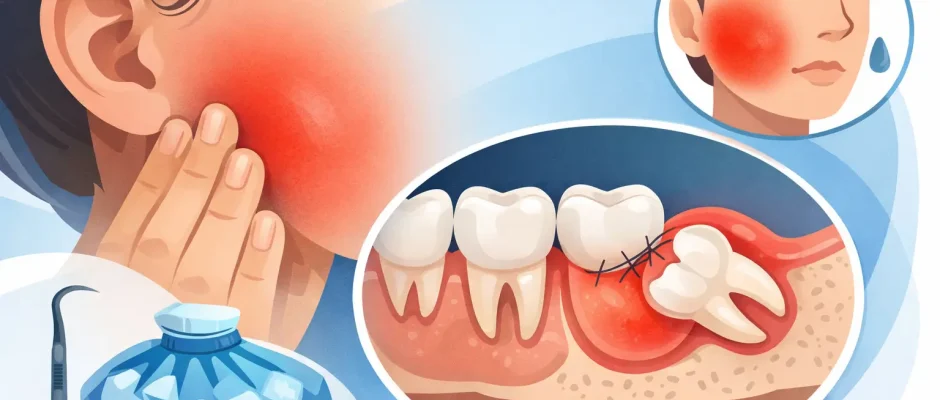
If your cheek looks fuller on day two than it did the evening after extraction, that usually does not mean something went wrong. Wisdom tooth swelling after surgery often peaks later than patients expect, and that delay is one of the most common reasons for post-op anxiety.
Swelling is a normal inflammatory response to surgical trauma. It is the body’s way of bringing fluid, immune cells, and repair factors into the area. After a simple extraction, swelling may be mild. After removal of an impacted lower wisdom tooth, especially when bone removal or sectioning of the tooth was necessary, swelling can be more noticeable and last longer.
Why wisdom tooth swelling after surgery happens
A wisdom tooth extraction is not just removal of a tooth from soft tissue. In many cases, the tooth is partially or fully covered by gum and bone, lies at an angle, or sits close to important anatomical structures. The more surgical access required, the more tissue manipulation occurs, and the stronger the inflammatory response can be.
That does not mean severe swelling is always expected. It depends on the position of the tooth, the duration of the procedure, the amount of bone work needed, your baseline healing response, and whether there was pre-existing infection around the tooth. Patients with recurrent pericoronitis, significant local inflammation, or difficult impactions often swell more than patients whose wisdom teeth are removed in a planned, quiet setting.
Technique also matters. A precise surgical approach, gentle tissue handling, good irrigation, and careful closure help reduce unnecessary trauma. In modern oral surgery, the goal is not only to remove the tooth safely but also to make healing as predictable and comfortable as possible.
What swelling is considered normal
In most cases, swelling begins during the first 24 hours, becomes more obvious on days two and three, and then gradually starts to improve. This pattern is typical. Mild limitation in mouth opening, soreness when swallowing, and a feeling of tightness in the cheek or jaw can happen alongside it.
Many patients expect a straight-line recovery. In reality, the first three days are often the inflammatory phase, not the recovery phase. So if you wake up on day two looking more swollen than on day one, that can still be within the normal range.
The location matters too. Lower wisdom tooth surgery usually causes more swelling than upper wisdom tooth extraction. The angle of the tooth and the depth of impaction matter as well. A deeply impacted lower third molar can produce significant facial swelling even when the surgery itself went well.
Bruising may also appear. Some patients notice yellow, blue, or green discoloration near the jawline or down the neck a few days later. That can look dramatic, but by itself it is usually not dangerous.
When swelling may be a warning sign
Normal swelling should peak and then begin to settle. If swelling continues to increase after day three, or improves and then suddenly worsens again, that deserves attention. The same applies if the area becomes progressively harder, hotter, or more painful.
You should contact your surgeon promptly if swelling is accompanied by fever, pus or a bad-tasting discharge, difficulty breathing, trouble swallowing liquids, or inability to open the mouth that is getting worse instead of better. These findings may suggest infection, a collection of fluid, or another complication that needs examination.
Not every post-op problem is infection. Dry socket, for example, is usually defined more by pain than by major swelling. Patients often feel a deep, radiating ache several days after extraction, with little visible swelling. Infection is more likely when pain and swelling are both escalating, especially with fever or drainage.
This is why timing matters. Swelling on day two is often expected. New swelling on day six is a different conversation.
How to reduce swelling in the first 72 hours
The first three days matter most. Cold application is useful early because it helps limit the inflammatory response in superficial tissues. An ice pack wrapped in cloth can be applied to the cheek for 15 to 20 minutes on and 15 to 20 minutes off during the first 24 to 48 hours.
After that window, ice usually helps less. Some patients feel better switching to gentle warmth after 48 to 72 hours, especially if jaw stiffness becomes more bothersome than visible swelling. Warmth should be mild, not intense.
Head elevation also helps. Sleeping with the head slightly raised can reduce fluid accumulation in the face. Keeping the head flat immediately after surgery may make morning swelling more pronounced.
Medication should be taken exactly as prescribed. Anti-inflammatory medication is often more effective when started on schedule rather than waiting for pain and swelling to build. If your surgeon prescribed antibiotics, they are not a substitute for proper local healing, but they should be taken as directed when indicated.
Hydration matters more than many patients realize. If you are barely drinking because the area feels tender, swelling and discomfort can seem worse. Soft foods are fine, but try to maintain normal fluid intake.
Common mistakes that make swelling worse
The most frequent mistake is heat too early. Patients often apply a warm compress on the first day because it feels soothing, but early heat can increase blood flow and make swelling more pronounced.
Another issue is overexertion. Heavy exercise, bending, lifting, and long days in the sun can increase bleeding and swelling, especially during the first 48 to 72 hours. Returning to normal activity too quickly is one of the most predictable ways to turn mild swelling into moderate swelling.
Smoking and vaping impair healing and increase the risk of complications. Suction from straws can also disturb the clot in the extraction site. Neither directly causes every case of swelling, but both can make the post-operative course less stable.
Skipping oral hygiene is another problem. Patients are often afraid to clean near the area and end up allowing plaque and food debris to accumulate. The solution is not aggressive brushing. It is careful, guided hygiene, usually including gentle rinsing when your surgeon says it is safe to begin.
How long does swelling usually last?
For many patients, visible swelling starts improving after day three and is substantially better within five to seven days. Residual puffiness can last longer after difficult lower wisdom tooth surgery. Minor firmness in the cheek or tenderness in the jaw muscles may persist for a week or two.
That said, recovery is not identical for every patient. A healthy 28-year-old with a straightforward extraction may look nearly normal within a few days. A patient with a deeply impacted tooth, dense bone, limited mouth opening before surgery, or pre-existing inflammation may need longer.
Age can influence healing as well. In general, younger patients tend to recover faster after third molar removal. But surgical difficulty often matters more than age alone.
What your surgeon evaluates if swelling seems excessive
If you come in with concerning swelling, the examination is not limited to looking at your cheek. Your surgeon will assess the extraction site, the quality of the clot, mouth opening, the floor of the mouth, swallowing, temperature, lymph nodes, and whether there is fluctuation that suggests a fluid collection.
Sometimes the problem is local irritation and food retention. Sometimes it is infection. Sometimes it is simply a normal but stronger-than-average inflammatory response after a difficult procedure. Management depends on the cause, which is why self-diagnosis based on online photos is unreliable.
In a surgical practice focused on predictable healing, post-op planning is part of the treatment, not an afterthought. Clear instructions, the right medications, and scheduled follow-up reduce unnecessary complications and help distinguish normal healing from a true problem early.
A practical timeline for patients
On the day of surgery, bleeding control and clot protection matter most. During days one to three, swelling often increases and then reaches its peak. From days three to five, most patients should notice a gradual turn in the right direction. By one week, swelling should be clearly better, even if the area is not fully back to normal.
If your course does not follow that pattern, it does not automatically mean something serious is happening, but it does mean the surgeon who performed the extraction should know. That is especially true after complex wisdom tooth removal, where anatomy, surgical access, and tissue response can vary significantly.
A final thought: after oral surgery, patients do best when they watch the trend, not just the mirror. Swelling that follows the expected timeline is usually part of healing. Swelling that changes direction, intensifies late, or comes with fever or worsening function should be checked without delay.


