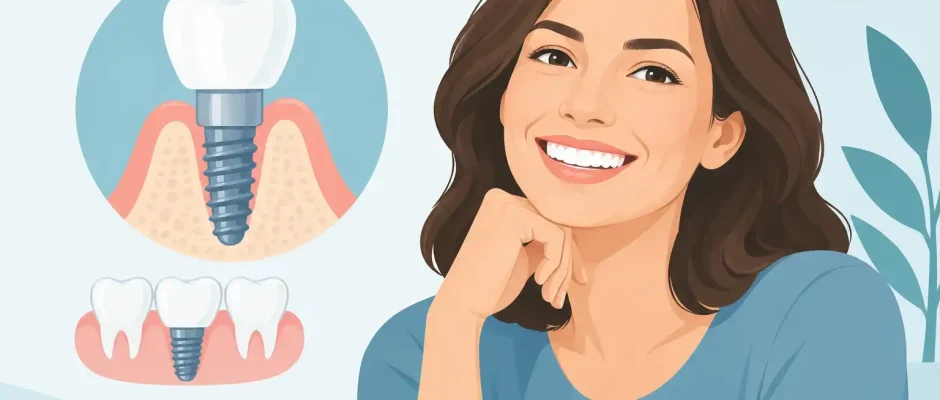
Dental Implants for a Fixed, Confident Smile
A missing tooth is rarely only a cosmetic concern. It can change how you chew, affect speech, allow nearby teeth to shift, and gradually reduce the bone volume in the jaw. Dental implants are designed to address the root of that problem by replacing the tooth root, not merely covering the gap. For many patients, they offer the closest functional alternative to a natural tooth, provided that treatment is planned around the individual anatomy and health condition.
The right result begins well before surgery. It requires accurate diagnostics, a clear understanding of bone and gum conditions, and coordination with the restorative dentist who will create the final crown or bridge. This is especially important when an implant is placed in the smile zone, after a difficult extraction, or in an area with limited bone.
What Dental Implants Actually Replace
A dental implant is a small titanium fixture placed into the jawbone. Over time, bone bonds with its surface in a process called osseointegration. Once the implant is stable, it can support an abutment and a custom crown, or become part of a bridge or fixed full-arch restoration.
The implant itself is not the visible tooth. A complete restoration has several parts: the implant in bone, the connecting abutment, and the crown or prosthesis above the gum line. Each component matters. Implant position influences the shape of the future crown, the contour of the gum tissue, access for hygiene, and how forces are distributed during chewing.
This is why placing an implant simply where a tooth once stood is not always enough. A predictable plan starts with the final tooth position and works backward to determine the safest and most prosthetically correct implant position.
Who Is a Candidate for Implant Treatment?
Many adults can be candidates for implants, including people who have lost one tooth, several teeth, or an entire arch. Age alone is rarely the deciding factor. More relevant questions are whether the gums are healthy, whether there is enough bone for stable placement, how the bite functions, and whether systemic conditions are well controlled.
Smoking, untreated periodontal disease, poorly controlled diabetes, active infection, severe grinding, and certain medications can increase risk or alter the treatment plan. They do not automatically rule out treatment, but they require an honest clinical assessment. A safe plan may involve stabilizing gum disease first, adjusting hygiene habits, using a protective night guard, or coordinating care with the patient’s physician.
When Bone Is Not Sufficient
Bone naturally remodels after a tooth is removed. The longer a gap remains, the more likely the ridge is to become narrower or shorter. In the upper back jaw, the maxillary sinus may also limit the available bone height.
These situations are common and often treatable. Depending on the anatomy, preparation may include guided bone regeneration with grafting material and a membrane, a sinus lift, or placement of the implant in a different position or at a different stage. PRF, prepared from the patient’s own blood, may be used to support soft-tissue healing and regenerative procedures where clinically appropriate.
The choice is not always between a simple implant and a major procedure. Sometimes a short period of healing after extraction preserves more options. In other cases, immediate implantation can help maintain the bone and soft-tissue contours. The decision depends on the quality of the socket walls, the presence of infection, the thickness of the gums, and the ability to obtain primary stability.
Dental Implants Begin With Digital Planning
A three-dimensional CBCT scan allows the surgeon to assess bone volume, neighboring roots, the sinus, and important anatomical structures such as the mandibular nerve. Combined with an intraoral scan or digital model, it helps create a plan that is based on millimeters rather than assumptions.
For selected cases, a surgical guide transfers that digital plan to the clinical procedure. The guide can help control the position, angle, and depth of implant placement. It is particularly valuable when space is limited, several implants are being placed, or the final restoration requires precise positioning.
Technology does not replace surgical judgment. A guide is only as reliable as the diagnostics, the digital design, and the way it is used during surgery. However, when integrated into a disciplined protocol, it can improve precision and make treatment more predictable for the patient.
Immediate or Delayed Placement: Which Is Better?
Immediate implantation means placing the implant during the same appointment as tooth extraction. It can reduce the total number of surgical stages and, in carefully selected cases, may help preserve tissue contours. It is not automatically the best choice simply because it is faster.
Immediate placement requires adequate bone around the extraction socket, a stable implant position, and proper management of the gap between implant and socket walls. When active infection, major bone loss, thin soft tissue, or insufficient initial stability is present, a staged approach may be safer.
Delayed placement allows the site to heal after extraction and, if necessary, after bone grafting. This can lengthen treatment, but it may provide a more controlled foundation in complex cases. A good treatment plan explains not only what is recommended, but why a particular timeline protects the long-term result.
What Surgery and Recovery Usually Involve
Implant surgery is generally performed under local anesthesia. For patients with significant anxiety or complex surgical needs, additional sedation options may be discussed according to the clinic setting and medical indications. During the procedure, the implant site is prepared carefully, the implant is inserted, and the gum tissue is sutured when needed.
Most patients describe the recovery as manageable, with swelling and tenderness being most noticeable during the first several days. The extent of recovery depends on the procedure. Placing one implant in healthy bone is different from performing extraction, bone augmentation, sinus lifting, and multiple implant placement in the same visit.
Clear postoperative instructions are part of treatment, not an afterthought. They typically address medication, gentle hygiene, food texture, physical activity, and follow-up visits. Patients should contact the surgical team promptly if they experience increasing pain after initial improvement, persistent bleeding, fever, swelling that worsens, or changes in sensation.
Osseointegration takes time. In many cases, the final crown is placed after several months of healing, although temporary teeth may be possible during this period. Loading an implant too early without the necessary stability can compromise a result that would otherwise have had an excellent prognosis.
Replacing Several Teeth or a Full Arch
For several missing teeth, implants can support a fixed bridge without preparing healthy neighboring teeth. For patients missing all teeth in one jaw, a fixed full-arch solution may be planned with a limited number of strategically positioned implants. Concepts such as All-on-4 can be effective in suitable cases, particularly when posterior bone is limited.
The number and location of implants should not be chosen from a marketing formula. Bone quality, bite forces, the design of the prosthesis, hygiene access, and facial and smile support all influence the plan. A fixed bridge can feel life-changing, but it still needs daily cleaning beneath the restoration and periodic professional maintenance.
How Long Do Implants Last?
Implants can serve for many years, but they are not maintenance-free. Their long-term health depends on stable bone, healthy gums, accurate bite adjustment, and consistent home care. Brushing alone may not clean the areas around bridges and implant-supported restorations, so interdental brushes, flossing aids, or water irrigation may be recommended based on the prosthesis design.
Regular reviews allow the clinician to assess the gum tissues, bite, restoration screws, and bone levels before small problems become larger ones. The crown or bridge may eventually need repair or replacement because it is exposed to daily chewing forces. That does not necessarily mean the implant itself has failed.
For patients considering treatment in Tel Aviv, the most useful first step is a consultation built around diagnostics and a written sequence of care. The goal is not to rush toward surgery. It is to determine whether implants are the right solution, what preparation is needed, and how to create a restoration that is comfortable to use and realistic to maintain for years.


