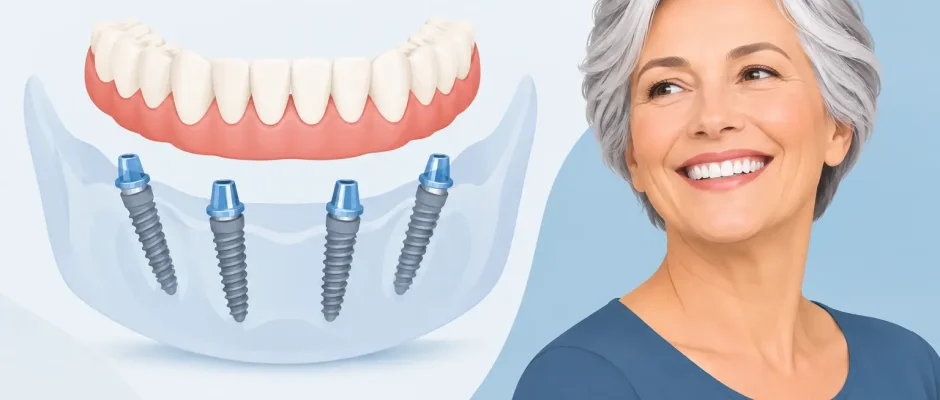
A removable denture that shifts while speaking or makes eating stressful is more than an inconvenience. For many patients, it changes how they socialize, smile, and choose food. All on four is a full-arch implant approach designed to replace all teeth in one jaw with a fixed bridge supported by four strategically placed implants. It can be an effective solution, but it is not a shortcut and it is not the right protocol for every patient.
The quality of the result depends less on the number four and more on careful diagnosis: bone volume, bite, gum condition, medical history, facial anatomy, and the design of the final teeth all matter. A predictable treatment plan begins before any tooth is removed.
What does All on Four treatment involve?
The concept is straightforward. Two implants are commonly placed in the front part of the jaw, where bone is often denser and more stable. Two posterior implants are placed at an angle to use available bone efficiently and avoid important anatomical structures, such as the maxillary sinus in the upper jaw or the nerve canal in the lower jaw.
A fixed provisional bridge may be attached on the day of surgery or shortly afterward, provided that implant stability, bite control, and the patient’s clinical situation allow it. This is often called immediate loading. It means the patient does not leave without teeth, but it does not mean that the final bridge is completed in one day.
During the healing phase, implants integrate with the bone. The provisional bridge must be treated as a healing device as well as a temporary set of teeth. After the tissues stabilize, the final prosthesis is designed with attention to speech, facial support, hygiene access, bite forces, and esthetics.
Who may be a candidate for All on Four?
This treatment is most often considered when a patient has no teeth in one jaw, has failing teeth that cannot be predictably restored, or relies on a removable full denture and wants a fixed alternative. It can also be useful when posterior bone loss would otherwise require more extensive grafting before conventional implant placement.
However, candidacy cannot be decided from a panoramic X-ray alone. A 3D CBCT scan and a clinical examination are essential. The clinician evaluates the amount and quality of bone, the position of the sinuses and nerves, gum inflammation, the opposing teeth, jaw relationship, and the forces created by clenching or grinding.
Certain conditions require additional preparation rather than excluding treatment automatically. Active periodontal infection must be controlled. Smoking increases the risk of impaired healing and long-term complications. Uncontrolled diabetes, some medications affecting bone metabolism, and a history of head and neck radiation require a more individualized medical assessment. Patients with severe grinding may need a reinforced final prosthesis and consistent use of a night guard.
The key question is not, “Can four implants be placed?” It is, “Will this design provide a safe, maintainable, long-lasting restoration for this individual patient?”
Why digital planning matters
Full-arch surgery requires precise coordination between surgical and prosthetic planning. Implant position should be planned not only according to where bone is present, but also according to where the future teeth need support. An implant placed in available bone but outside the ideal prosthetic position can complicate hygiene, esthetics, bite, and the strength of the bridge.
Digital records may include CBCT imaging, intraoral scans or conventional impressions, photographs, bite records, and a diagnostic tooth setup. Together, these records allow the team to plan the relationship between the jawbone, implants, gums, lips, and future teeth.
When clinically appropriate, a surgical guide can transfer the digital plan to the mouth with greater precision. It does not replace surgical judgment. It helps the surgeon execute a well-designed plan, while allowing adjustments if the clinical situation differs from what imaging predicted.
For patients with infected or failing teeth, the plan may include atraumatic extraction, thorough cleaning of the sockets, implant placement, grafting in selected areas, and use of PRF when indicated. PRF is created from the patient’s own blood and can support soft-tissue and bone healing as part of a broader surgical protocol. It is not a substitute for sound implant positioning or infection control.
The day of surgery and the first weeks
Treatment is performed under local anesthesia, with additional anxiety-management options discussed individually when appropriate. If remaining teeth must be removed, the goal is to preserve bone and soft tissue wherever possible while eliminating infection and unstable teeth.
After implant placement, primary stability is measured. This step is critical because an immediate fixed bridge is appropriate only when the implants can safely support it. If stability is inadequate or the bone quality is unfavorable, a different temporary solution may be safer. Changing the plan in that situation is not a failure. It is a decision made to protect the final outcome.
The first weeks require discipline. Even with a fixed provisional bridge, patients are usually asked to follow a soft diet and avoid heavy chewing. The implants are healing beneath the bridge, and excessive force can interfere with integration. Mild swelling, bruising, and temporary speech changes are possible. Clear postoperative instructions, prescribed medication when needed, and scheduled follow-up visits help make recovery calmer and more controlled.
All on Four vs. more implants or bone grafting
All on Four is one full-arch strategy, not a universal standard. In some cases, four implants provide adequate support for a carefully designed bridge. In others, placing five or six implants may improve load distribution, especially in the upper jaw where bone is often less dense. The number of implants should follow the clinical plan, not a marketing formula.
Angled posterior implants can reduce the need for sinus lift procedures or large bone grafts, which may shorten treatment and limit surgical stages. That advantage is meaningful for the right patient. Yet severe bone loss, unfavorable anatomy, or a desire for a different prosthetic design may still make bone regeneration the better choice.
There is also a difference between a fixed bridge and an implant-supported removable overdenture. An overdenture can be easier to clean and may be a more practical or cost-conscious option for some patients. A fixed bridge usually feels closer to natural teeth, but it requires precise daily hygiene beneath the prosthesis and professional maintenance.
What affects the long-term result?
The surgery is only one stage of full-arch rehabilitation. Long-term success depends on the health of the tissues around the implants, the accuracy of the bite, the materials used, and the patient’s maintenance routine. Implants do not develop cavities, but they can develop inflammatory disease around the implant if plaque accumulates or cleaning is inadequate.
Daily home care typically includes a water flosser or oral irrigator, specialized brushes, and cleaning under the bridge as instructed. Professional hygiene visits are necessary because the bridge design has areas that cannot be fully assessed at home. At maintenance appointments, the team evaluates gum health, implant stability, bite changes, screws, bridge wear, and the condition of the opposing teeth.
The final bridge material is selected according to function, esthetic expectations, available restorative space, and bite forces. Zirconia, ceramic, acrylic-based, and hybrid designs each have benefits and limitations. A highly esthetic material may not be ideal in every high-force situation. A good plan balances appearance with repairability and strength.
Questions worth asking at your consultation
A focused consultation should give you more than a price range. Ask whether immediate loading is expected in your case and what would change that decision. Ask how the final bridge will be designed, what temporary option is available if same-day fixation is not safe, and how hygiene access will be created.
It is also reasonable to ask about the surgeon’s approach to complications, follow-up schedule, and collaboration with the restorative dentist or prosthodontist. Full-arch treatment succeeds when surgery and prosthetics are planned as one process, not as separate procedures.
For patients considering treatment in Tel Aviv, Dr. Artem Naymushin approaches complex implant cases with 3D diagnostics, surgical planning, and attention to the healing period that follows surgery. The objective is not simply to place implants quickly. It is to create a stable foundation for teeth that feel secure and can be maintained over time.
A well-planned full-arch restoration should give you clarity before it gives you new teeth. When you understand the surgical steps, the provisional phase, and the responsibilities after treatment, you can make a decision based on safety and long-term function rather than urgency alone.


