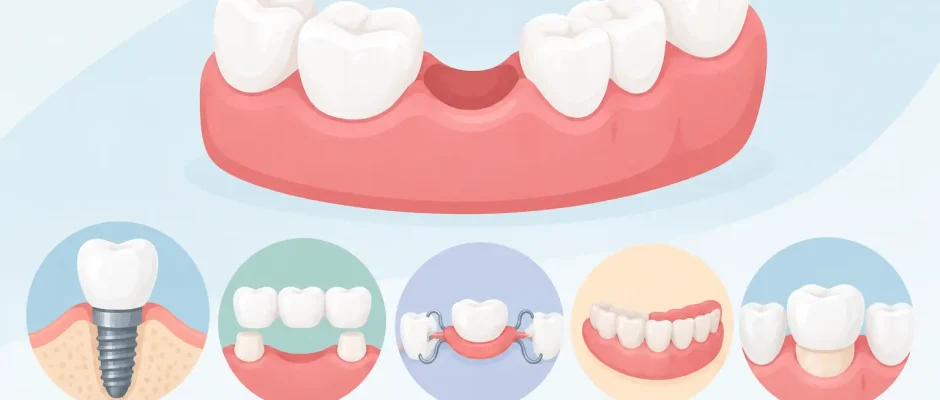
A missing molar may not be visible when you smile, but it carries a large share of the work of chewing. When a back tooth is lost, the teeth beside it can drift, the opposing tooth may over-erupt, and the jawbone in that area gradually loses volume. The best ways to replace molars depend on where the tooth was located, the condition of the neighboring teeth, available bone, bite forces, and your overall health.
For many patients, the right goal is not simply to fill a space. It is to restore stable chewing, protect the bite, and create a result that can be cleaned and maintained for years. That requires proper diagnosis before choosing a treatment.
Why replacing a molar deserves a careful plan
Molars are built to tolerate significant vertical and lateral forces. A restoration that works well for a front tooth may not be the best solution in the back of the mouth, where chewing pressure is highest. The treatment must also account for gum health, nighttime grinding, the position of the sinus in the upper jaw, and the mandibular nerve in the lower jaw.
A clinical examination and three-dimensional imaging help determine whether an implant can be placed safely, whether bone augmentation is needed, and whether the adjacent teeth would benefit from or be harmed by a bridge. Digital planning is particularly useful for posterior implants because it allows the surgeon to evaluate available bone in relation to important anatomical structures before treatment begins.
Timing matters as well. After an extraction, bone remodeling begins quickly. In selected cases, an implant can be placed at the time of extraction. In others, preserving the socket with bone graft material, allowing healing, and placing the implant later is the more predictable choice. Immediate treatment is not automatically better – it must be justified by the condition of the socket, infection status, gum tissue, and ability to achieve implant stability.
The best ways to replace molars
A single dental implant and crown
For a single missing molar, an implant-supported crown is often the most conservative fixed option. The implant replaces the root inside the jawbone, and a custom crown restores the chewing surface above the gumline. Because it stands independently, the neighboring teeth do not need to be filed down for a bridge.
This option is especially valuable when the adjacent teeth are healthy. It can provide excellent chewing function and helps maintain bone stimulation in the area of the missing root. A correctly designed molar crown must have appropriate contact points and bite contours, so it distributes force without overloading the implant or opposing teeth.
The process usually includes diagnostic imaging, surgical placement, a healing period, and final restoration by the restorative dentist. When anatomy and tissue conditions allow, guided surgery with a surgical template can improve the precision of implant positioning. PRF, made from the patient’s own blood, may also be used in appropriate surgical situations to support soft-tissue and bone healing.
An implant is not maintenance-free. It requires daily cleaning around the crown and regular professional examinations. Patients with untreated gum disease, poorly controlled diabetes, heavy smoking habits, or severe clenching need an individualized plan to reduce complications.
Implant-supported bridge for two or more missing molars
When several adjacent back teeth are missing, separate implants are not always necessary. In some cases, two implants can support a bridge replacing three teeth. This approach can reduce the number of surgical sites while still providing a fixed restoration and distributing chewing load effectively.
The design depends on the length of the missing segment, bone quality, available space, and bite. A long bridge supported by too few implants can be exposed to excessive mechanical stress, especially in patients who grind their teeth. Conversely, placing more implants than necessary is not automatically beneficial. The aim is a biologically sound, cleanable, and durable design.
For patients missing molars on both sides or throughout the jaw, a full-arch solution such as All-on-4 may be considered. This is a different clinical situation from replacing one tooth and requires detailed planning of the entire bite, bone volume, smile line, and hygiene access.
A traditional fixed dental bridge
A traditional bridge replaces the missing molar by placing crowns on the teeth next to the gap, with an artificial tooth between them. It may be a sensible option when those neighboring teeth already have large fillings, existing crowns, fractures, or a need for full-coverage restoration.
Its main advantage is that it can avoid implant surgery and may be completed in a shorter overall timeframe. However, the supporting teeth must be prepared, even if they are otherwise healthy. The bridge also does not prevent bone loss beneath the missing tooth area because no root-like structure is present in the bone.
A bridge may be preferable if medical factors make surgery unsuitable, if bone augmentation would be extensive, or if the patient has specific time or budget constraints. It is a valid treatment when planned carefully, rather than a second-choice solution by default.
A removable partial denture
A removable partial denture can replace one or several molars with a prosthesis that is taken out for cleaning. It is generally less invasive and often less expensive at the beginning than fixed treatment. For patients who need to replace multiple teeth quickly or are not candidates for surgery, it can restore basic chewing ability and appearance.
The trade-off is stability. A removable appliance may move slightly during eating, feel bulkier than fixed teeth, and place pressure on gums or supporting teeth. Clasps can be visible depending on the design. It also does not preserve bone in the same way as an implant.
A well-made partial denture remains a useful clinical tool, particularly as an interim restoration during healing or as a long-term option when fixed treatment is not appropriate. Its success depends on fit, hygiene, and regular adjustments as oral tissues change over time.
Choosing not to replace a molar
Not every missing molar requires replacement. This is most commonly considered for a last molar, especially if the patient has stable chewing contacts, no opposing tooth likely to shift, and no functional complaint. Some people adapt well to a shortened dental arch.
But leaving a space should be an informed decision, not an assumption that back teeth do not matter. The risks vary: neighboring teeth can tip into the gap, food can become trapped, the bite can change, and the opposing tooth can move out of position. A dentist should assess the whole arch before recommending observation alone.
When bone grafting or a sinus lift is needed
A missing upper molar can present a particular challenge because the maxillary sinus sits above the roots. If bone height is limited, a sinus lift may create the space needed for stable implant placement. In the lower jaw, the location of the mandibular nerve requires equally careful three-dimensional assessment.
Bone loss does not rule out implants. Guided bone regeneration can rebuild selected defects using graft materials and membranes. The treatment may be performed at the time of implant placement or as a separate stage, depending on the size and shape of the defect and the desired predictability.
These procedures add time and cost, but they can make it possible to place an implant in a prosthetically correct position rather than compromising the final crown design. In surgical dentistry, the shortest path is not always the safest path.
How to choose the right molar replacement
The decision should start with a diagnosis, not with a preferred product. Your clinician should evaluate the remaining teeth, gums, bite, bone volume, medical history, habits such as clenching or smoking, and your expectations about fixed versus removable treatment.
Ask whether the proposed restoration can be cleaned easily, how it will affect the neighboring teeth, whether bone preservation is possible, and what maintenance it will require. You should also understand the treatment sequence: extraction, socket preservation if needed, implant surgery, healing, temporary restoration, final crown, and follow-up care.
For patients with complex anatomy, previous failed treatment, bone deficiency, or a strong fear of surgery, a clear staged plan can make treatment feel far more manageable. At Implantolog.co.il in Tel Aviv, planning is based on clinical examination and digital imaging, with the surgical approach selected for safety and long-term function rather than speed alone.
A missing molar is rarely an emergency, but postponing the decision for years can limit future options. A focused consultation can clarify what is possible now, what can wait, and which solution best protects your ability to chew comfortably for the long term.


