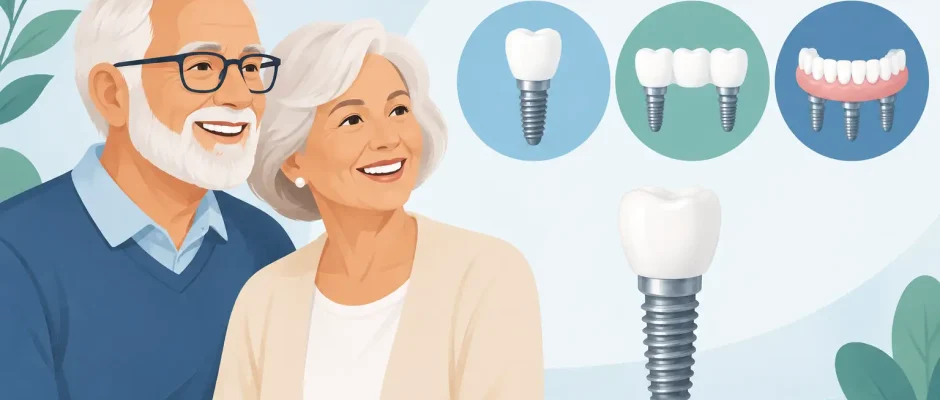
Age does not determine whether dental implants are appropriate. Overall health, bone anatomy, oral hygiene, medications, and the specific restoration goal matter far more. The best implant options for seniors are therefore not one standard treatment, but a carefully planned choice between replacing one tooth, stabilizing a denture, or rebuilding an entire arch.
For many older patients, the real priority is not simply having teeth that look better. It is being able to chew comfortably, speak without worrying about a denture moving, and avoid repeated repairs. A predictable result begins with diagnosis: a clinical examination, 3D imaging when indicated, assessment of the gums and bite, and a review of medical history.
Are Dental Implants Safe for Older Adults?
There is no upper age limit for implant treatment. Patients in their seventies and eighties can be suitable candidates when their medical condition is stable and the treatment plan respects their healing capacity. The question is not “Am I too old for implants?” but “What level of surgery and restoration is appropriate for me?”
Certain conditions require closer coordination with the patient’s physician. These include uncontrolled diabetes, active cancer treatment, significant immune suppression, previous radiation therapy to the jaws, and use of some antiresorptive medications prescribed for osteoporosis or bone metastases. Such factors do not automatically rule out treatment, but they can change the timing, surgical technique, or preferred alternative.
Smoking, untreated gum disease, and poor plaque control also increase the risk of complications around implants. A responsible plan addresses these issues before surgery rather than treating implants as a shortcut around them.
Best Implant Options for Seniors by Clinical Need
A Single Implant for One Missing Tooth
When one tooth is missing and the neighboring teeth are healthy, a single implant with a crown is often the most conservative fixed option. Unlike a conventional bridge, it does not require preparing the teeth on either side of the gap.
This option can work very well in later life if there is enough bone for stable implant placement and the patient can maintain daily cleaning around the crown. In some cases, an implant can be placed at the time of extraction. Immediate placement is not suitable for every tooth or every infection pattern, but when anatomy and soft tissues permit it, it may reduce the number of surgical stages.
An Implant-Supported Bridge for Several Missing Teeth
When two or more adjacent teeth are missing, two implants may support a bridge rather than replacing every lost tooth with a separate implant. This can reduce surgical complexity and cost while providing a fixed restoration.
The design depends on the available bone, the force of the bite, and the location in the mouth. Back teeth carry greater chewing load, so the number, diameter, and position of implants must be planned with care. A bridge that looks good but overloads the implants is not a durable solution.
Two-Implant Overdenture for a Loose Lower Denture
For a patient whose lower removable denture lifts, rotates, or causes discomfort while eating, two implants supporting an overdenture can be life-changing. The denture remains removable for cleaning, but it snaps onto attachments and becomes far more stable than a conventional lower denture.
This is often one of the most practical solutions for seniors who want improved function without the cost and maintenance demands of a full fixed bridge. It requires fewer implants and is generally less invasive than full-arch rehabilitation. The trade-off is that the denture must still be removed daily, and attachment components need periodic maintenance.
Four or More Implants for a Fixed Full Arch
Patients who have lost most or all teeth in one jaw, or whose remaining teeth cannot be predictably saved, may consider a fixed full-arch restoration. Concepts commonly known as All-on-4 use strategically angled implants to support a full bridge, often avoiding some anatomical limitations in the back of the jaw.
A fixed full arch can offer strong chewing efficiency and the feeling of non-removable teeth. However, it is not automatically the best answer for every patient. It requires careful assessment of bone volume, bite forces, gum display, hygiene ability, and the condition of any remaining teeth. In many cases, six implants offer additional support, particularly in the upper jaw or when bone quality is reduced.
A provisional fixed bridge may sometimes be placed shortly after surgery, but immediate loading depends on achieving excellent implant stability and controlling the bite. When those conditions are not present, a staged approach is safer. The goal is not to promise teeth in a day at any cost. The goal is to protect long-term implant integration and the final result.
Bone Loss Does Not Always Eliminate Implant Treatment
Bone resorption is common after teeth have been missing for years, especially under removable dentures. It may make standard implant placement more complex, but it does not necessarily mean implants are impossible.
3D imaging allows the surgeon to evaluate bone width, height, density, sinus position in the upper jaw, and the course of the mandibular nerve in the lower jaw. Based on this information, treatment may include guided bone regeneration, bone grafting, sinus lift surgery, or use of implants in positions that make better use of available bone.
Each option has a trade-off. Bone augmentation can create a better foundation for ideal implant placement, but it adds healing time and another surgical stage. Tilted implants in a full-arch plan may avoid grafting in selected cases, but they require precise prosthetic planning. Shorter implants may be reasonable in some situations, yet not when the planned bite or bone quality creates excessive load.
Modern digital planning and surgical guides can improve accuracy by transferring a virtual plan to the clinical procedure. They are valuable tools, not substitutes for surgical judgment. In complex cases, the final decision should be based on the scan, the restorative plan, and the patient’s health priorities together.
Choosing Between Fixed Teeth and a Removable Solution
A fixed bridge is attractive because it does not come out at night. Yet removable implant overdentures remain an excellent treatment choice for many seniors. They can be easier to clean, simpler to repair, and less costly to maintain over time.
The right decision often comes down to hand dexterity, hygiene habits, budget, bone anatomy, and expectations. A patient with arthritis or reduced vision may find cleaning beneath a fixed full-arch bridge challenging without assistance. Conversely, a patient who has struggled for years with a mobile denture may value the stability of a fixed restoration enough to accept a more involved treatment process.
Patients should also ask what future maintenance will involve. Implant crowns, bridges, attachments, and dentures are durable, but not maintenance-free. Professional checkups, periodic X-rays, hygiene visits, and occasional replacement of wear components protect the investment and help detect inflammation early.
What a Safe Treatment Plan Should Include
A treatment recommendation should be more than a list of implants and prices. It should explain why a particular number and position of implants is being proposed, what type of final restoration is planned, and whether temporary teeth will be fixed or removable during healing.
For complex cases, the plan should also address extraction of failing teeth, infection control, gum condition, bone reconstruction if needed, and the timeline to the final prosthesis. PRF, made from the patient’s own blood, may be used in selected surgical procedures to support soft-tissue healing and graft management. It is an adjunct to sound technique, not a guarantee of faster or perfect healing.
At Implantolog.co.il, complex implant treatment is planned as a surgical and restorative process rather than a single procedure. Digital diagnostics, microsurgical principles, and clear postoperative follow-up help reduce uncertainty for patients who may already feel anxious about dental surgery.
Questions Worth Asking Before You Decide
Before committing to treatment, ask whether the proposed plan is fixed or removable, how many implants are needed and why, whether bone grafting is necessary, and what temporary solution will be used. Ask about the expected healing stages, cleaning requirements, follow-up visits, and the long-term maintenance costs.
It is also reasonable to ask what happens if an implant does not integrate or if the final bite needs adjustment. A clinician should be able to discuss risks plainly and explain how complications are prevented and managed.
The best choice is the one that gives you reliable function without asking your body, budget, or daily routine to do more than is realistic. With accurate diagnostics and a plan tailored to the individual, implant treatment can remain a comfortable and worthwhile option well beyond retirement age.


