A missing tooth changes more than a smile. The teeth beside the gap can drift, chewing becomes less balanced, and the bone in the area gradually loses stimulation. When patients compare implants versus bridges, the right answer is rarely a matter of choosing the newest or quickest option. It is a clinical decision based on the condition of the neighboring teeth, bone volume, bite forces, general health, and the result you want to preserve over time.
Both methods can restore function and appearance. The difference is in how they do it, what they ask of the surrounding teeth, and what future treatment may look like.
Implants versus bridges: the core difference
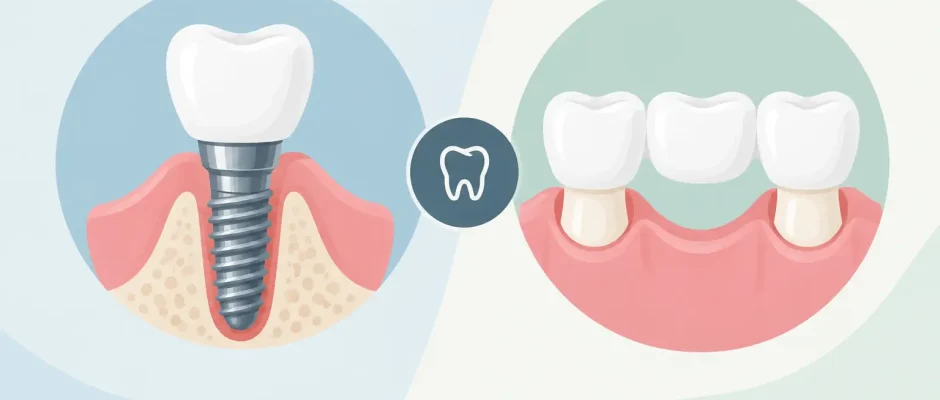
A conventional dental bridge replaces a missing tooth by connecting an artificial tooth, called a pontic, to crowns placed on the teeth next to the gap. Those supporting teeth must be reshaped to make room for the crowns. A bridge is fixed in place, so it does not come out for cleaning, but the area beneath the pontic requires careful hygiene.
A dental implant replaces the root as well as the visible tooth. A titanium implant is placed in the jawbone, where it integrates with the bone during healing. After that, it supports an individual crown. The adjacent teeth are usually left untouched.
That structural difference matters. A bridge uses existing teeth for support. An implant creates independent support in the bone. Neither is automatically better for every person, but one may be clearly more appropriate in a specific clinical situation.
When a dental implant is often the preferred option
An implant is frequently recommended when the teeth next to the missing space are healthy or have only small restorations. Preparing healthy teeth for a bridge means removing enamel and dentin that cannot be replaced later. With an implant, those teeth remain intact.
Implants also help preserve the jawbone. Bone needs functional load to maintain its volume. After a tooth is removed, the ridge can become narrower and lower over time. Because an implant transfers chewing forces into the bone, it can reduce this process. It does not guarantee that every change in bone shape will stop, but it provides stimulation that a conventional bridge does not.
Another advantage is maintenance. An implant crown can be designed as a separate restoration, allowing access around adjacent natural teeth. If the crown is damaged years later, it may often be repaired or replaced without involving other teeth. Long-term success still depends on precise planning, healthy gum tissue, excellent hygiene, and regular professional monitoring.
For a single missing tooth, an implant can provide a result that feels and functions very close to a natural tooth. Digital planning and a surgical guide may improve the precision of implant positioning when indicated. In selected cases, immediate implant placement after extraction is possible, but it is not a default shortcut. The condition of the socket, infection level, gum thickness, bone walls, and ability to achieve primary stability must all be assessed first.
When a bridge may be the sensible choice
A bridge is not an inferior treatment by definition. It can be an efficient, reliable solution when the neighboring teeth already need full crowns because of extensive fillings, fractures, large root canal restorations, or significant wear. In that situation, preparing them for a bridge may not require sacrificing substantial healthy tooth structure.
A bridge may also be appropriate when implant surgery should be postponed or avoided. Examples include uncontrolled medical conditions, active treatment that affects bone healing, or a patient who cannot commit to the surgical and healing stages at that time. Smoking, untreated periodontal disease, and poor plaque control do not always rule out implants, but they increase risk and need to be addressed honestly before treatment.
Time can be another practical consideration. A bridge may often be completed sooner than a conventional implant restoration. Implant treatment usually includes a healing phase after placement, particularly when bone grafting or sinus lifting is needed. A temporary tooth can often be provided during this period, but the final restoration is not always immediate.
The limitation of a bridge is that its long-term health depends on the supporting teeth. If decay develops at a crown margin, if a supporting tooth fractures, or if one tooth needs endodontic treatment, the entire bridge may be affected. This does not mean bridges fail routinely. It means their prognosis must be evaluated as a unit, not only as a replacement for one missing tooth.
Bone, gums, and bite can change the decision
An implant requires enough bone in the right three-dimensional position. A standard X-ray is useful, but a CBCT scan is often necessary to evaluate bone width, height, density, root positions, the maxillary sinus, and important nerve structures. In the upper back jaw, for example, the sinus may limit available bone height. In the lower jaw, the position of the mandibular nerve must be respected.
When bone volume is limited, an implant may still be possible with guided bone regeneration, bone grafting, or a sinus lift. These procedures can create a more stable foundation, but they add time, cost, and healing considerations. The plan should explain why augmentation is recommended, what material or technique is proposed, and whether there are reasonable alternatives.
Gum tissue is equally important, especially in the smile zone. A well-positioned implant with insufficient soft-tissue volume may be healthy but aesthetically compromised. In selected cases, connective tissue grafting or other periodontal plastic surgery can improve tissue thickness and the contour around the future crown.
Your bite matters as well. People who clench or grind their teeth place higher forces on restorations. Implants do not have the same shock-absorbing ligament as natural teeth, so crown design, implant position, and bite adjustment require precision. A night guard may be recommended to protect both implants and natural teeth.
Cost should be viewed over the full treatment life
The initial price of a bridge is often lower than the total cost of an implant with a crown, especially when grafting is required. But a meaningful comparison includes more than the first procedure. Consider the condition of the supporting teeth, expected maintenance, possible replacement of the bridge in the future, and the potential consequences if one supporting tooth develops a problem.
An implant may involve a higher up-front investment and a longer treatment sequence. A bridge may be faster and more economical in the short term. For some patients, that makes it the right choice. For others, preserving adjacent healthy teeth and supporting the bone justifies the additional surgical stages.
Cost discussions should be clear rather than vague. Ask what is included: imaging, extraction if needed, grafting materials, membrane use, PRF when appropriate, the implant, healing components, temporary restoration, final crown, anesthesia, and postoperative visits. A treatment plan is easier to trust when every stage is visible.
How the treatment process differs
With a bridge, treatment usually begins with preparation of the supporting teeth, digital or conventional impressions, and a temporary bridge. The final bridge is then fabricated and cemented or otherwise retained. Good home care includes brushing along the gumline and cleaning beneath the pontic with an interdental brush, floss threader, or water flosser as advised.
With an implant, the process starts with diagnostic planning. If a failing tooth must be removed, the extraction should be as atraumatic as possible to preserve bone and gum architecture. Depending on the case, the implant may be placed immediately, after several weeks of soft-tissue healing, or after a longer bone-healing period.
Once the implant has integrated, the final crown is made. Throughout the process, the aim is not simply to place an implant, but to position it so the restoration can be cleaned, withstand chewing forces, and blend naturally with the gum line. Surgical templates, microsurgical techniques, and careful soft-tissue management can make the treatment more predictable, particularly in complex cases.
Questions worth asking at your consultation
The most useful consultation is not a sales conversation. It is a diagnostic appointment that explains the condition of the tooth site and the alternatives in your case. Ask whether the adjacent teeth are healthy enough to preserve, whether there is enough bone for an implant, and whether gum tissue requires attention. Ask what happens if you choose to wait, how long each pathway will take, and what maintenance will be expected afterward.
For patients considering care in Tel Aviv, a detailed plan based on clinical examination and 3D imaging can replace uncertainty with specific answers. The goal is a treatment choice that is biologically sound, comfortable to maintain, and realistic for your schedule and budget.
The best restoration is the one that protects as much healthy tissue as possible while giving you a stable, cleanable result. Give the decision the same care you would give the treatment itself.


