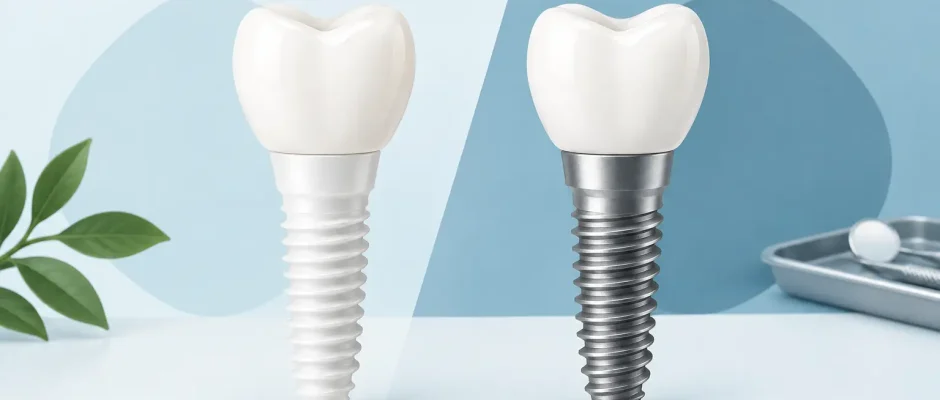
A dental implant is not simply a white tooth or a metal screw. It is a surgical foundation that must integrate with living bone, support the planned restoration, and tolerate years of chewing. When patients ask about zirconia versus titanium dental implants, they are usually asking two different questions: which material is safer for the body, and which will look better over time. The right answer depends on the position of the tooth, bone volume, bite forces, gum anatomy, and the type of restoration planned.
Titanium remains the standard material for most implant treatments because it has the longest and strongest clinical track record. Zirconia is a valuable alternative in selected cases, particularly where metal-free treatment or the highest esthetic demands are a priority. Neither material is automatically better for every patient.
Zirconia Versus Titanium Dental Implants: The Main Difference
Titanium implants are made from medical-grade titanium or titanium alloys. Their surface is specially treated to promote osseointegration – the direct biological connection between the implant and surrounding bone. This material has been used in implant dentistry for decades, including full-arch restorations, immediate implants, and complex reconstructions after bone grafting.
Zirconia implants are made from a high-strength ceramic called zirconium dioxide. They are naturally tooth-colored and contain no metal. Modern zirconia is far stronger than traditional dental ceramics, but it behaves differently from titanium under load and offers fewer prosthetic design options in some situations.
The material itself is only one part of the treatment. Implant diameter, length, three-dimensional position, connection type, crown design, oral hygiene, and bite control can have as much influence on the result as the choice between zirconia and titanium.
Titanium: The Most Versatile Clinical Option
Titanium has an extensive evidence base for both routine and complex implant treatment. It is available in many diameters and lengths, with different implant-abutment connections and restorative components. This flexibility matters when anatomy is limited or when the final teeth require precise support.
For example, titanium is often preferred when a patient has significant bone loss and needs guided bone regeneration, a sinus lift, or a staged reconstruction. It is also generally the more predictable option for multiple missing teeth, bridges, and full-arch concepts such as All-on-4. These cases require careful control of implant angulation, load distribution, and prosthetic maintenance.
Titanium is exceptionally resistant to fracture. This is particularly relevant for molars, patients with strong chewing muscles, bruxism, or a history of broken teeth and restorations. In these situations, the implant must withstand repeated high forces, not just look good on the day the crown is placed.
A titanium implant is gray, but it is normally covered by bone and gum tissue. In most posterior areas, its color has no visible effect. In the front of the mouth, a dark shadow may occasionally become visible through very thin gum tissue or if recession develops. Proper implant positioning and soft-tissue management reduce this risk, but the concern is reasonable in patients with a high smile line and delicate gums.
When Zirconia May Be a Good Choice
Zirconia implants can be attractive for patients who strongly prefer a metal-free restoration. Their white color may offer an esthetic benefit in the front of the mouth, especially when gum tissue is thin and the risk of a gray hue is a concern.
Some patients also report a history of sensitivity or adverse reactions to metals. True titanium hypersensitivity appears to be uncommon, and symptoms attributed to titanium can have other causes, including inflammation around the implant, retained dental materials, or unrelated dermatologic conditions. Still, if a patient has a documented metal allergy or a strong preference to avoid metal after appropriate consultation, zirconia may be considered.
Zirconia’s surface properties may also be favorable for soft-tissue attachment and plaque control. However, this should not be interpreted as protection against peri-implant disease. Gum inflammation and bone loss around any implant can occur when biofilm accumulates, cement remains under the gums, the crown is difficult to clean, or regular maintenance is missed.
The strongest zirconia indication is often a carefully selected single-tooth restoration in the esthetic zone, where bone volume is sufficient, bite forces are controlled, and the final crown can be planned precisely. In this scenario, the material’s color can be a meaningful advantage.
The Limits of Zirconia Implants
Zirconia implants are not simply titanium implants in white. Their clinical limitations should be discussed openly before surgery.
Many zirconia systems are one-piece implants, meaning the implant and abutment are connected as one unit. This can reduce flexibility after placement. The implant must be positioned with exceptional precision because the angle of the abutment cannot be changed later. If the implant is not ideally aligned, achieving an esthetic and functional crown becomes more difficult.
Two-piece zirconia systems are now available and expand restorative options, but they still have a shorter long-term evidence base than established titanium systems. Their components may also be less versatile in advanced restorative cases. If future adjustments, replacement of a crown, or a more complex bridge are anticipated, titanium commonly provides more predictable options.
Ceramic is highly strong under compression but can be more vulnerable to fracture than titanium when exposed to unfavorable bending forces. This does not mean zirconia implants are fragile. It means patient selection and bite planning matter. A patient with severe nighttime grinding, an unstable bite, or limited space for a properly designed crown may be better served by titanium.
Healing and Osseointegration: Does One Integrate Better?
Both materials can integrate with bone successfully when the surgical and restorative protocol is correct. The key factors are atraumatic surgery, stable implant placement, appropriate healing time or carefully selected immediate loading, infection control, and a restoration that does not overload the implant.
In immediate implantation after tooth extraction, the decision is particularly individual. The surgeon evaluates the thickness of the facial bone wall, presence of infection, ability to achieve primary stability, gum phenotype, and whether a provisional crown can be kept out of heavy bite contact. Titanium is often selected because of its design range and extensive evidence in immediate-placement protocols, but each case requires three-dimensional imaging and prosthetic planning.
No implant material can compensate for inadequate bone or poor positioning. When bone volume is insufficient, a predictable result may require bone grafting, guided bone regeneration, or a sinus lift before or together with implant placement. Digital planning and surgical guides can improve the accuracy of implant position, particularly when restoring the front teeth or several teeth at once.
Esthetics Depend on More Than Implant Color
Patients often focus on the color of the implant body, but the visible result is driven mainly by the crown, abutment, gum contour, and the stability of bone around the implant. A beautifully white zirconia implant cannot correct a crown that is too long, a gum line that has receded, or an implant positioned too far toward the lip.
For an anterior tooth, the plan should begin with the desired position of the final crown. The surgeon then determines where the implant must be placed to support that crown while preserving surrounding bone and soft tissue. Sometimes connective tissue grafting, bone augmentation, or a temporary restoration is necessary to create a natural emergence profile.
A titanium implant with a customized ceramic abutment and high-quality all-ceramic crown can produce an excellent esthetic result. Conversely, zirconia may be the better material in a selected case with very thin tissue and a clear need to avoid any gray shine-through. The decision is clinical, not ideological.
Which Implant Material Fits Your Situation?
Titanium is generally the first choice for patients who need multiple implants, full-arch rehabilitation, treatment in the posterior jaw, bone augmentation, or a solution that must tolerate high chewing forces. It is also usually the most practical option when the future restoration may need flexibility, repair, or modification.
Zirconia may be appropriate for a single missing tooth, especially in the visible smile zone, when bone and gum conditions are favorable and a metal-free solution is a central priority. It can also be part of a discussion for patients with specific concerns about metal exposure, provided those concerns are evaluated carefully rather than assumed to be an allergy.
The consultation should include a clinical examination, periodontal assessment, CBCT imaging when indicated, and a review of your bite, medical history, and esthetic expectations. The best treatment plan is the one that protects both the implant and the tissues around it for the long term.
A thoughtful decision about implant material should leave you feeling informed rather than pressured. Ask to see how the implant position, crown design, and gum support will be planned in your specific case. That conversation is often more valuable than choosing a material based on color alone.


