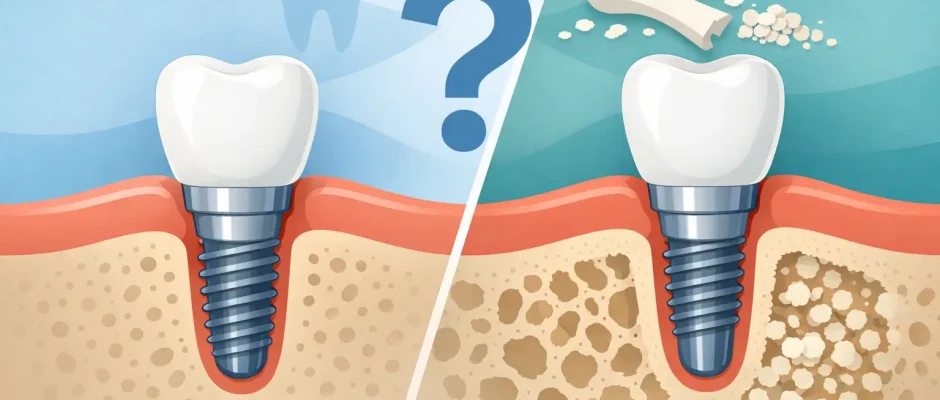
Can Dental Implants Work Without a Bone Graft?
A missing tooth does not automatically mean months of bone grafting before an implant. But the question, can dental implants work without bone graft, cannot be answered from an X-ray alone or by looking at the gum line. The deciding factors are the three-dimensional bone volume, its density, the location of the missing tooth, the bite, and the position of nearby structures such as the maxillary sinus or the mandibular nerve.
For some patients, graft-free implant treatment is a safe and highly predictable option. For others, avoiding grafting would mean placing an implant in a compromised position, weakening long-term function or compromising the final appearance. The goal is not to avoid a procedure at any cost. The goal is to choose the least invasive protocol that still provides a stable, well-positioned, durable result.
When can dental implants work without bone graft?
An implant may be placed without grafting when there is enough native bone to achieve primary stability – firm mechanical fixation at the time of surgery – and when the implant can be positioned correctly for the future crown or bridge.
Bone height is only part of the picture. The ridge must also have adequate width, and the implant must be surrounded by sufficient bone on its facial and lingual sides. A fixture that is technically “in bone” but placed too far toward the cheek, too close to an adjacent root, or at an unfavorable angle can create future problems even if it initially integrates.
Graft-free treatment is most often possible in these situations:
- A tooth was removed recently and the socket walls remain largely intact.
- The missing tooth has been absent for a limited time and bone resorption is modest.
- The available bone is narrow but still sufficient for a correctly sized implant.
- The surgeon can use existing bone in a more favorable position with a carefully planned implant angle.
- A full-arch protocol allows the use of stronger areas of the jaw, often with tilted posterior implants.
Each case requires a cone-beam CT scan, not guesswork. A CBCT scan shows bone volume in three dimensions and identifies anatomical limitations that cannot be assessed reliably with a standard two-dimensional dental X-ray.
Why bone disappears after tooth loss
The jawbone is biologically active. It is maintained partly by the forces transmitted through natural tooth roots. After an extraction, the bone that once surrounded the root gradually remodels. The greatest changes usually occur during the first months, especially in the thin outer wall of bone in the front of the upper jaw.
Periodontal disease, infection, traumatic extraction, smoking, diabetes that is not well controlled, and long-standing dentures can intensify bone loss. In the posterior upper jaw, the maxillary sinus may also expand downward over time, reducing the available vertical bone height. In the lower jaw, the main limitation may be the proximity of the mandibular nerve.
This is why two people who lost the same tooth can need very different treatment. One may be ready for immediate implant placement. The other may require guided bone regeneration, a sinus lift, or a staged approach before an implant can be placed safely.
Graft-free approaches that may be appropriate
Immediate implant placement
When a tooth must be extracted, an implant can sometimes be inserted during the same appointment. This approach may reduce treatment time and can help preserve the architecture of the extraction site. It is not simply a matter of placing an implant into an empty socket, however.
The implant must engage stable bone beyond or around the socket, and infection must be thoroughly removed. In many immediate-placement cases, a small amount of graft material is still placed around the implant to support contour preservation. That is different from a separate bone-grafting surgery performed because there is not enough bone to place the implant.
Short or narrow implants
Modern implant systems offer shorter and narrower designs for selected situations. A short implant may help avoid a sinus lift in the posterior upper jaw or reduce the need for vertical augmentation in other areas. A narrow implant can be useful where the ridge is limited in width.
These solutions are not interchangeable with standard implants in every case. Implant diameter and length must match the expected chewing load, bone quality, and restoration design. For example, a patient with strong bite forces or nighttime grinding may need a different strategy than a patient replacing a small lower incisor.
Angled implants and full-arch protocols
For patients missing most or all teeth, full-arch concepts such as All-on-4 can often avoid extensive grafting. The posterior implants are placed at an angle to use denser bone in the front portion of the jaw while avoiding the sinus in the upper jaw or the nerve in the lower jaw.
This is a sophisticated surgical and prosthetic protocol, not a shortcut. Digital planning, surgical guides when indicated, implant distribution, bite design, and a provisional fixed bridge all affect the result. In properly selected patients, it can provide fixed teeth with fewer grafting procedures and a shorter path to function.
Using the patient’s existing bone more precisely
Sometimes the issue is not a total lack of bone, but an implant plan that does not use it intelligently. Three-dimensional planning can identify the safest and most useful bone volume. Guided surgery can then transfer that plan to the clinical setting with greater precision.
This is particularly valuable in complex cases, where millimeters matter. It helps the surgeon plan around the sinus, nerve canal, roots of neighboring teeth, and the prosthetic position required for a natural-looking crown.
When a bone graft is the better choice
A graft is recommended when it improves the ability to place an implant in the correct position and gives the surrounding tissues adequate long-term support. Trying to avoid grafting when the ridge is severely narrow, low, or uneven may create a result that looks acceptable initially but is difficult to maintain.
In the front zone, grafting is often considered not only for implant stability but also for esthetics. The bone supports the gum contour around the future crown. Without adequate facial bone, the gum may recede, metal components may become visible, or the crown may appear too long compared with neighboring teeth.
In the posterior upper jaw, a sinus lift may be needed when the sinus has reduced the available height to the point that implant fixation would be unreliable. In other areas, guided bone regeneration can rebuild width or height with graft material and a protective membrane. PRF may also be used as an adjunct to support soft-tissue healing, depending on the clinical situation.
A staged protocol requires patience. It may add several months to treatment, but it can be the more conservative decision when it protects the final result. The right question is not “Can grafting be avoided?” but “What approach gives this implant the best chance of functioning comfortably for years?”
How the decision should be made
A responsible implant plan starts with a clinical examination, periodontal assessment, bite evaluation, and CBCT-based analysis. The plan should consider the final restoration before surgery begins. This prosthetically driven approach helps ensure that the implant is placed for the crown, rather than forcing the crown to compensate for a poorly placed implant.
Your surgeon should explain whether grafting is necessary, optional, or unnecessary, and why. You should also understand the trade-off between a faster treatment path and the long-term support of the bone and gums. If an immediate implant is proposed, ask whether there is sufficient primary stability and whether a temporary tooth can be placed safely without overloading the implant.
At Implantolog.co.il, complex implant planning is approached as a surgical and restorative decision, supported by digital diagnostics and microsurgical principles. The treatment plan is individualized because the anatomy, healing potential, and functional demands are individual.
A graft-free plan should never be a compromise plan
Dental implants can work without a bone graft in many well-selected cases. Modern diagnostics, implant designs, immediate placement protocols, and full-arch concepts have expanded what is possible. Yet these methods do not eliminate the need for bone biology, careful planning, and disciplined surgical technique.
If grafting is recommended, it does not mean your case is unusually difficult or that implant treatment has failed before it began. It may simply be the step that allows the implant to be placed where it belongs. A clear CT-based plan can replace uncertainty with a practical path toward stable teeth, comfortable chewing, and a result that feels like your own.


