Why a Sinus Lift Is Needed for Dental Implants
A missing upper back tooth can look like a straightforward implant case until a 3D scan shows only a few millimeters of bone beneath the maxillary sinus. Patients often ask why sinus lift is needed for implants if the gum has healed and they feel no pain. The answer is mechanical and anatomical: an implant needs stable bone around it, while the sinus is a natural air-filled cavity directly above the posterior upper jaw.
A sinus lift is not performed simply because an implant is planned. It is recommended when the available bone height is insufficient to place an implant of appropriate length and position with reliable long-term support. Careful diagnostics determine whether it is necessary, which technique is appropriate, and whether it can be combined with implant placement.
Why a sinus lift may be needed for implants
The maxillary sinus is located above the premolars and molars of the upper jaw. Its floor is separated from the tooth roots by a layer of bone that can be substantial in some people and very thin in others. When an upper back tooth is lost, that bone often decreases further over time.
Two processes usually contribute. First, the bone that previously held the tooth no longer receives normal chewing stimulation and gradually resorbs. Second, the sinus may enlarge downward into the space left by the missing tooth, a natural process called pneumatization. The result can be too little vertical bone between the oral cavity and the sinus.
An implant must be surrounded by bone to achieve primary stability during healing and to distribute chewing forces safely after restoration. Placing an implant into an area with inadequate bone can compromise its initial fixation, force an unfavorable implant angle, or create a risk of sinus membrane perforation. A sinus lift creates the conditions for proper implant placement rather than accepting a compromise.
This is especially relevant when restoring one or several upper molars. These teeth carry considerable chewing load. A solution that is merely possible on the day of surgery is not always the solution that is predictable years later.
What a sinus lift actually does
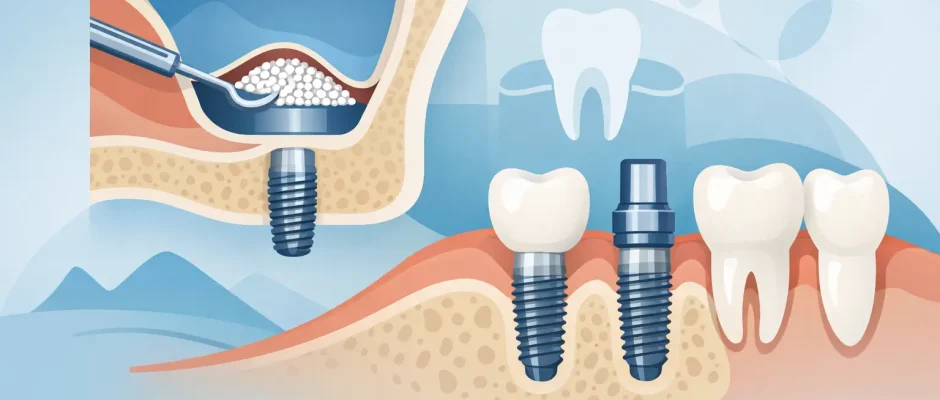
The procedure does not “lift the sinus” itself. The surgeon gently elevates the thin Schneiderian membrane lining the inside of the sinus and creates a protected space beneath it. Bone grafting material is placed in that space so the body can form new bone over time.
The sinus remains an air-filled cavity and continues to function normally. The purpose is to increase the bone volume available in the posterior upper jaw, allowing an implant to be placed in a stable, prosthetically correct position.
A sinus lift is planned from a cone beam CT scan, not from a standard X-ray alone. The scan shows the true height and width of available bone, the shape of the sinus floor, the condition of adjacent teeth, possible sinus septa, and signs of inflammation or pathology. These details affect both safety and the choice of surgical technique.
Internal and lateral sinus lift techniques
When a patient has a moderate amount of residual bone, an internal, or crestal, sinus lift may be suitable. Access is created through the implant site, the membrane is elevated carefully, and the implant can often be placed during the same procedure. This approach is less extensive, but it is appropriate only in selected clinical situations.
When the bone height is very limited or a larger augmentation is required, a lateral window sinus lift is generally more predictable. A small access window is created on the side of the upper jaw, allowing direct and controlled elevation of the membrane. Bone graft material is placed, and implant placement may occur at the same visit or after a healing period.
Neither method is automatically better. The right option depends on the amount and quality of remaining bone, the anatomy of the sinus, the planned implant position, and the need for a fixed restoration. A smaller procedure is desirable when it is safe, but choosing a less invasive method should never mean reducing the reliability of the result.
Can an implant be placed at the same time?
Sometimes, yes. Simultaneous implant placement can reduce the number of surgical stages and shorten the overall treatment timeline. It is usually considered when the existing bone can provide enough primary stability for the implant at the time of placement.
If the available bone is too thin, placing the implant immediately may not provide sufficient fixation. In that situation, the safer protocol is to perform the sinus augmentation first, allow graft maturation, and place the implant later. This requires more time, but it can be the more responsible decision.
Treatment timing also depends on whether the tooth was recently extracted, whether infection was present, the condition of the soft tissue, smoking status, diabetes control, periodontal health, and the patient’s ability to maintain hygiene. The plan should be individualized rather than based on a fixed schedule.
What happens before surgery
A proper sinus lift starts with diagnosis and planning, not with the surgery itself. The surgeon evaluates the CT scan and examines the mouth, bite, gums, remaining teeth, and planned future crown. The final crown determines where the implant should ideally be positioned. Implant surgery should support the future tooth, not simply follow the area where bone happens to be available.
Digital planning can help identify the safest implant trajectory and the volume of augmentation needed. In selected cases, a surgical guide helps transfer the approved plan accurately to the clinical procedure. PRF, created from a small sample of the patient’s own blood, may also be used as part of a regenerative protocol when clinically indicated.
If the CT scan suggests acute sinus inflammation, significant mucosal disease, or an obstruction affecting sinus drainage, treatment may need to be postponed and coordinated with an ear, nose, and throat specialist. This is not an unnecessary delay. A healthy sinus environment is part of a safe surgical plan.
Recovery and what patients can expect
Sinus lift surgery is usually performed under local anesthesia. Many patients are surprised that the procedure itself is more comfortable than anticipated, especially when each stage has been explained in advance. After surgery, mild swelling, pressure, or bruising in the cheek area can occur for several days.
Patients are typically advised to avoid forceful nose blowing, sneezing with the mouth closed, smoking, drinking through straws, and strenuous activity during the early healing period. These precautions help protect the healing area from pressure changes. Medication, hygiene instructions, and follow-up visits are tailored to the clinical situation.
A small amount of nasal congestion or light blood staining can occur early on. However, persistent bleeding, increasing pain after initial improvement, fever, foul taste or discharge, or fluid passing between the mouth and nose should be reported promptly. Clear postoperative communication is as important as the surgical procedure.
Is a sinus lift always necessary for upper-jaw implants?
No. Some patients naturally have sufficient bone height despite tooth loss. Others may be candidates for shorter implants, angled implants as part of a full-arch rehabilitation, or a different restorative strategy. In certain full-arch cases, protocols such as All-on-4 can avoid sinus augmentation by using implants placed in available anterior bone at specific angles.
These alternatives have indications and limitations. A short implant can be an excellent solution in the right bone volume and bite conditions, but it is not a universal substitute for augmentation. Avoiding a sinus lift is beneficial only when it does not reduce stability, hygiene access, esthetics, or the long-term prognosis of the restoration.
For a single missing molar, the goal is usually to restore a tooth that feels natural, supports normal chewing, and can be maintained for years. If a sinus lift is needed to achieve that goal, it is not an extra procedure. It is part of building the foundation the implant requires.
A careful consultation turns a CT image into a clear treatment plan: what bone is available, whether augmentation is needed, whether the implant can be placed immediately, and what recovery will involve. That clarity allows the decision to be made calmly, with safety and predictability at the center.


