Is Computer Guided Implant Surgery Right for You?
A dental implant is placed within millimeters of structures that cannot be ignored: the maxillary sinus, the inferior alveolar nerve, neighboring roots, and the thin outer wall of bone. Computer guided implant surgery is designed to make those millimeters visible before treatment begins and to transfer a carefully planned position to the surgical field.
For a patient, the value is not technology for its own sake. It is a clearer treatment plan, a more controlled procedure, and a better chance of placing the implant where the future crown needs it to be. Yet a surgical guide is not automatically necessary for every implant case. Its usefulness depends on anatomy, the number of implants, the prosthetic plan, and the quality of the digital preparation.
What computer guided implant surgery means
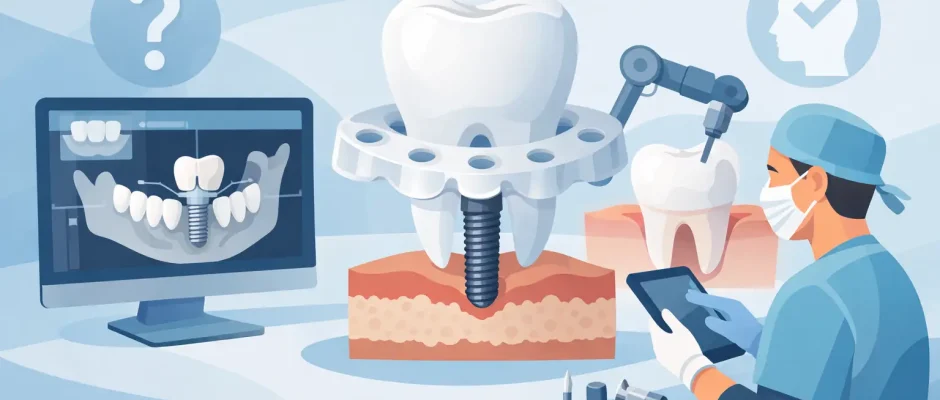
Computer guided implant surgery is a protocol that combines three-dimensional imaging with digital treatment planning and a custom surgical guide. A cone beam CT scan provides information about the height, width, and density of the jawbone, as well as the location of important anatomical structures. An intraoral scan or a precise dental model records the teeth, gums, and bite.
These records are combined in planning software. The surgeon can select the implant dimensions and determine its depth, angle, and position in relation to the planned crown or bridge. This distinction matters. An implant should not simply be placed where there appears to be bone. It should be placed in a position that allows the restorative dentist to create a functional, hygienic, and esthetic tooth.
After the plan is approved, a custom guide is manufactured. It fits onto the teeth, gum tissue, or bone and contains sleeves that direct the drills. Depending on the clinical protocol, the guide may be used only for the first osteotomy or for a fully guided sequence that also controls implant insertion.
Planning the final tooth, not only the implant
The strongest principle behind guided surgery is prosthetically driven planning. The ideal implant position is determined by the future restoration: where the chewing forces will be directed, where the crown will emerge through the gum, and how the patient will clean around it.
If an implant is angled too far toward the cheek or tongue, the final crown may be difficult to design and maintain. In the esthetic zone, small deviations can also affect gum contours and the visual symmetry of the smile. Digital planning gives the surgical and restorative stages a shared reference point before the first incision is made.
This is especially relevant when replacing several teeth, restoring a full arch with an All-on-4-type concept, or preparing for immediate loading. In these cases, implant positions must support a provisional bridge with the correct bite and adequate access for hygiene. A plan based only on the available bone can create compromises later.
The diagnostic foundation still matters
A guide is only as accurate as the information used to create it. The CBCT scan must be clear, the intraoral scan must capture the teeth and soft tissue correctly, and the guide must seat securely on the day of surgery. If a patient has mobile teeth, extensive metal restorations that affect imaging, severe gum inflammation, or limited mouth opening, the protocol may need adjustment.
For this reason, guided surgery is not a substitute for clinical examination. The surgeon evaluates oral hygiene, bite forces, gum thickness, infection, medical history, and whether bone augmentation is needed. Digital planning adds precision, but it does not replace diagnosis or surgical judgment.
When a surgical guide is particularly helpful
Guided placement is often valuable when there is little room for error. This includes implants close to the maxillary sinus or the mandibular nerve, narrow bone ridges, and sites where the bone has resorbed after a long-standing missing tooth. It can also be helpful when implants must be positioned precisely to support a bridge or an immediately placed provisional restoration.
For patients with dental anxiety, a planned and structured procedure can be reassuring. The surgical team knows the intended implant position, the required drilling sequence, and the anticipated need for grafting before treatment starts. In selected cases, this may reduce surgical time and allow a less invasive approach.
Computer guidance can also be useful for immediate implant placement after extraction. The extraction socket does not always provide a stable or ideal path for the implant. Planning helps identify where the implant should engage healthy bone beyond the socket, while preserving appropriate space for grafting and soft-tissue support. However, the condition of the tooth, the socket walls, and any active infection must be assessed individually.
What a guide cannot guarantee
Patients sometimes hear “guided” and assume the procedure is risk-free or completely flapless. Neither assumption is correct. Implant surgery remains a medical procedure, and the final approach may change if the clinical situation differs from the scan.
Bone quality can vary. The guide can show the intended trajectory, but it cannot turn soft bone into dense bone or eliminate the need for a graft. If the guide does not seat perfectly, it must not be used until the cause is identified. If an extraction reveals a fracture or loss of bone that was not fully apparent beforehand, the surgeon may need to modify the plan.
A flapless approach may preserve blood supply and reduce postoperative discomfort in selected cases, but it limits direct visualization of the bone. In situations involving bone regeneration, thin bone walls, or uncertain anatomy, opening the tissue may be safer and more predictable. The goal is not the smallest possible incision. The goal is stable implant placement and healthy tissue around the final restoration.
The typical treatment sequence
The process begins with a consultation, examination, and review of medical history. Imaging and digital impressions are collected when indicated. The surgical plan is then developed with the final restoration in mind, including the number and type of implants, anticipated need for bone augmentation, and timing of the crown or bridge.
Once the guide is fabricated, the surgery is performed under local anesthesia. Sedation options may be considered when appropriate for the patient and the clinical setting. The guide is tried in and verified for stable seating before drilling begins. After implant placement, the surgeon may place a healing abutment, cover screw, grafting material, membrane, or PRF preparation depending on the treatment plan.
Some patients receive a temporary tooth on the same day. This is possible only when the implant achieves sufficient primary stability and the bite can be controlled to avoid overloading it during healing. A same-day temporary is not the same as a final permanent crown, and it is not advisable in every case.
Recovery and the role of follow-up
Postoperative symptoms vary according to the procedure. A straightforward single implant may cause mild swelling and tenderness for several days. Implant placement combined with extraction, sinus lift, or guided bone regeneration generally involves a longer recovery period and more detailed restrictions.
Patients should expect clear instructions regarding medication, oral hygiene, food texture, smoking, physical activity, and follow-up visits. Smoking and poorly controlled diabetes can significantly affect healing and implant outcomes. Night grinding may require a protective appliance once the restoration is completed.
Long-term success also depends on maintenance. Implants cannot develop cavities, but the gum and bone around them can become inflamed. Professional hygiene visits, home cleaning, and periodic radiographic control are part of responsible implant care.
Choosing the right approach for your case
Computer guided implant surgery is most useful when it supports a sound clinical plan. It can improve precision, communication, and predictability, particularly in complex anatomy, multiple-implant rehabilitation, and esthetic cases. It is not a universal requirement, and a conventional approach in experienced hands may be entirely appropriate for some straightforward cases.
At Implantolog.co.il, the decision to use a surgical guide is made after diagnosis, not before it. The appropriate protocol should reflect your bone anatomy, the planned restoration, your health status, and the level of control required for a stable result.
A good implant plan should leave you with more than an implant on a scan. It should give you a clear understanding of the procedure, realistic expectations for healing, and a restoration that is comfortable to use and practical to maintain for years.


