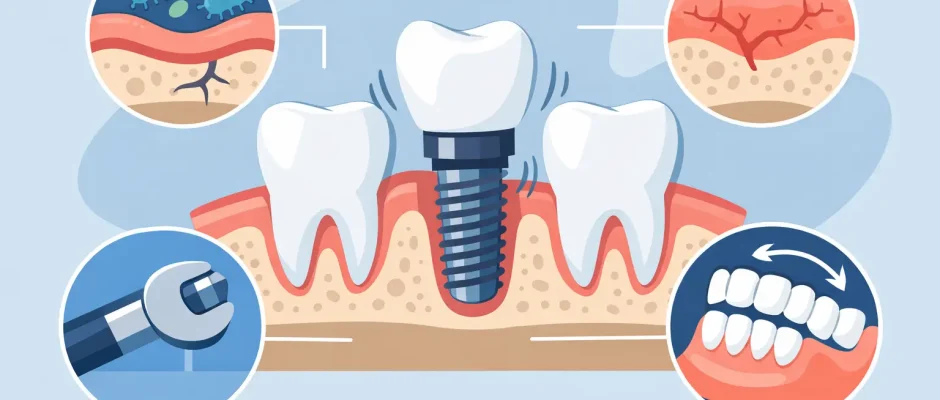
A patient usually notices it in a very ordinary moment – while chewing soft bread, brushing, or touching the tooth with the tongue. Something feels off. If you are searching for loose dental implant causes, the first thing to know is this: not every “loose implant” is actually the implant itself. In many cases, the implant body remains stable in the bone, while the crown, abutment, or screw has loosened. That distinction matters, because the treatment, urgency, and long-term prognosis are very different.
A true loose implant is a clinical problem that requires prompt evaluation. But a loose implant crown can often be corrected in a much simpler way. The challenge for patients is that both situations may feel similar at home. What you feel is movement. What your surgeon needs to determine is where that movement comes from and why it happened.
Loose dental implant causes – what can actually become loose?
When people say, “my implant is loose,” they usually mean one of three things. The crown may be moving. The abutment, which connects the crown to the implant, may be unstable. Or the implant fixture itself may have lost stability in the bone.
These are not small technical differences. If the crown is loose, the surrounding bone may still be completely healthy. If the implant fixture is loose, that points to failed osseointegration, overload, infection, or progressive bone loss. A proper exam should include a clinical check of each component, radiographs when indicated, and evaluation of the bite.
The most common loose dental implant causes
Screw loosening
This is one of the most frequent reasons a patient feels movement. The retaining screw can gradually lose preload, especially if the bite is heavy, the implant position creates unfavorable force, or the crown design concentrates pressure in the wrong direction.
In plain terms, the implant may be fine, but the connection above it is not fully tightened anymore. Patients often describe a small rocking sensation or a clicking feeling during chewing. This is usually less serious than a loose implant fixture, but it should not be ignored. Continued movement can wear components, damage threads, or increase the risk of fracture.
Failure of osseointegration
A dental implant depends on stable biological integration with the surrounding bone. If that process does not occur properly, the implant can become mobile early, sometimes within weeks or months after placement.
This can happen for several reasons. The implant may have had insufficient primary stability at surgery. Bone quality may have been poor. Micromovement during healing can interfere with integration. Smoking, uncontrolled diabetes, untreated periodontal disease, and certain healing disturbances can also reduce the chance of successful integration.
When osseointegration fails, the implant itself becomes loose, not just the crown. In that situation, retightening a screw will not solve the problem.
Peri-implantitis and bone loss
A previously stable implant can loosen later because the supporting bone is gradually lost. One major cause is peri-implantitis – an inflammatory disease around implants associated with bacterial plaque and progressive bone destruction.
Patients do not always feel pain early. Sometimes the first signs are bleeding during brushing, swelling, bad taste, recurrent gum irritation, or gradual mobility. In more advanced cases, there may be pus, gum recession, and visible thread exposure.
Peri-implantitis is not just “implant gingivitis.” Once bone loss develops, the case becomes more complex. Treatment depends on how much bone has been lost, implant design, surface characteristics, prosthetic access, and whether the implant can still be predictably saved.
Occlusal overload
Implants do not have the same shock-absorbing ligament that natural teeth have. That means they tolerate force differently. A bite that is too heavy, poorly distributed, or repetitive can place excessive stress on the implant system.
This matters especially in patients who clench or grind, in full-arch cases, and where implant number or position forces unfavorable load patterns. Overload by itself may not always be the only cause, but it often contributes. It can lead to screw loosening, component fracture, marginal bone stress, and in some cases loss of integration.
The bite should never be treated as a minor detail. In implant dentistry, biomechanics is part of long-term survival.
Poor implant positioning or prosthetic design
Even a well-integrated implant may develop complications if the restoration is not biomechanically favorable. Excessive crown height, off-axis loading, cantilever effects, limited restorative space, or an implant placed at an angle that creates stress concentration can all increase risk.
This is where planning matters. Digital diagnostics, surgical guides, and prosthetic planning before surgery are not marketing extras. In many cases, they help reduce exactly these avoidable mechanical complications.
Trauma or repeated microtrauma
A direct hit to the face can damage an implant restoration. More often, the issue is not a single dramatic injury but chronic microtrauma – years of clenching, uneven bite contacts, or chewing patterns that repeatedly overload one area.
A patient may say, “it was fine for years, then it started moving.” That timeline fits both biological and mechanical failure. Long-term success is never just about the surgery day. It depends on how the implant is loaded over time.
Early vs. late mobility
Timing gives important clues. If an implant feels loose soon after placement, the concern is usually failed osseointegration, early overload, infection, or healing disturbance. If the problem appears years later, screw loosening, prosthetic wear, peri-implantitis, or progressive overload become more likely.
That said, there is overlap. An early loose crown may simply be a mechanical issue. A late loose implant body may reflect bone loss that has been developing silently for quite some time. This is why self-diagnosis is unreliable.
What increases the risk?
Some risk factors are biological, some are technical, and many cases involve both. Smoking remains a major issue because it affects blood supply and healing. Poor plaque control increases the risk of peri-implant inflammation. A history of periodontitis raises concern as well, especially when maintenance is irregular.
Bruxism matters more than many patients realize. So do uncontrolled systemic conditions, low bone volume, and implant placement in challenging anatomy without proper augmentation or load management. In complex cases, careful planning is not about making treatment look sophisticated. It is about controlling variables that influence survival.
How a surgeon figures out the real cause
The exam starts with a simple but critical question: what is moving? The crown, the abutment, or the implant fixture? Sometimes this can be identified clinically within minutes. Sometimes radiographs and component removal are necessary.
Your surgeon will assess soft tissue condition, bleeding, suppuration, pocket depth, radiographic bone level, prosthetic fit, and occlusion. If the implant itself is mobile, the prognosis changes immediately. If only the prosthetic parts are loose, the implant may still be healthy.
This step-by-step diagnosis is the reason not to keep chewing on a mobile implant restoration for weeks. Small problems become expensive when movement is repeated.
Can a loose dental implant be saved?
It depends on the cause. A loose crown or abutment screw is often very manageable if treated early. The components can be examined, retightened or replaced, and the bite adjusted if needed.
A truly loose implant fixture is more complicated. If osseointegration failed, the implant usually needs to be removed. After healing, replacement may still be possible, sometimes with a modified protocol or additional bone support.
If the problem is peri-implantitis, outcomes vary. Some implants can be treated with decontamination, surgical access, regenerative procedures, and correction of prosthetic factors. Others have lost too much support and are no longer predictable to maintain. Good implant dentistry is not about saving every implant at any cost. It is about choosing the option with the best long-term prognosis.
What you should do right away
Do not try to test the movement yourself over and over. Do not keep chewing on that side to “see if it gets better.” And do not assume that lack of pain means lack of urgency.
Schedule an evaluation promptly. If there is swelling, bleeding, pus, sudden movement, or pain when biting, sooner is better. If you are traveling or being treated away from home, keep records of the implant system and previous treatment if available. That makes diagnosis and repair much more efficient.
In a practice focused on surgical implant care, including complex and revision cases, the main goal is not just to tighten something and send the patient home. It is to identify whether the issue is mechanical, biological, or both, and then correct the reason it happened.
A loose implant is never a diagnosis by itself. It is a sign. Sometimes the fix is straightforward. Sometimes it reveals bone loss, overload, or a failing connection that needs a more careful plan. The useful next step is not guessing – it is getting a precise diagnosis before a small complication becomes a larger one.


