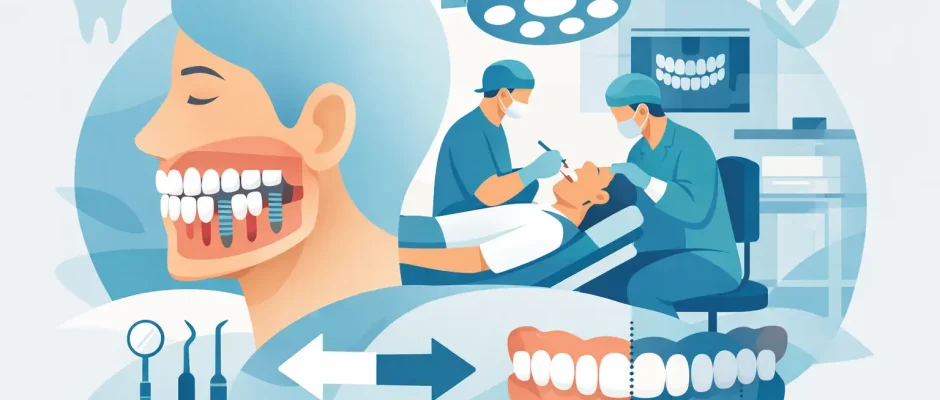
When chewing becomes difficult, teeth continue to break down, and the smile no longer feels stable, treating one tooth at a time may only postpone a larger problem. Full mouth rehabilitation surgery is a carefully planned approach to restoring function, comfort, and appearance when multiple teeth, gums, bone, or the bite require treatment at the same time.
It is not one standard operation and it is not automatically synonymous with placing implants in every missing space. For some patients, rehabilitation combines extractions, implants, bone grafting, and fixed prosthetic teeth. For others, preserving strategic natural teeth with microsurgery or periodontal treatment creates the most reliable result. The right plan begins with diagnosis, not a predetermined procedure.
What Full Mouth Rehabilitation Surgery Can Include
Full mouth rehabilitation addresses the mouth as one functional system. The goal is not simply to replace visible teeth. A stable result must consider the health of the gums, available jawbone, bite relationship, jaw function, facial support, and the long-term ability to maintain hygiene.
Surgical treatment may be recommended when teeth cannot be predictably saved because of extensive decay, fractures below the gumline, advanced periodontal disease, repeated infection, or severe mobility. Missing teeth may be restored with implants, either individually or as part of a fixed full-arch solution such as All-on-4 or All-on-6, when clinically appropriate.
A comprehensive plan may include several stages:
- atraumatic extraction of hopeless teeth, including difficult roots or impacted teeth;
- immediate implant placement in selected extraction sites;
- bone grafting or guided bone regeneration where the ridge has resorbed;
- sinus lift surgery in the upper posterior jaw when bone height is limited;
- PRF, or platelet-rich fibrin, to support soft-tissue and bone healing in appropriate cases;
- implant placement using a digital surgical guide; and
- provisional and final restorations designed around a stable bite.
Not every patient needs every stage. A patient with a few failing teeth and good bone volume may be treated more conservatively than someone who has worn dentures for years and has substantial bone loss. This distinction matters for both safety and cost.
When a Full Mouth Approach Is Worth Considering
A full-mouth plan is often considered when separate dental problems are affecting each other. For example, missing back teeth can overload the front teeth. Worn teeth can change the bite and reduce the space available for restoration. Gum disease can weaken support around teeth that appear acceptable at first glance.
Common situations include extensive tooth loss, severely worn or collapsed bite, multiple failed crowns and bridges, advanced gum disease, repeated inflammation around old dental work, or unstable removable dentures. Patients may also seek treatment because they avoid certain foods, have persistent discomfort, or feel self-conscious when speaking or smiling.
The decision should never be based on appearance alone. A natural-looking smile is important, but it must be supported by healthy tissues and a bite that does not place excessive force on implants or remaining teeth. Replacing every compromised tooth quickly can be tempting, yet preserving a tooth with a favorable prognosis may sometimes be the better biological choice.
Saving Teeth Versus Replacing Them With Implants
Implants are an excellent solution for missing or non-restorable teeth, but they are not a substitute for a tooth that can be predictably retained. Root-end microsurgery, periodontal surgery, retreatment of a root canal, or restorative care may be appropriate when the tooth has sufficient support and a reasonable long-term prognosis.
On the other hand, a tooth with severe root fracture, uncontrolled infection, major bone loss, or repeated treatment failure may compromise the entire rehabilitation if it is kept for too long. The clinical question is not whether natural teeth are always better than implants. It is whether each tooth contributes to a stable, maintainable result.
Diagnosis Determines the Surgical Plan
A comprehensive assessment is the foundation of safe treatment. It usually includes a clinical examination, periodontal evaluation, photographs, digital scans, and three-dimensional imaging such as CBCT when implants, bone grafting, or complex extractions are being considered.
CBCT imaging helps evaluate bone volume, the location of the maxillary sinus, nerve pathways in the lower jaw, root anatomy, hidden infection, and other structures that cannot be fully assessed with standard two-dimensional X-rays. This information is especially valuable in cases involving atrophy of the jawbone or multiple implant sites.
Digital planning allows the surgical and restorative phases to be coordinated before treatment begins. The ideal position of the future teeth guides implant placement, rather than placing implants first and trying to adapt the restoration afterward. When indicated, a surgical guide transfers that virtual plan to the clinical setting with greater precision.
A predictable plan also includes an honest discussion of limitations. Bone grafting can increase treatment time. Immediate implants are not suitable in every extraction site. Fixed teeth on the day of surgery may be possible for some full-arch cases, but only if implant stability, bite control, and the condition of the tissues support that protocol.
The Typical Treatment Sequence
Full mouth rehabilitation is usually performed in phases because the tissues need time to heal and because each phase informs the next. The process can be efficient without being rushed.
First, the clinician establishes what can be saved, what must be removed, and what should be restored later. Active infection and inflammation are controlled. If extractions are required, the socket may be preserved with grafting material to reduce future bone loss. In selected cases, an implant can be placed immediately after extraction.
The next phase may involve implant surgery, bone regeneration, or sinus augmentation. Healing periods vary. Some patients proceed to provisional teeth quickly, while others benefit from several months of healing before the implants are loaded. The approach depends on bone quality, implant stability, the extent of grafting, smoking status, bite forces, and general health.
Once the surgical foundation is stable, the final prosthetic phase refines tooth shape, speech, bite, and esthetics. This is not a cosmetic afterthought. The final restoration must be designed so that it can be cleaned effectively and repaired if needed. A beautiful result that cannot be maintained is not a successful result.
Comfort and Safety During Surgical Care
Dental surgery should feel organized and controlled, not overwhelming. Local anesthesia is used to ensure comfort during treatment. For patients with significant anxiety or more extensive procedures, sedation options may be discussed based on medical history, the planned intervention, and the setting of care.
Postoperative discomfort is expected after major surgery, but it should be managed proactively. Clear instructions for medication, oral hygiene, diet, swelling, and follow-up visits reduce uncertainty during healing. PRF may be used in selected procedures to support wound healing, though it does not replace sound surgical technique or appropriate aftercare.
Safety also means recognizing when treatment should be delayed or modified. Uncontrolled diabetes, certain medications affecting bone metabolism, active smoking, untreated periodontal disease, and poor oral hygiene can affect healing and implant success. These factors do not always prevent rehabilitation, but they may change the sequence, materials, or expected timeline.
How Long Does Rehabilitation Take?
The timeline ranges from a few months to more than a year. A straightforward case with immediate implant placement and stable conditions may move faster. Complex cases involving severe bone loss, staged grafting, sinus lifts, or treatment of gum disease require more time.
Patients traveling for care should plan around both surgical visits and follow-up requirements. Remote coordination can help organize imaging and appointments, but the final treatment plan should be confirmed after an in-person examination. In Tel Aviv, treatment can be coordinated in clear stages so patients understand what must happen during each visit and what can safely wait.
Questions to Ask Before Starting
Before committing to comprehensive treatment, ask why each tooth is being removed or preserved, whether bone grafting is necessary, and what alternatives exist. Ask how the bite will be planned, how provisional teeth will function, and how the final restoration will be cleaned.
It is also reasonable to ask about the surgeon’s experience with complex extractions, implant placement in limited bone, guided surgery, and management of complications. A detailed plan should explain not only the ideal result but also the possible need for additional procedures if healing does not follow the expected course.
The most reassuring plan is not the fastest or the most aggressive one. It is the one that gives each stage a clear purpose, protects the biology of the tissues, and leaves you with teeth that feel secure enough to use every day.


