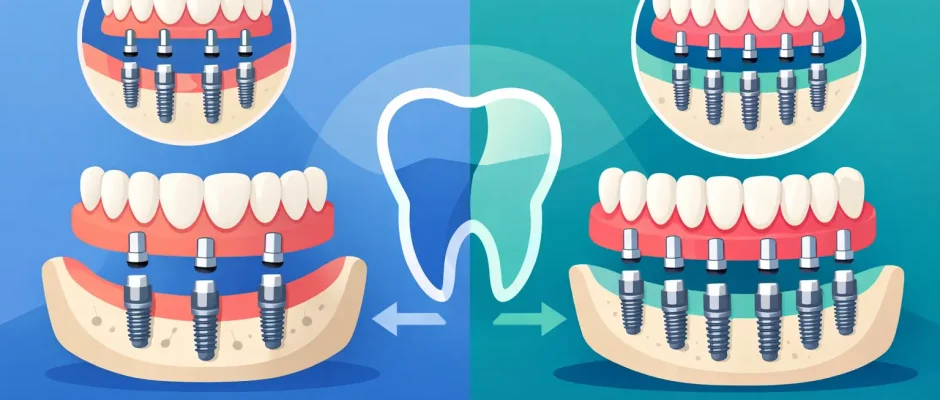
A full-arch restoration should not be chosen by implant count alone. Patients searching for “All-on-4 vs All-on-6 отличия” usually want to know which treatment is stronger, safer, and more durable. The clinically correct answer is more personal: it depends on bone volume and quality, bite forces, jaw anatomy, the condition of the gums, and the type of final bridge planned.
Both protocols can restore a complete upper or lower arch with a fixed prosthesis. Both may allow immediate placement of a temporary fixed bridge when primary implant stability is sufficient. The difference is not simply two additional implants. It is the way the surgical and prosthetic plan distributes chewing forces and manages clinical risk.
All-on-4 vs All-on-6: the essential differences
All-on-4 uses four implants to support a full-arch bridge. In the classic protocol, the two front implants are placed more vertically, while the two posterior implants are tilted. Tilting helps use available bone more efficiently and can avoid anatomical structures such as the maxillary sinuses in the upper jaw or the mandibular nerve in the lower jaw.
All-on-6 uses six implants distributed across the arch. With more support points, the bridge may have a broader foundation and a shorter unsupported rear section, called a cantilever. This can be beneficial when the patient has strong chewing muscles, a history of grinding, or sufficient bone to place implants in predictable positions.
Neither approach is automatically superior. A well-planned All-on-4 case is safer than an All-on-6 plan that places implants into inadequate bone or ignores the patient’s bite. The goal is not to maximize the number of implants. It is to create a stable, maintainable restoration with a controlled load on the bone and prosthesis.
When All-on-4 can be the right solution
All-on-4 is often considered when many teeth in one arch have a poor prognosis and the patient wants a fixed restoration without extensive bone grafting. It can be especially useful in the posterior upper jaw, where sinus expansion reduces available bone height, or in the posterior lower jaw, where the location of the nerve limits implant placement.
By angling the posterior implants, the surgeon may achieve better implant length and anchorage in the available bone. This approach can reduce the need for additional reconstructive procedures in selected cases. Fewer implants can also mean a shorter surgery and lower surgical cost.
However, “fewer” does not mean “simpler.” All-on-4 requires precise three-dimensional planning. Implant position affects the emergence of screw channels, the design of the temporary bridge, hygiene access, speech, and the forces that reach the implants. A surgical guide, created from CBCT imaging and digital prosthetic planning, helps transfer the plan accurately to the mouth.
All-on-4 may be less suitable when bone quality is very poor, the front jaw has significant volume loss, the patient has severe bruxism, or the prosthetic design would require an excessive cantilever. These factors do not always rule out treatment, but they may shift the recommendation toward six implants, bone augmentation, staged treatment, or a different fixed-prosthetic solution.
When All-on-6 may offer an advantage
All-on-6 provides two additional points of support. In a patient with adequate bone, this may allow a more even distribution of load across the full arch. It can also reduce dependence on tilted posterior implants and may permit a more favorable bridge design.
For the upper jaw, six implants are frequently considered because maxillary bone is often softer than mandibular bone. Additional support can be helpful for a full upper bridge, particularly in patients with a strong bite or a long history of tooth wear. It may also provide greater flexibility if one implant later develops a complication, although this should never be treated as a substitute for careful planning and maintenance.
All-on-6 may be appropriate for patients who have enough bone after extraction, have completed bone regeneration, or are willing to undergo grafting or sinus lift procedures when needed. The trade-off is that more implants require more surgical sites, more available bone, and usually a higher treatment cost. Healing and follow-up still depend on the individual case, not only on the protocol name.
Bone volume is only part of the decision
A panoramic X-ray is not enough to decide between four and six implants. Planning should include a CBCT scan to evaluate bone width, height, density, sinus anatomy, and the position of the lower jaw nerve. The surgeon also evaluates active infection, periodontal condition, soft-tissue volume, facial support, and whether teeth can be predictably preserved.
Bone quality matters as much as bone quantity. Dense bone in the lower jaw may provide strong initial implant stability even where volume is limited. In contrast, a wide-looking upper jaw may still have low-density bone that requires a more cautious strategy. Immediate loading with a fixed temporary bridge is considered only when implant stability and the overall distribution of implants meet clinical criteria.
For some patients, the best plan is not All-on-4 or All-on-6 on the day of extraction. Treating inflammation, preserving bone, performing guided bone regeneration, or allowing a staged healing period may improve the long-term prognosis. A temporary removable solution can sometimes be the more responsible choice while tissues recover.
Immediate teeth versus the final bridge
Many patients hear “teeth in one day” and assume the final restoration is completed on the day of surgery. Usually, the first bridge is a temporary fixed prosthesis. It is designed to protect healing implants, restore appearance, and allow the patient to function with a controlled diet.
During the healing period, the bone bonds to the implant surface through osseointegration. The temporary bridge may need adjustments as swelling resolves and the gums reshape. The final bridge is fabricated after healing is assessed and the bite is refined.
The final material is chosen according to the clinical situation, esthetic goals, bite, available restorative space, and maintenance needs. A full-arch bridge is not maintenance-free. Regular professional reviews, home hygiene around the bridge, and cleaning under the prosthesis are essential whether it is supported by four or six implants.
Cost: why the number alone is misleading
All-on-6 usually costs more than All-on-4 because it includes two additional implants and associated components. But comparing treatment estimates only by the number of implants can be misleading. The total plan may include extractions, temporary restoration, surgical guide, sedation or anesthesia, bone grafting, PRF protocols, final prosthesis, and postoperative visits.
A lower initial price is not necessarily better value if the plan compromises implant positioning, hygiene access, or long-term prosthetic design. Conversely, additional implants or grafting should not be proposed routinely when they do not improve the prognosis. A transparent treatment plan explains what is included, why each stage is recommended, and which alternatives are clinically reasonable.
How the treatment plan is selected
The decision should start with diagnosis, not with a preferred package. A digital workflow combines CBCT data, intraoral scans or impressions, photographs, and prosthetic planning. This allows the surgeon and restorative dentist to evaluate the planned tooth position before placing the implants.
The key questions are practical: Where should the new teeth sit for speech and lip support? Can implants be placed under those teeth in stable bone? Will the bridge be easy to clean? How much force will the patient place on the restoration? Is a fixed temporary bridge safe at the time of surgery?
At Implantolog.co.il in Tel Aviv, full-arch cases are planned around these surgical and prosthetic variables, with attention to guided surgery and predictable postoperative care. The recommended protocol should be understandable: why four implants are sufficient in one case, or why six implants, grafting, or a staged approach offers a safer margin in another.
A good full-arch solution should feel like a considered medical plan rather than a choice between two labels. Bring your scan, medical history, and expectations to a consultation, then ask which design best protects your bone, bite, and ability to maintain the restoration for years.


