Sinus Lift Healing Stages: What to Expect
The first few days after surgery are usually not the hardest part of a sinus lift. The harder part is uncertainty – wondering whether pressure, swelling, or a small streak of blood is normal, and how long the graft actually takes to become usable bone. Understanding sinus lift healing stages helps reduce that uncertainty and makes recovery easier to manage.
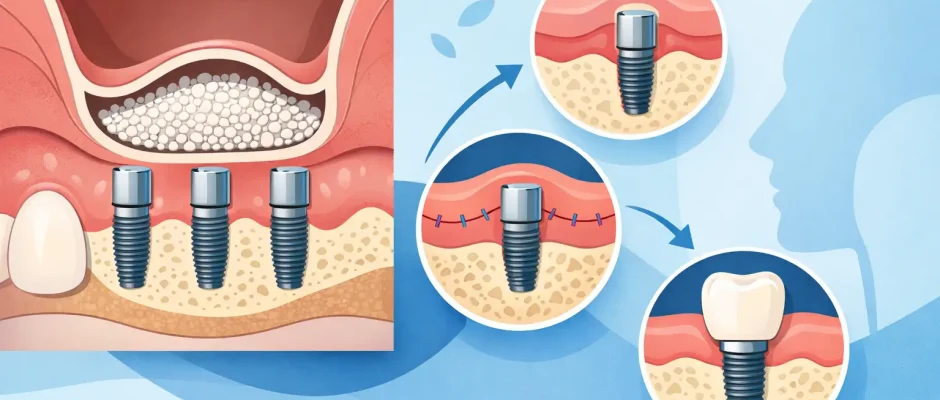
A sinus lift is not just a matter of “healing the gums.” The procedure creates space under the sinus membrane and fills that space with graft material so the body can gradually build new bone in the upper back jaw. That biology takes time. The external recovery may feel relatively quick, while the internal healing continues for months.
Sinus lift healing stages from surgery to final bone maturation
In most cases, healing happens in overlapping phases rather than neat calendar blocks. Still, there is a practical timeline patients can use to understand what is usually happening.
Stage 1: The first 24 to 72 hours
This is the acute postoperative phase. Swelling, mild bleeding, nasal stuffiness, and pressure in the cheek area are common. If the sinus lift was performed carefully and the membrane remained stable, discomfort is often manageable with routine postoperative medication. Many patients expect severe pain and are surprised that pressure and congestion are more noticeable than pain itself.
During this stage, the body forms a blood clot and begins the inflammatory response that starts healing. That word – inflammation – sounds negative, but early inflammation is necessary. It brings cells and growth factors into the surgical site. The goal is controlled inflammation, not none at all.
This is why your surgeon usually emphasizes a few rules that seem repetitive but matter a great deal: do not blow your nose, sneeze with your mouth open, avoid forceful rinsing, and avoid creating pressure changes in the sinus. A technically excellent graft can be disturbed by repeated pressure in the early phase.
Stage 2: Days 4 to 14
By the end of the first week, swelling usually starts to decrease. Bruising may become more visible before it fades. Mild soreness when chewing, opening wide, or touching the cheek can still be normal. If sutures were placed, this is often the period when the soft tissue begins to feel more stable.
What patients see at this point is soft tissue recovery. What they do not see is that the graft is still fragile. It has not become mature bone. It is being stabilized biologically, but the site still depends on a protected healing environment.
Some patients notice intermittent fullness in the sinus area, especially when bending forward. That can be expected. What should not be ignored is increasing pain after initial improvement, foul taste or drainage, fever, marked unilateral nasal discharge, or swelling that suddenly worsens. Those findings deserve direct review.
Stage 3: Weeks 2 to 6
This is the quieter phase, and that can be misleading. Many patients feel mostly normal by now and assume the area is fully healed. In reality, this is when the graft is transitioning from a protected surgical site into early regenerating bone.
Blood vessels grow into the grafted area. The body begins replacing or integrating the graft particles depending on the material used and the clinical protocol. New woven bone starts to form. This is early bone, not final bone. It is biologically active and improving, but it is not yet the dense, mature foundation needed for long-term implant stability.
The practical message is simple: feeling better does not mean the sinus lift is finished healing. Heavy pressure on the area, smoking, uncontrolled sinus problems, and poor oral hygiene can still interfere with the process.
Stage 4: Around 2 to 4 months
At this point, soft tissues are usually well healed, and the deeper regenerative phase is progressing. Depending on the original bone height, graft volume, and surgical stability, some cases may be ready for implant placement earlier, while others need more time.
This is where treatment planning matters. If there was enough native bone to stabilize an implant at the time of sinus augmentation, implant placement may have been done simultaneously. If primary stability was not predictable, the safer approach is often to graft first and place the implant later.
There is no prize for rushing this stage. In implant dentistry, speed matters less than predictable integration.
Stage 5: Around 4 to 9 months
This is the period when many grafted sinuses become suitable for implant placement if implants were not placed during the original surgery. Imaging and clinical assessment guide the decision. The exact timing depends on the starting anatomy, membrane condition, graft material, smoking status, and the patient’s healing capacity.
Bone remodeling continues even after implants are placed. The grafted area becomes more organized, more vascularized, and better able to support function. Some patients hear a single number such as “6 months” and assume that applies to everyone. It does not. A small lift in a healthy patient may mature faster than a large graft in a patient with significant bone loss or sinus history.
What is normal during sinus lift healing stages
A normal recovery does not mean an identical recovery. Some patients have very little swelling. Others look more swollen on days two and three and then improve steadily. Common findings include cheek swelling, mild bruising, a sensation of sinus pressure, small amounts of blood-tinged nasal drainage early on, and tenderness in the upper jaw.
Temporary changes in how the upper teeth feel can also happen because the area is close to the sinus and the surgical site. Appetite may be lower for a few days because chewing feels inconvenient. Fatigue is also common after oral surgery, especially when stress before surgery has been high.
The pattern matters more than any single symptom. If each day is gradually calmer, that usually supports normal healing.
What can slow healing or increase risk
The biology of a sinus lift is predictable, but only when the environment is favorable. Smoking is one of the most important factors that can compromise blood supply and tissue quality. Poor control of diabetes, untreated periodontal inflammation, and chronic sinus disease can also complicate recovery.
Technique matters just as much. A sinus membrane perforation does not always mean failure, but it changes the surgical situation and may require modified management. The same applies to very thin residual bone, previous infection, or large augmentation volume. These cases can still be treated successfully, but they require judgment rather than a routine approach.
This is one reason digital planning and careful surgical protocols matter. When the anatomy is assessed properly before surgery, the surgeon can decide whether to use a lateral window or a less invasive crestal approach, whether simultaneous implant placement is realistic, and how to reduce unnecessary trauma.
When to call your surgeon
Patients are often told what to expect, but they are not always told what should raise concern. Contact your surgeon if pain intensifies instead of improving, if swelling rapidly increases after the first few days, if you develop fever, if there is pus or foul-smelling drainage, or if nasal symptoms become pronounced on one side.
A feeling of air or fluid passing between the mouth and nose should also be assessed. It does not always indicate a serious complication, but it should never be self-diagnosed. The same is true if you feel movement in the grafted area or if the surgical site opens.
Early review is almost always better than waiting and hoping. Most postoperative concerns turn out to be manageable, but timely examination protects the result.
How surgeons monitor healing before implants
Healing is not judged by symptoms alone. The patient may feel excellent while the graft is still immature, or feel pressure while the site is actually progressing normally. Follow-up usually combines clinical evaluation with imaging.
Cone beam CT is especially useful because it shows the grafted volume, sinus anatomy, and developing bone in three dimensions. That helps determine whether the augmented site is ready for implant placement and whether the planned implant position remains ideal. In practices that emphasize precision and safety, this step is not administrative – it is part of risk control.
In some clinical settings, adjuncts such as PRF may be used to support soft tissue and bone healing. These tools can improve the biological environment, but they do not replace careful indication, atraumatic technique, and compliance during recovery.
A realistic timeline patients can trust
If you want a simple way to think about sinus lift healing stages, use this framework: the first one to two weeks are about recovering from surgery, the next several weeks are about protecting the graft while early bone forms, and the following months are about maturation strong enough to support implantation or long-term stability.
That distinction matters because many disappointments in implant treatment come from confusing “I feel fine” with “the bone is ready.” They are not the same thing.
A well-planned sinus lift should feel organized, not mysterious. You should know what symptoms are expected, what restrictions actually matter, and what checkpoint determines the next step. When the surgical plan is clear and the follow-up is disciplined, healing becomes far more predictable – and much less stressful for the patient.
If you are considering a sinus lift, the most useful question is not “How fast can this be done?” It is “What timeline gives me the safest and most stable result?” That is usually the question that leads to the right treatment.


