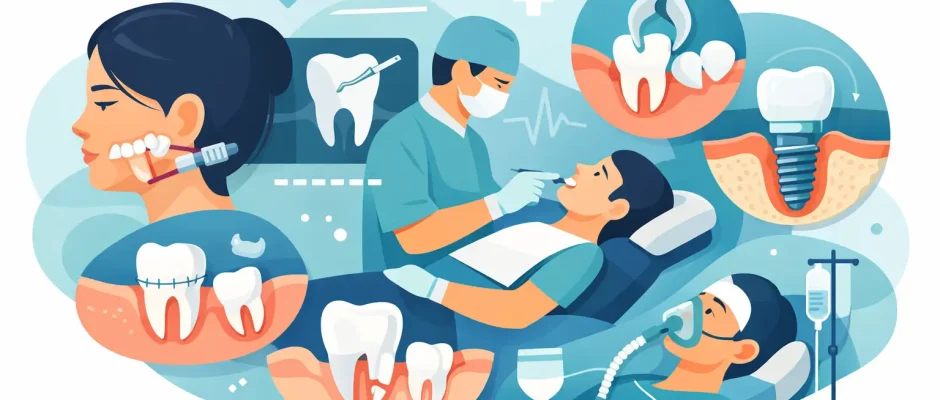
A tooth that breaks below the gumline, a wisdom tooth pressing against its neighbor, or a missing tooth with shrinking bone can look like separate problems. In practice, they often require carefully selected types of oral surgery procedures that restore health, function, and the conditions needed for a stable long-term result.
Oral surgery is not one treatment. It is a group of procedures performed on teeth, gums, jawbone, and surrounding tissues. The right approach depends on three things: the diagnosis, the quality and volume of bone and soft tissue, and the patient’s overall health and goals. A precise diagnosis and a staged plan often make treatment more comfortable and more predictable than trying to solve every problem in a single visit.
Tooth Extractions and Surgical Tooth Removal
Extraction is recommended when a tooth cannot be saved predictably due to severe decay, a vertical root fracture, advanced periodontal disease, or infection that has damaged too much supporting bone. Some teeth are straightforward to remove. Others require surgical extraction because they are broken, deeply decayed, fused to bone, or positioned at an angle.
A surgical extraction may involve a small incision in the gum, careful removal of a limited amount of bone, and sectioning the tooth into smaller parts. This controlled technique can be less traumatic than applying excessive force. After removal, the socket may be cleaned, treated with PRF – platelet-rich fibrin prepared from the patient’s own blood – and closed with sutures when indicated.
The decision to remove a tooth should never be automatic. When a tooth can be restored or treated with microsurgical endodontic care, preserving it may be the better option. When the prognosis is poor, however, delayed extraction can lead to further bone loss and make future implant treatment more complex.
Wisdom Tooth Removal
Wisdom teeth, also called third molars, are among the most common reasons for oral surgery. A partially erupted or impacted wisdom tooth can cause repeated gum inflammation, pain, food trapping, cavities on the adjacent second molar, cyst formation, or damage to nearby structures.
The difficulty of removal depends on the tooth’s position, root shape, and relationship to the mandibular nerve in the lower jaw or the sinus in the upper jaw. Three-dimensional imaging may be recommended when conventional X-rays do not provide enough information for safe planning. The goal is not simply to remove the tooth, but to protect neighboring teeth, nerves, and bone while supporting a smooth recovery.
Dental Implant Surgery
Dental implant surgery replaces the root of a missing tooth with a biocompatible titanium implant placed in the jawbone. After healing and integration with bone, the implant can support a crown, bridge, or full-arch restoration. It is often the most conservative fixed solution because adjacent healthy teeth do not need to be prepared for a traditional bridge.
Implant placement can be performed after a healing period following extraction, or immediately after removal of a tooth in selected cases. Immediate implant placement is not automatically better or faster. It is appropriate only when the socket is sufficiently clean, the remaining bone provides primary stability, and the soft-tissue situation allows a predictable result.
Digital planning and surgical guides can improve accuracy by transferring the planned implant position to the clinical procedure. This is particularly valuable in esthetic areas, near anatomical structures, and in full-arch rehabilitation. Technology supports the plan, but it does not replace clinical judgment: the final protocol must account for bone quality, bite forces, hygiene, and the restoration that will be placed on top of the implant.
Full-Arch Implant Rehabilitation
When most or all teeth in one jaw are missing or cannot be preserved, a fixed full-arch restoration may be supported by several implants. Protocols such as All-on-4 use strategically angled posterior implants to make use of available bone and may reduce the need for grafting in some patients.
This can be an efficient solution, but it is not a shortcut for every case. The number and position of implants, need for bone augmentation, condition of the gums, and ability to maintain hygiene all influence the treatment plan. A temporary fixed bridge may sometimes be placed shortly after surgery, but only when implant stability and bite conditions meet the required criteria.
Bone Grafting and Guided Bone Regeneration
Bone naturally remodels after a tooth is lost. In the first months, the ridge can become narrower and lower, especially in the front of the mouth. Periodontal disease, infection, trauma, and long-term denture use can also reduce available bone.
Bone grafting rebuilds or preserves the volume needed for implant placement. Depending on the defect, the surgeon may use bone substitute materials, the patient’s own bone, or a combination. A barrier membrane is often placed to protect the grafted area and guide bone regeneration while it heals.
A socket preservation graft may be completed at the time of extraction to limit future ridge collapse. Larger defects may require a separate grafting procedure before implants are placed. The trade-off is time: staged treatment can extend the overall timeline, but it may create the stable foundation needed for correct implant position and a natural-looking restoration.
Sinus Lift Surgery
In the upper back jaw, the maxillary sinus sits above the roots of the premolars and molars. After tooth loss, the sinus may expand downward while the bone ridge shrinks, leaving too little vertical bone for a conventional implant.
A sinus lift creates space beneath the sinus membrane, where graft material can support new bone formation. In some cases, implants can be placed during the same procedure. In others, graft healing is needed first. The choice depends on how much native bone remains and whether it can stabilize the implant at the time of surgery.
Proper imaging is central to sinus planning. It helps evaluate sinus anatomy, bone dimensions, and possible findings that may require attention before surgery. A sinus lift is a well-established procedure, but it requires delicate handling of the membrane and careful postoperative instructions.
Tooth-Preserving Microsurgery
Not every surgical procedure involves removing a tooth. When root canal treatment has failed or inflammation persists around the root tip, an apicoectomy may be considered. This microsurgical procedure removes the infected tip of the root and surrounding diseased tissue, then seals the root end from the surgical side.
Apicoectomy is usually considered when retreatment through the crown is not feasible, would compromise a restoration, or has already been unsuccessful. Magnification, microsurgical instruments, and biocompatible root-end materials help improve precision. Whether the tooth is worth saving depends on the quality of the remaining tooth structure, periodontal support, crack risk, and the long-term restorative plan.
Periodontal and Soft-Tissue Surgery
Healthy bone is only part of a successful result. The gum tissue around natural teeth and implants affects comfort, hygiene, esthetics, and long-term stability. Soft-tissue procedures may treat gum recession, thicken thin tissue around an implant, improve the contour of the gumline, or help cover exposed root surfaces.
Periodontal surgery may also be used to access deep deposits below the gumline, reduce periodontal pockets, or reshape tissue where inflammation persists despite non-surgical treatment. In visible areas, soft-tissue management is especially important because even a well-positioned implant can look unnatural if the gum contour is unstable.
How the Right Procedure Is Chosen
The names of different types of oral surgery procedures matter less than the diagnostic process behind them. A thoughtful consultation usually includes a clinical examination, periodontal assessment, review of medical history and medications, and appropriate imaging. For implant and complex surgical cases, three-dimensional CBCT imaging can clarify bone volume, root anatomy, nerve location, and sinus position.
The treatment plan should explain what is being treated, why a specific procedure is recommended, what alternatives exist, and what healing period to expect. It should also address anesthesia, pain control, sutures, follow-up visits, and the possible need for temporary teeth. Clear information reduces uncertainty and allows patients to make decisions based on prognosis rather than urgency alone.
Smoking, uncontrolled diabetes, active periodontal disease, certain medications, and clenching can affect healing and implant outcomes. These factors do not always rule out surgery, but they may change the sequence of care or require additional precautions.
A good surgical plan does not begin with the procedure that sounds most advanced. It begins with a precise diagnosis, respects the biology of bone and soft tissue, and gives each stage enough time to heal. That is how surgery becomes a controlled step toward a result that feels comfortable, functions reliably, and remains easier to maintain.


