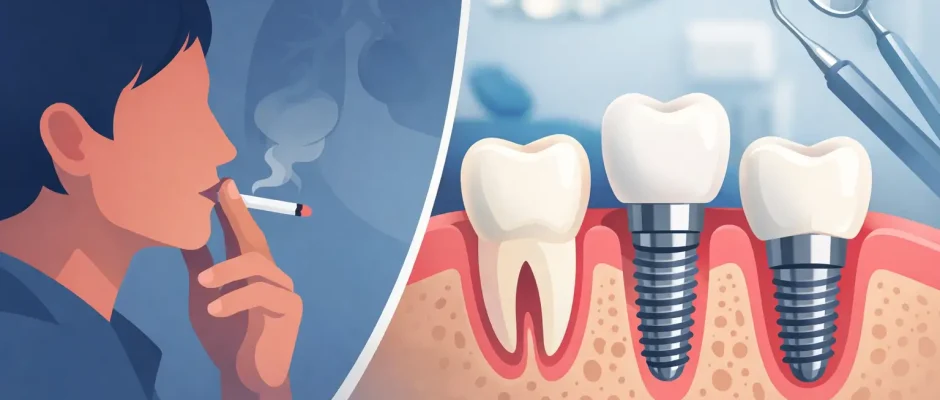
A missing tooth can affect how you eat, speak, and smile. If you smoke, the question becomes more urgent: can smokers get dental implants without accepting an unacceptable risk? In many cases, yes. Smoking is not usually an automatic reason to deny implant treatment, but it changes the biological conditions for healing and requires a more deliberate surgical plan.
An implant is not simply placed into bone like a screw into wood. During the weeks and months after surgery, bone must heal directly against the titanium surface in a process called osseointegration. Healthy blood supply, stable clot formation, controlled bacterial load, and careful postoperative behavior all matter. Tobacco smoking can interfere with each of these factors.
Can smokers get dental implants safely?
A smoker may be a suitable candidate for dental implants, provided that the risks are assessed honestly and reduced wherever possible. The decision should be based on a clinical examination, 3D imaging when indicated, periodontal health, bone volume, medical history, and the type and frequency of smoking.
The key issue is not whether an implant can be placed on the day of surgery. It is whether the implant, surrounding bone, and gum tissue can heal predictably and remain stable over years. Smokers have a higher risk of early healing complications, implant failure, gum inflammation around implants, and progressive bone loss compared with nonsmokers. The level of risk rises with heavier daily tobacco use, poor plaque control, untreated periodontal disease, and procedures that require bone grafting or sinus lifting.
This does not mean every smoker will lose an implant. Many smokers heal successfully. It does mean that a responsible treatment plan should not present smoking as irrelevant.
Why smoking affects implant healing
Nicotine causes blood vessels to constrict, reducing blood flow to the surgical site. Tobacco smoke also introduces heat, toxins, and carbon monoxide, which can reduce oxygen delivery to healing tissues. The mouth is then less able to form and maintain the stable, well-vascularized environment needed after implant surgery.
Smoking may also impair the early immune response and make wound healing slower. After an extraction or implant placement, the blood clot and soft-tissue seal are protective barriers. If healing is delayed or the clot is disturbed, the chance of infection, wound opening, or painful inflammation can increase.
Over the long term, smoking is strongly associated with peri-implant disease. This is inflammation and infection in the tissue around an implant. It may begin with bleeding, swelling, bad taste, or deeper pockets around the implant, and it can progress to bone loss if not managed early. Because smoking can mask gum bleeding, a smoker may not always see the same warning signs that a nonsmoker would notice.
The higher-risk situations
Not all implant cases carry the same level of complexity. Replacing a single tooth in a well-healed area with adequate bone is different from rebuilding a severely damaged jaw.
Risk deserves particular attention when treatment includes immediate implant placement after extraction, immediate temporary teeth, guided bone regeneration, sinus lift surgery, or full-arch reconstruction such as All-on-4. These procedures can be excellent solutions when correctly indicated, but they demand reliable healing. Smoking does not automatically rule them out, yet it may change the timing, technique, or choice of protocol.
For example, after removing an infected tooth, it may be safer in some cases to allow the area to heal before implant placement rather than pursuing an immediate implant. In a site with limited bone, a surgeon may recommend staged grafting before placing the implant. These are not unnecessary delays. They can be decisions made to protect the final result.
Stopping smoking before and after surgery
The most effective way to lower smoking-related risk is to stop smoking before implant treatment and remain smoke-free during healing. The exact period should be individualized with the surgeon, especially if bone grafting or extensive reconstruction is planned. In general, more smoke-free time before and after surgery is better than a brief pause.
The first days after surgery are particularly sensitive. Smoking creates suction in the mouth, exposes the wound to heat and chemicals, and may disrupt the clot. This is especially concerning after tooth extraction, bone grafting, or sinus surgery. A patient who continues smoking immediately after surgery is accepting risk at precisely the time when the tissues are most vulnerable.
Patients sometimes ask whether reducing cigarettes is enough. Cutting down is better than no change, but it does not eliminate the biological effect of nicotine and smoke exposure. A person who smokes fewer cigarettes may still have impaired circulation and healing. For predictable implant treatment, cessation is the preferred goal.
Vaping, heated tobacco products, and nicotine-containing products should also be discussed openly. They may avoid some combustion products, but nicotine can still affect blood vessels and healing, while aerosol exposure may irritate oral tissues. Do not assume that vaping is risk-free for implant surgery simply because it is not a conventional cigarette.
If stopping feels difficult, it is worth involving a primary-care physician or smoking-cessation professional before surgery. Medication, counseling, and a structured plan may offer more reliable support than willpower alone. The dental team needs accurate information about all nicotine use in order to plan safely.
How the surgical plan can reduce risk
Good implant planning begins before the procedure, not in the operating room. A clinical examination and cone-beam CT scan can show bone height, width, density, sinus anatomy, nerve position, and hidden infection. Digital planning and a surgical guide may help position implants more precisely, particularly in complex or full-arch cases.
Before surgery, active gum disease should be controlled. Existing teeth and implants need professional cleaning and a home-care routine that the patient can realistically maintain. An implant cannot compensate for untreated periodontitis. In fact, a history of periodontal disease combined with smoking calls for especially close monitoring.
During surgery, gentle tissue handling, stable implant positioning, appropriate grafting materials when needed, and tension-free wound closure all support healing. PRF, prepared from the patient’s own blood, may be used in selected cases to support soft-tissue and bone healing. It is an adjunct, not a substitute for smoking cessation or proper surgical technique.
After surgery, follow-up is part of treatment rather than an optional extra. The surgeon should check early wound healing, remove sutures when appropriate, assess hygiene, and monitor implant integration before the final crown or bridge is loaded. A patient who smokes needs to take these appointments seriously, since small problems are far easier to manage before bone loss develops.
What patients should discuss at the consultation
A useful consultation is direct, not judgmental. The goal is not to criticize a patient for smoking, but to identify risks and make a plan that gives the implant a fair chance.
Be prepared to discuss how many cigarettes you smoke per day, how long you have smoked, whether you vape or use other nicotine products, and whether you have attempted to quit before. Also mention diabetes, medications that affect bone healing, past radiation therapy, clenching or grinding, previous gum treatment, and any prior implant complications.
Ask whether your case requires bone grafting, whether immediate placement is truly appropriate, how long healing is expected to take, and what smoking restrictions apply to your procedure. A clear answer should include the possibility that the plan may need to change once the tooth is removed or the bone is assessed directly.
When implants may need to wait
Sometimes the safest answer is not “no,” but “not yet.” Implant placement may be postponed if there is uncontrolled periodontal infection, poor oral hygiene, an inability to avoid smoking during the early healing phase, uncontrolled diabetes, or a medical issue that requires stabilization first.
Delaying treatment can be frustrating, especially when a visible tooth is missing. Yet a temporary solution while improving gum health, building bone, or establishing a smoke-free period may protect both your health and your investment. Replacing a failed implant after infection and bone loss is usually more demanding than planning the first procedure carefully.
A practical perspective for smokers considering implants
Dental implants are possible for many smokers, but they should be approached as a medically planned reconstruction, not a cosmetic purchase. The implant system, the surgeon’s experience, a digital surgical guide, or PRF cannot fully cancel the effect of continued smoking. They are tools that support a well-chosen protocol.
The strongest starting point is an honest consultation with an implant surgeon who can assess your anatomy, gum condition, and healing risks without oversimplifying the case. If you can use the implant process as a reason to stop smoking, even temporarily at first, you give your tissues and your future restoration a much better foundation.


