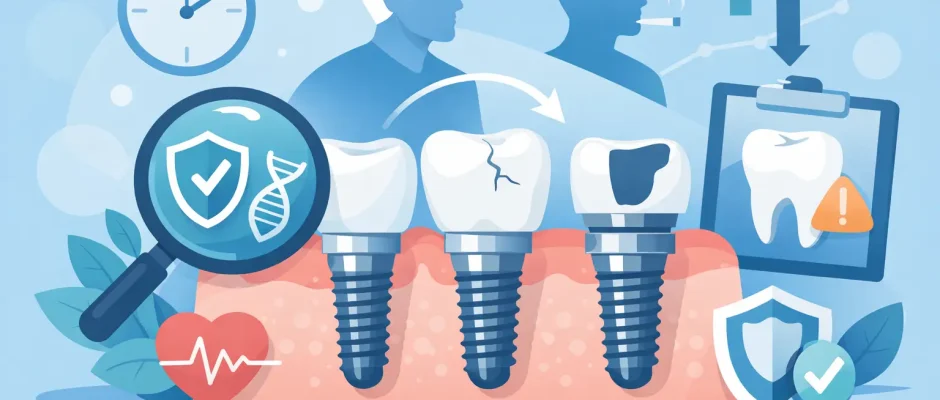
What Affects Dental Implant Survival Rate?
A dental implant is not simply a titanium post placed into bone. It is a long-term biological and mechanical system: bone must heal around the implant, gum tissue must form a protective seal, and the final crown must receive chewing forces correctly. That is why the dental implant survival rate is high in well-planned treatment, but never determined by the implant brand or surgical procedure alone.
For a patient, the meaningful question is not only, “Will the implant stay in place?” It is also whether it will remain comfortable, stable, cleanable, and aesthetically natural for years. A predictable result begins with careful diagnosis and continues long after the surgical appointment.
What does dental implant survival rate mean?
Survival rate refers to whether an implant remains present and functional over a defined period, commonly five or 10 years. An implant may be counted as surviving if it remains stable in the bone and supports a restoration, even if it has required some maintenance along the way.
Success is a stricter standard. In addition to remaining in place, a successful implant should have healthy surrounding tissues, no persistent pain or infection, acceptable bone levels, and a restoration that functions properly. This distinction matters. A stable implant with gum inflammation or an awkward crown shape should not be treated as the ideal outcome simply because it has not been removed.
Published long-term studies commonly report survival rates above 90% at 10 years in appropriately selected and maintained cases. Individual numbers vary because studies involve different patient groups, implant systems, surgical techniques, definitions of failure, and follow-up periods. A personal prognosis cannot be derived from one percentage found online.
Why implant outcomes are usually predictable
Modern implant treatment is supported by decades of clinical research, improved implant surfaces, three-dimensional imaging, guided surgery, and more precise restorative planning. When bone volume, gum condition, bite, and medical history are assessed before surgery, the clinician can choose the safest position, diameter, length, and timing for each implant.
Digital planning is especially valuable near anatomical structures such as the maxillary sinus in the upper jaw or the mandibular nerve in the lower jaw. A surgical guide can transfer a virtual plan to the clinical procedure with greater precision. It does not replace surgical judgment, but it helps make implant positioning more controlled and prosthetically driven.
The surgical procedure itself is only one phase. Proper healing, a well-designed crown or bridge, and regular professional monitoring are equally relevant to long-term stability.
Factors that affect dental implant survival rate
Bone quality and implant stability
For bone integration to occur, the implant must achieve sufficient initial stability and then heal without excessive movement. Dense bone in the lower jaw often behaves differently from softer bone in the posterior upper jaw. Bone quantity matters, but bone quality, anatomy, and the direction of chewing forces matter as well.
When bone is insufficient, placing an implant in a compromised position just to avoid grafting may create problems later. Bone augmentation, sinus lifting, or guided bone regeneration can add time and cost to treatment, yet may provide the foundation needed for a safer and more durable restoration. The correct choice depends on the defect, the final tooth position, and the patient’s priorities.
Gum health and a cleanable restoration
Implants do not decay, but the tissues around them can become inflamed. Mucositis affects the soft tissue around an implant. If inflammation progresses with bone loss, it is called peri-implantitis. This condition can threaten an otherwise well-integrated implant.
The design of the final crown has a direct role here. It should allow access for a toothbrush, interdental brush, floss designed for implants, or water irrigation when appropriate. Crowns and bridges that are difficult to clean create a preventable long-term risk, particularly in the posterior areas and in full-arch restorations.
A history of periodontitis does not automatically rule out implant treatment. It does mean periodontal disease should be stabilized first and maintenance visits should be taken seriously afterward.
Smoking, diabetes, and general health
Smoking can impair blood supply and wound healing, increasing the risk of early complications and later tissue problems. Reducing or stopping smoking before surgery is one of the most practical ways to improve the conditions for healing.
Diabetes requires thoughtful planning rather than automatic exclusion. When blood glucose is well controlled, implant treatment can often be performed successfully. Poor control, however, may increase the risk of infection and delayed healing. Medical history, medications, immune conditions, osteoporosis treatment, and previous radiation therapy in the jaw area must all be discussed before any surgical plan is finalized.
Bite forces and teeth grinding
An implant does not have the same shock-absorbing ligament as a natural tooth. Patients who clench or grind their teeth can place high repetitive forces on an implant crown, bridge, screw, or the surrounding bone.
This does not mean bruxism makes implants impossible. It means restoration design and protection become more important. A night guard, careful bite adjustment, adequate implant number, and avoiding overly long cantilevers can reduce mechanical overload. For a full-arch case, these details are central to the plan, not optional refinements.
Surgical timing and healing protocol
Immediate implant placement after tooth extraction can be an excellent option in selected cases. It may shorten treatment time and help preserve the natural gum contour. However, it is not automatically the best approach for every extraction site.
Active infection, severe bone loss, thin gum tissue, poor primary stability, or an unfavorable socket shape may make staged treatment more predictable. Sometimes the most conservative choice is to extract the tooth, preserve or rebuild the site, allow healing, and place the implant later. Speed has value, but it should not outweigh biological safety.
Early failure and late complications are different
Early implant failure occurs before the implant fully integrates with bone. It may be related to inadequate stability, impaired healing, infection, or excessive loading during the healing period. Although this is uncommon, it can happen even when treatment follows appropriate protocols.
Late complications occur after the implant has been functioning for months or years. They are more often connected to plaque accumulation, peri-implant disease, smoking, uncontrolled systemic conditions, bite overload, or a restoration that is difficult to maintain. Technical issues such as porcelain chipping, crown loosening, or screw fracture can also occur. These problems are often treatable and do not always mean the implant itself has failed.
A transparent treatment plan should address both categories. Patients deserve to know not only the expected benefits, but also how complications would be recognized, managed, and monitored.
How to protect an implant for the long term
The daily routine is straightforward, but it must be consistent. Brush carefully at the gumline, clean between teeth and around the implant restoration using the tools recommended for your specific design, and attend periodic professional hygiene and examination visits. Implant maintenance is not identical to care for natural teeth because the shape of the crown, bridge, and gum contour may require a different technique.
Call the clinic if you notice bleeding when cleaning, swelling, a persistent unpleasant taste, discomfort during chewing, loosening of a crown, or a change in the bite. Implant disease is often painless at first. Early assessment can prevent a small tissue problem from becoming bone loss.
For patients with a history of gum disease, smoking, diabetes, or complex restorations such as All-on-4, maintenance may need to be more frequent. The recall schedule should be individualized rather than copied from another patient’s plan.
Choosing the right plan matters more than chasing a percentage
A high dental implant survival rate is reassuring, but numbers should support clinical judgment, not replace it. The best plan is one that accounts for the missing tooth site, bone volume, gum thickness, medical health, smile expectations, bite forces, and ability to maintain the restoration.
At Implantolog.co.il, treatment planning is built around three-dimensional diagnostics, surgical protocols, and the final restoration position from the beginning. In complex cases, procedures such as guided bone regeneration, sinus lifting, PRF use, or guided implant placement may be recommended because they improve control of the biological conditions, not because every case needs more treatment.
A well-planned implant should feel like a return to normal life: eating without hesitation, smiling comfortably, and knowing that any changes will be detected early through regular care. The most valuable percentage is the one supported by a plan designed specifically for your mouth.


