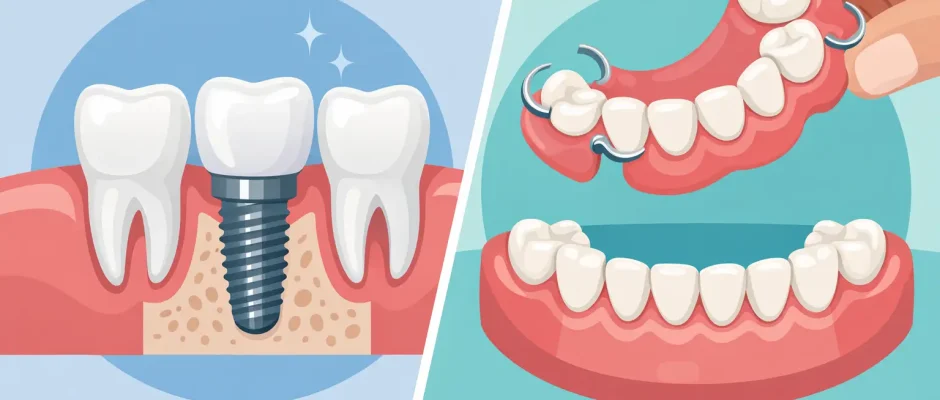
A missing tooth changes more than a smile. It can affect how you chew, how clearly you speak, and how confident you feel when eating or talking with others. When comparing a dental implant vs partial denture, the right choice is not simply the most modern option or the least expensive one. It is the restoration that fits your bone condition, adjacent teeth, bite, health history, expectations, and long-term treatment plan.
For some patients, an implant is the most stable way to replace one or several teeth. For others, a removable partial denture is a sensible interim or definitive solution. A careful examination and 3D imaging help determine which approach can be performed safely and predictably.
Dental Implant vs Partial Denture: The Core Difference
A dental implant replaces the root of a missing tooth. A titanium implant is placed in the jawbone, allowed to integrate with the bone, and then restored with a crown, bridge, or another fixed prosthetic solution. It stays in the mouth and is cleaned similarly to natural teeth, with additional attention around the gum line.
A partial denture is a removable appliance that replaces one or more missing teeth. It is usually supported by the remaining teeth and gum tissue. Depending on its design, it may use acrylic, a metal framework, flexible material, clasps, or precision attachments. It must be removed for cleaning and is generally not worn overnight.
This difference in support matters. An implant transfers chewing forces into the jawbone. A partial denture distributes forces over the gums and, in many designs, uses neighboring teeth for retention and stability.
When a Dental Implant Is Often the Better Option
An implant can be an excellent solution when a patient is missing a single tooth and the neighboring teeth are healthy. Unlike a traditional tooth-supported bridge, it usually does not require preparing those adjacent teeth for crowns. It also provides a fixed result that often feels closer to a natural tooth during speaking and chewing.
Another important advantage is bone preservation. After an extraction, the ridge in that area tends to shrink over time because it no longer receives normal functional stimulation. An implant cannot stop every biological change, but it can help preserve bone volume where it is placed. This is particularly relevant in the visible smile zone, where loss of bone and gum contour may affect esthetics.
Implants are also useful for patients who find removable appliances uncomfortable, unstable, or difficult to tolerate. A properly planned implant-supported crown does not cover the palate, shift while speaking, or need to be removed after meals.
However, implant treatment requires suitable conditions. There must be enough bone in the correct position, healthy gum tissue, and adequate space for a crown that works with the bite. If bone volume is insufficient, procedures such as guided bone regeneration or sinus lift surgery may be needed before or during implantation. These techniques can make treatment possible in complex cases, but they add time, cost, and surgical planning.
Immediate implant placement can sometimes be considered after extraction. It is not an automatic choice. The condition of the socket, infection level, gum thickness, bone walls, bite, and ability to achieve primary stability all influence whether an immediate protocol is appropriate.
When a Partial Denture Makes Practical Sense
A partial denture should not be viewed as a failure to choose an implant. In the right situation, it can be a practical and clinically appropriate solution.
It may be suitable when several teeth are missing across different areas of the mouth, especially if a patient is not ready for surgical treatment or needs a restoration quickly after extractions. A removable partial can also serve as a transitional appliance while gums heal, bone grafting matures, or implant treatment is planned in stages.
Medical history matters as well. Certain systemic conditions, uncontrolled diabetes, heavy smoking, active periodontal disease, previous radiation therapy in the jaw area, or medications that affect bone metabolism may require additional evaluation before implant surgery. These factors do not always rule out implants, but they can change the risk profile and the recommended protocol.
Cost is another real consideration. A partial denture usually has a lower initial cost than implant treatment, particularly when multiple teeth are absent. Yet initial cost should be weighed against expected maintenance, adjustments, possible replacement over time, and the effect on supporting teeth. The most economical option at the beginning is not always the lowest-cost option over many years.
Comfort, Function, and Daily Life
Most patients adapt to an implant-supported crown quickly. Because it is fixed, there is no need to remove it, apply adhesive, or worry that it will move while laughing or eating. Chewing efficiency is usually stronger and more consistent than with a conventional removable partial denture.
A partial denture can restore appearance and basic function very effectively, but adaptation is more variable. During the first weeks, it may feel bulky, create pressure points, or require adjustments as the mouth adapts. Food particles can collect beneath the appliance, and some patients notice movement when eating firm or sticky foods.
The quality of the prosthetic design makes a significant difference. A well-designed partial denture with appropriate support and a balanced bite is more comfortable than an appliance made without sufficient planning. The same principle applies to implants: accurate three-dimensional positioning is essential for a crown that is easy to clean, natural in appearance, and mechanically durable.
Digital planning and surgical guides can improve precision in implant placement. They are especially valuable when anatomy is limited, several implants are planned, or the final prosthetic position must be closely coordinated with the restorative dentist.
The Effect on Neighboring Teeth and Bone
This is often the deciding clinical issue in a dental implant vs partial denture discussion.
A single implant generally functions independently from adjacent teeth. That can be beneficial when the neighboring teeth are intact. A partial denture, by contrast, often relies on nearby teeth for clasps or rests. Over time, these teeth need monitoring for plaque accumulation, decay, gum inflammation, mobility, or overload.
At the same time, implants are not maintenance-free. Peri-implant tissues can become inflamed if plaque control is poor. Peri-implant mucositis may be reversible when managed early, while peri-implantitis can lead to progressive bone loss around an implant. Regular hygiene appointments and home care are part of protecting the investment.
In areas without implants, the jaw ridge may gradually resorb beneath a partial denture. As the ridge changes shape, the appliance can become less stable and may need relining, adjustment, or replacement. This is particularly common when many posterior teeth are missing.
Treatment Time and Surgical Considerations
A partial denture can often be delivered within a relatively short period once impressions, bite records, and design are completed. It may be used immediately after extraction in selected cases, although fit changes are expected as the tissues heal.
Implant treatment usually takes longer. After placement, the implant needs time to integrate with bone before the final crown is made. Depending on the clinical situation, treatment may take several months. If extraction, bone grafting, sinus lift surgery, or gum augmentation is required, the schedule may be longer.
That time is not simply a delay. It allows for biological healing and careful control of the final result. The goal is not to place an implant as quickly as possible, but to position it in a way that supports stable bone, healthy gums, function, and esthetics.
How to Make the Decision Safely
The best decision begins with diagnosis, not with a price list or a photograph of someone else’s result. A consultation should assess the missing-tooth area, condition of the remaining teeth, gums, bite, jaw joint, oral hygiene, and medical history. A CBCT scan is often needed to evaluate bone width, height, density, and the location of anatomical structures such as the maxillary sinus or nerve canal.
A clear plan should explain whether the proposed treatment is definitive or temporary, what preparatory procedures may be needed, how long healing is expected to take, and what maintenance will be required. If a partial denture is chosen, the design and the long-term prognosis of its supporting teeth should be discussed. If implants are chosen, the plan should include prosthetic positioning, not only the surgical procedure.
For patients in Tel Aviv who have been told they lack enough bone for implants, a second evaluation can be worthwhile. Modern regenerative protocols, PRF, and microsurgical techniques may expand the available options, but only when the benefit justifies the additional treatment.
The most useful question is not, “Which option is better?” It is, “Which option protects my oral health and gives me a realistic, maintainable result?” A thoughtful plan should leave you with a clear answer and the confidence to proceed at the right pace.


