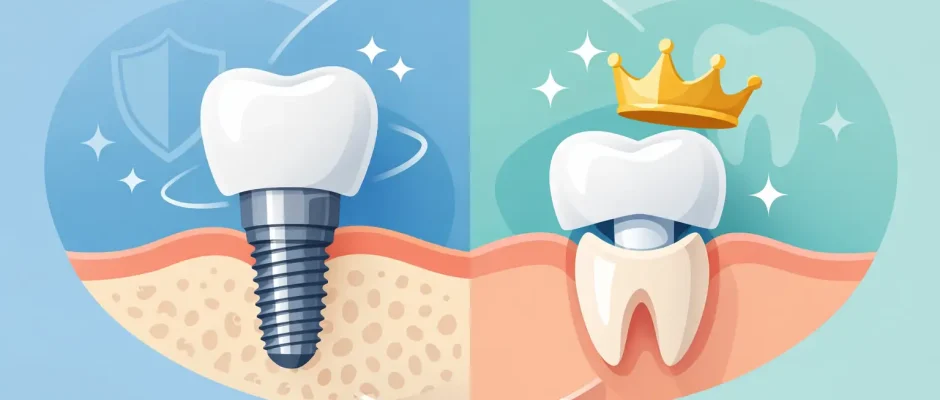
A cracked molar, a large old filling, or a tooth that has already been removed can all lead to the same question: dental implant vs crown. Although the two treatments are often discussed together, they solve different clinical problems. A crown protects and restores a tooth that can still be saved. An implant replaces the root of a tooth that is missing or cannot be predictably retained.
The right choice is not based on which option sounds more advanced. It depends on the condition of the root, the amount of healthy tooth structure remaining, the health of the gum and bone, bite forces, and your long-term treatment goals. A careful examination and 3D imaging, when indicated, make this decision more predictable and help prevent treatment that looks good initially but fails too soon.
Dental Implant vs Crown: The Key Difference
A dental crown is a custom restoration that covers the visible portion of an existing tooth. It may be made from ceramic, zirconia, porcelain fused to metal, or another material selected for the position of the tooth and the demands of your bite. The crown does not replace a root. It depends entirely on the natural root and supporting tissues beneath it.
A dental implant is a titanium fixture placed in the jawbone to replace a missing root. After integration with the bone and healing of the soft tissues, it supports a crown. In other words, many patients comparing a dental implant and a crown are actually comparing two different situations: placing a crown on a natural tooth versus removing or replacing that tooth with an implant and implant-supported crown.
This distinction matters. Preserving a healthy, stable natural tooth is generally preferable to extracting it simply to place an implant. At the same time, keeping a tooth with a poor prognosis may lead to repeated procedures, infection, bone loss, and a more difficult implant treatment later.
When a Crown Is the Better Choice
A crown is often recommended when the tooth has enough sound structure and its root is stable. Common examples include a tooth weakened by a large filling, significant decay that can be completely removed, a fracture limited to the crown portion of the tooth, or a tooth that has undergone root canal treatment.
After root canal treatment, a tooth can become more vulnerable to fracture, especially if it is a back tooth that receives high chewing forces. A crown may protect the remaining walls and restore normal function. If much of the visible tooth is missing, a buildup and sometimes a post can be used to support the restoration. The post does not strengthen the root. Its purpose is to help retain the buildup when there is too little remaining tooth structure.
The key question is whether the tooth is restorable with a predictable margin of healthy structure above the gum and bone. A crown placed on a tooth with deep decay, an untreated crack, unstable gum disease, or insufficient retention can become an expensive short-term solution.
A crown also requires preparation of the tooth. Modern adhesive techniques can often preserve substantial structure, but some enamel and dentin must be shaped to create room for a durable restoration. For a tooth with an excellent prognosis, this is a reasonable trade-off. For a minimally damaged tooth, a more conservative restoration such as an onlay may sometimes be appropriate instead.
What determines crown longevity?
A well-made crown can serve for many years, but it is not immune to problems. Recurrent decay may develop at its edges. The underlying tooth can crack, and gum recession can expose the margin. Heavy clenching or grinding may chip ceramic or loosen the crown.
Longevity depends on precise fit, good oral hygiene, stable gums, bite adjustment, and regular follow-up. For patients who grind their teeth, a night guard is often part of protecting both natural teeth and restorations.
When an Implant Is the Better Choice
An implant is considered when a tooth is absent, has already been extracted, or has a prognosis too poor to justify further restorative treatment. Examples include a vertical root fracture, severe root decay extending deeply below the gum and bone level, advanced periodontal bone loss with mobility, or recurrent infection that cannot be reliably treated with root canal retreatment or microsurgery.
In these cases, placing another crown does not address the cause of failure. If the root cannot support a restoration, covering it with a crown may delay a necessary extraction without creating a stable long-term result.
After extraction, the implant replaces the missing root and helps preserve the bone volume that is normally stimulated by chewing. It does not make the bone immune to change, and implants can still develop inflammatory complications if plaque control is poor. However, a properly planned implant can restore a single missing tooth without preparing the healthy teeth next to the gap, as would be required for a conventional bridge.
An implant-supported crown is not a single appointment procedure in most cases. Treatment includes diagnosis, implant placement, a healing period or provisional restoration when appropriate, and the final crown. Some patients are candidates for immediate implant placement at the time of extraction. Others need healing, bone grafting, or a sinus lift before or during implant treatment. The sequence should be selected based on anatomy and infection control, not convenience alone.
The Decision Is Often About Prognosis, Not Preference
The most difficult cases are not a straightforward missing tooth or a clearly healthy root. They are teeth that can technically be restored but have a guarded prognosis. A root canal-treated molar with a large post, deep decay near the bone, and a history of repeated crown failure may be salvageable, yet its long-term outlook may be limited.
Conversely, a tooth with a localized problem may be worth preserving through retreatment, root-end microsurgery, periodontal treatment, or a new crown. The fact that an implant is available does not make extraction the automatic answer.
A responsible treatment plan evaluates the whole picture: clinical examination, periodontal probing, bite analysis, digital scans, and 3D CBCT imaging when implant planning or complex root anatomy requires it. The goal is to understand not only whether a tooth can be saved today, but whether it is likely to function comfortably years from now.
Bone and gum conditions can change the implant plan
For an implant, sufficient bone in the correct three-dimensional position is essential. When bone has resorbed after an old extraction, guided bone regeneration may be required. In the upper back jaw, the maxillary sinus can limit available bone height and may require a sinus lift.
These procedures are routine within implant surgery but should not be treated as minor details. They affect the timeline, healing, cost, and predictability of treatment. Digital planning and surgical guides can improve the accuracy of implant position, particularly where available bone is limited or where the final crown must fit within an exact esthetic and functional plan.
Soft-tissue quality matters as well. Thick, healthy gum tissue around an implant can support hygiene and a natural appearance. In the smile zone, the shape of the gum and the position of neighboring teeth often determine whether immediate placement is advisable or whether a staged approach will deliver a more stable esthetic result.
Cost, Time, and Maintenance
A crown on a healthy, restorable tooth is usually less invasive, faster, and less costly than extraction followed by implant treatment. This is one reason natural tooth preservation remains a priority when the prognosis is favorable.
Implant treatment generally involves more stages and a higher initial investment. It may include extraction, grafting, implant placement, temporary restoration, and final crown fabrication. Yet repeated repair of a failing tooth can also carry significant financial and biological costs. The comparison should be made over the expected lifespan of each option, not only by the price of the next procedure.
Both crowns and implants need maintenance. A crowned tooth can decay at the crown margin and may develop root or gum problems. An implant cannot develop cavities, but the gum and bone around it can become inflamed. Daily cleaning, professional hygiene visits, and periodic examination are essential in either case.
Do Not Choose an Implant to Avoid Root Canal Treatment Automatically
Patients sometimes hear that an implant is “better than a root canal.” This is too simple. Root canal treatment addresses infection inside a tooth. If the tooth can then be sealed and restored predictably, keeping it may be the best biological option.
An implant is an excellent replacement for a tooth that cannot be retained. It is not a substitute for proper diagnosis. The same is true in reverse: a crown should not be used to avoid the conversation about extraction when the root is already compromised.
The most useful question is not, “Which treatment is best in general?” It is, “Which treatment gives this specific tooth and this specific patient the safest, most predictable long-term result?” A plan built around that question gives you clarity before any irreversible step is taken.


