A loose lower denture that shifts while speaking or makes eating feel like a calculation is more than an inconvenience. It can affect nutrition, confidence, and daily comfort. When considering all on four versus dentures, the real question is not which option is universally better. It is which treatment provides a predictable result for your anatomy, health, expectations, and willingness to undergo surgery.
A removable denture and a fixed full-arch implant restoration solve tooth loss in fundamentally different ways. Understanding those differences before treatment helps replace uncertainty with a clear, medically sound plan.
All on Four Versus Dentures: What Actually Changes
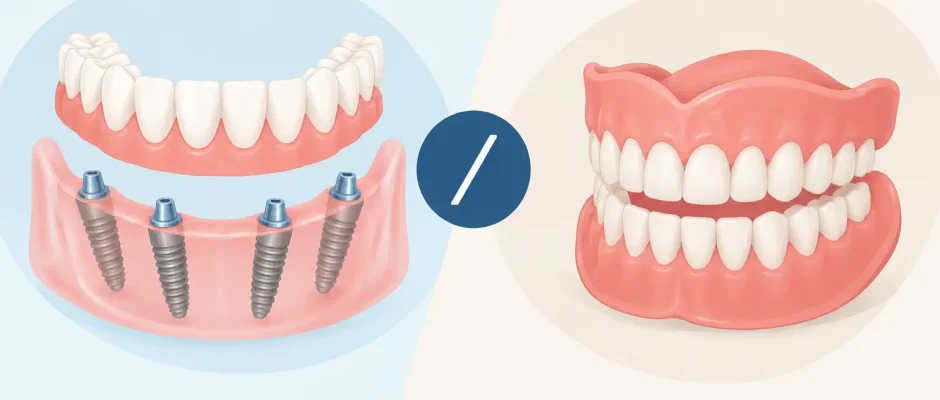
A conventional complete denture rests on the gums and underlying jawbone. It is removable, usually replaces all teeth in one arch, and does not require implant surgery. Upper dentures often gain some suction from the palate. Lower dentures have far less surface area for retention and are more likely to move during meals or conversation.
All-on-Four is a fixed restoration supported by four strategically positioned dental implants. The posterior implants are often angled to make use of available bone and avoid anatomic structures such as the maxillary sinus or mandibular nerve. After healing, the implants support a full bridge that is secured in place by the dentist. The patient does not remove it at night.
This distinction affects almost every part of daily life. A stable implant-supported bridge generally feels more secure during chewing and speech. A removable denture is easier to remove for cleaning and requires no surgery, but it can move under pressure and may need adhesive or periodic adjustment.
Neither option should be selected from a photograph or a price list alone. A proper decision begins with examination, digital imaging, bite analysis, gum assessment, and a discussion of medical history.
Stability and Chewing Function
The greatest practical advantage of All-on-Four is stability. Because the bridge is anchored to implants, it does not rely on suction, denture adhesive, or the shape of the jaw ridge. Many patients find this especially meaningful in the lower jaw, where conventional dentures commonly become less stable as bone volume decreases.
Implant-supported teeth can allow a more confident and varied diet. However, they are not indestructible. Patients still need to avoid habits such as chewing ice, opening packaging with their teeth, or biting very hard objects. The final bridge material also matters. Acrylic-based provisional and definitive restorations have different repair needs and wear characteristics than ceramic or zirconia options.
Dentures can restore appearance and provide useful function, particularly when surgery is not appropriate or is not desired. But their chewing efficiency is usually lower than that of a stable implant-supported bridge. If a denture repeatedly lifts, rocks, causes sore spots, or limits food choices, those are clinical signs worth addressing rather than simply accepting.
Bone Changes Matter Over Time
After tooth loss, the jawbone no longer receives the mechanical stimulation created by tooth roots. Bone remodeling and gradual volume loss can follow, especially under a conventional denture. As the ridge changes shape, the denture may lose its fit. Relines, adjustments, and eventual replacement are normal parts of denture care.
Dental implants transfer chewing forces to the bone and may help preserve bone around the implant sites. They do not stop all facial aging or guarantee that no bone changes will occur. Peri-implant tissues still require careful monitoring, professional hygiene, and control of inflammation. But for many patients, implants provide a more stable long-term foundation than a tissue-supported prosthesis.
Severe bone loss does not automatically rule out fixed treatment. Angled implant placement, digital planning, and guided surgery can sometimes avoid the need for extensive grafting. In other situations, bone regeneration or a sinus lift may be the safer route. The correct protocol depends on three-dimensional imaging, not assumptions.
Surgery, Healing, and Immediate Teeth
All-on-Four involves surgery. Remaining hopeless teeth may need to be removed, implants are placed, and a temporary fixed bridge may be attached on the same day or shortly afterward. This is often called immediate loading.
Immediate teeth are possible only when the implants achieve sufficient initial stability, the bite can be controlled, and the patient can follow a soft-food diet during healing. It is not a promise that should be made before diagnostics. Bone quality, infection, parafunctional habits such as clenching, smoking, systemic health, and the condition of the gums can all affect the treatment timeline.
Careful surgical planning makes a meaningful difference. CBCT imaging, digital impressions, and a surgical guide can help position implants according to the planned restoration, not simply where bone appears available. PRF may be used in selected surgical cases to support soft-tissue and bone healing. These technologies do not replace clinical judgment, but they improve precision and help make treatment more predictable.
Dentures have a shorter initial path. Once extractions and healing are managed, a denture can be fabricated without implant placement. For someone who needs a non-surgical or lower-cost solution quickly, that can be the right choice. Still, rapid treatment should not mean rushed treatment. An ill-fitting immediate denture can create pressure areas and frustration during an already difficult adjustment period.
Maintenance Is Different, Not Optional
A denture is removed and cleaned outside the mouth. It should be brushed with a suitable denture brush, stored properly, and examined periodically for cracks, wear, and fit. The gums and tongue also need regular cleaning. Sleeping without the denture is often recommended to allow the tissues to rest, unless a clinician gives different instructions.
A fixed All-on-Four bridge stays in the mouth, so home care requires a deliberate routine. A soft toothbrush, interdental brushes, floss designed for bridges, and often a water flosser help clean beneath the bridge where plaque can accumulate. Professional maintenance visits are essential. The bridge may need to be removed by the dental team periodically so the implants, screws, and surrounding tissues can be evaluated thoroughly.
Patients sometimes assume fixed means maintenance-free. It does not. It means the restoration is stable during everyday use. Long-term success depends on hygiene, regular follow-up, managing clenching when present, and repairing wear before it becomes a larger problem.
Cost and Value Should Be Discussed Honestly
A conventional denture usually has a lower initial cost than full-arch implant treatment. All-on-Four includes diagnostic planning, surgery, implants, temporary restoration, definitive prosthesis, and follow-up care. If extractions, sedation, bone procedures, or treatment of gum disease are required, the total plan may change further.
The fairest comparison is not only the starting fee. Consider expected maintenance, relines and replacements, dietary limitations, comfort, and the value you place on fixed teeth. At the same time, a higher-cost treatment is not automatically the right treatment. If a patient cannot maintain implants, has uncontrolled medical risks, or simply prefers a removable solution, a well-made denture may be the responsible choice.
Who Is a Candidate for Each Option?
All-on-Four may suit patients who have lost most or all teeth in an arch, have teeth with poor prognosis, struggle with unstable dentures, or want a fixed alternative. It can also be considered in cases of moderate bone loss, provided imaging confirms that implant placement can be performed safely.
Candidacy is individual. Diabetes should be controlled, smoking should be reduced or stopped, active periodontal infection must be treated, and certain medications or medical conditions require additional planning. Bruxism does not necessarily exclude treatment, but it may require a protective night guard and careful prosthetic design.
Dentures may be preferable when surgery is contraindicated, when a patient needs a transitional solution, or when budget and treatment priorities point toward a removable restoration. There is also a middle option: an implant-retained overdenture. Usually supported by two or more implants, it snaps into place for improved stability but can be removed for cleaning.
The most helpful next step is a consultation built around your scan, bite, medical history, and goals. A predictable full-arch result starts with an honest diagnosis and a treatment plan that respects both the biology of your mouth and the life you want to return to.


