Tooth Extraction vs Root Canal: Which Saves More?
A painful tooth can make the decision feel urgent: remove it now, or try to save it. But tooth extraction vs root canal is not a contest between a “quick fix” and a “complicated treatment.” It is a clinical decision based on whether the tooth can remain healthy, functional, and predictable over time.
The goal is usually to preserve a natural tooth when its structure, root, and supporting bone give it a reasonable prognosis. Extraction becomes the more responsible choice when saving the tooth would mean repeated treatment, persistent infection, or a high risk of failure. A careful diagnosis protects patients from both overtreatment and a false sense of security.
Tooth Extraction vs Root Canal: The Core Difference
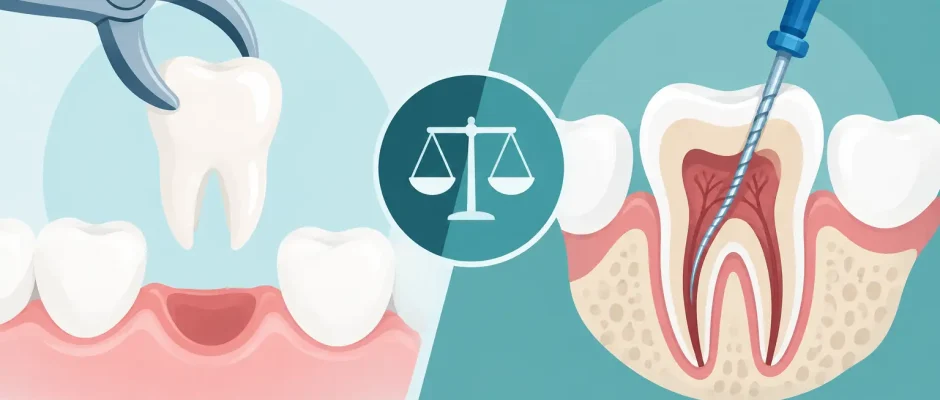
A root canal treats infection or inflammation inside the tooth. During treatment, the dentist removes damaged pulp tissue, disinfects the root canal system, seals it, and restores the tooth. In many cases, a crown is then needed to protect the remaining structure from fracture.
Extraction removes the entire tooth, including its roots. The empty space may later be restored with an implant, bridge, or removable prosthesis. In some situations, especially in the back of the mouth, replacement may not be necessary immediately. That decision depends on bite function, the opposing tooth, the condition of neighboring teeth, and the patient’s overall treatment plan.
Neither procedure is inherently better. Root canal treatment keeps the natural tooth in place. Extraction removes a source of disease that cannot be predictably controlled. The right option depends on the actual condition of the tooth, not only on the level of pain or what appears on a basic X-ray.
When a Root Canal Is Often the Better Choice
A root canal is commonly appropriate when infection has reached the pulp but the tooth remains structurally restorable. Deep decay, a large old filling, trauma, or repeated dental work can allow bacteria to enter the pulp chamber. This may cause spontaneous pain, sensitivity to heat, swelling, or discomfort when biting. Sometimes there are no symptoms at all, and the infection is discovered on imaging.
The tooth may be a good candidate for treatment when there is enough healthy structure above the gumline to support a reliable restoration. The roots should be intact, the surrounding bone support should be adequate, and there should be no deep crack extending into the root. Good access for cleaning and sealing the canals also matters.
Saving a natural tooth can offer excellent chewing function and preserve the existing anatomy of the jaw. It also avoids surgery and eliminates the need for immediate replacement planning. However, successful root canal treatment is only one part of the process. A tooth weakened by decay or a large filling may fracture later without proper restorative protection. In molars, this frequently means a well-fitting crown.
A root canal should not be chosen simply because the tooth is still present. The relevant question is whether it can be restored to serve comfortably for years.
Retreatment and Microsurgery Can Sometimes Save a Tooth
A previously treated tooth that has developed a new infection is not automatically destined for extraction. In selected cases, root canal retreatment can remove old filling material, address missed anatomy, and disinfect the canals again.
When retreatment through the crown is not feasible or has not resolved the infection, microsurgical treatment may be considered. An apicoectomy, or root-end resection, removes the infected tip of the root and seals it under magnification. This is a tooth-preserving procedure, but it requires a specific indication and favorable anatomy. It is not a substitute for treating a tooth with a vertical root fracture or severe structural loss.
When Extraction Is the Safer, More Predictable Option
Extraction may be recommended when a tooth has a poor long-term prognosis despite technically possible root canal treatment. A vertical crack extending down the root is one of the clearest examples. Bacteria can travel along the fracture line, and sealing the canals cannot repair the split root.
Severe decay below the gumline can also make restoration unreliable. Even if infection is removed from inside the tooth, there may be too little sound tooth structure left to hold a crown securely. Attempts to extend the visible tooth structure through gum or bone procedures are sometimes possible, but they are not always appropriate, especially if they compromise esthetics or the support of adjacent teeth.
Advanced periodontal disease changes the decision as well. A tooth can have a technically successful root canal yet still be too loose because of significant bone loss. Other reasons extraction may be preferable include severe root resorption, repeated failed treatment with persistent inflammation, non-restorable trauma, or a wisdom tooth that is damaging the tooth in front of it.
For a tooth that cannot be predictably saved, extraction is not a failure. It is the first step in controlling infection, preserving surrounding bone where possible, and planning a durable restoration.
The Hidden Factor: What Happens After Extraction?
Removing a tooth solves the immediate problem, but it creates a new planning question. After extraction, the jawbone naturally begins to remodel. The greatest change often occurs in the first months, and this can affect the position of the gum and the available bone for a future implant.
For this reason, an extraction plan should include discussion of socket preservation when appropriate. Bone grafting material and a membrane may help maintain the ridge contour, particularly in visible areas or where implant placement is planned. PRF, made from the patient’s own blood, may also be used in selected surgical protocols to support soft-tissue healing.
In suitable cases, an implant can be placed immediately after extraction. This is not the same as placing an implant quickly for its own sake. Immediate implantation requires adequate bone, control of infection, stable implant fixation, and careful three-dimensional positioning. When these conditions are absent, a staged approach is often safer and more predictable.
Digital imaging and surgical planning are especially valuable when an implant is being considered. They help assess bone volume, nearby nerves and sinuses, root anatomy, and the ideal restorative position before surgery begins.
Cost, Time, and Comfort: Looking Beyond the First Appointment
A root canal may appear less expensive than extraction followed by an implant, particularly at the first stage. But the total comparison should include the final restoration, possible crown replacement, retreatment risk, and the expected lifespan of the tooth.
Extraction can be less costly initially, yet replacing a missing tooth with an implant and crown is a separate investment. If bone augmentation or sinus lifting is needed, treatment time and cost increase. A bridge may be an alternative, but it can require preparation of neighboring teeth. A removable option may be suitable in some cases, though it usually offers less fixed stability.
Comfort should also be discussed realistically. Modern local anesthesia allows both root canal treatment and extraction to be performed with minimal pain during the procedure. Afterward, the recovery experience differs. Root canal treatment often causes temporary tenderness when biting. Surgical extraction can involve swelling, bruising, and several days of recovery, particularly for impacted teeth or complex root anatomy.
Anxiety matters, too. Clear explanation, adequate anesthesia, gentle surgical technique, and planned follow-up can make treatment far more manageable. The best plan is one the patient understands and can complete reliably.
How the Decision Is Actually Made
A responsible recommendation begins with a clinical examination, periodontal evaluation, and focused imaging. A three-dimensional CBCT scan may be useful when conventional X-rays cannot show the full extent of a fracture, infection, root anatomy, or bone defect.
The clinician evaluates several connected questions: Is the tooth restorable? Is there a crack? How much bone supports it? Can it be properly cleaned and restored? Does it have a strategic role in the bite? If extraction is necessary, can the site support immediate implant placement, or should healing and bone preservation come first?
For complex cases, the decision should be coordinated between the restorative dentist, endodontist, and surgeon. A root canal can be expertly performed and still be the wrong choice if the tooth cannot be restored. Conversely, a difficult-looking tooth may be worth saving when its roots, bone support, and restoration prospects are favorable.
A Practical Way to Think About Your Options
If a tooth has a realistic chance of long-term function, preserving it is often worthwhile. If its survival depends on multiple compromises, repeated procedures, or unstable remaining structure, extraction with a carefully planned replacement may provide a better long-term result.
Do not make the decision based on pain alone. A severely infected tooth can sometimes be saved, while a painless cracked tooth may have a poor prognosis. Ask your clinician to explain the prognosis of both paths, including what each option requires over the next five to ten years.
The most reassuring treatment plan is not necessarily the one that sounds simplest today. It is the one that controls disease, respects your anatomy, and gives you a clear, predictable path back to comfortable function.


