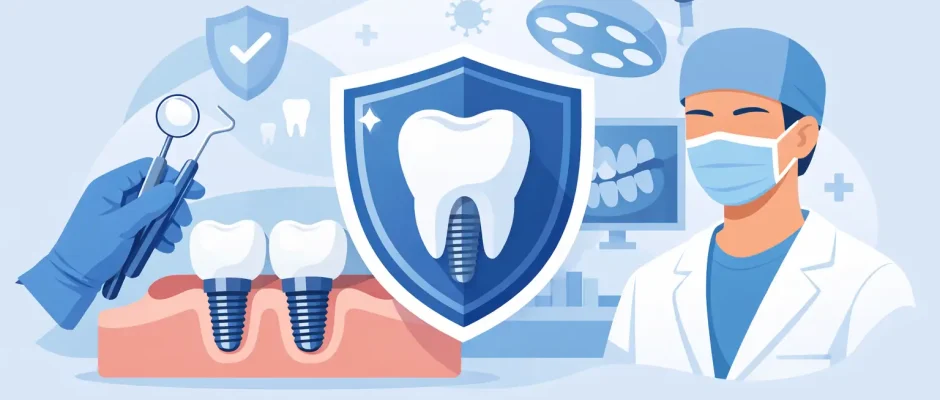
Dental Implant Safety Protocols That Protect You
A dental implant is not simply placed into bone. It is planned around your anatomy, bite, medical history, healing capacity, and the final restoration. Strong dental implant safety protocols make each of those decisions visible before surgery begins. Their purpose is not to promise zero risk – no surgical procedure can do that – but to reduce avoidable complications and create a treatment plan that is appropriate for you.
For a straightforward single-tooth case, this process may be relatively concise. For severe bone loss, active gum disease, a missing tooth near the sinus or lower-jaw nerve, or a full-arch restoration such as All-on-4, the same principles apply with greater diagnostic and surgical precision.
Safety begins before the implant procedure
The safest implant surgery is often determined well before the day of surgery. A clinical examination alone cannot show the full three-dimensional anatomy of the jaw. Cone beam CT, or CBCT, provides detailed imaging of bone volume and density, the position of neighboring roots, the maxillary sinus, and the mandibular nerve canal.
This information helps determine whether an implant can be placed safely in the available bone, which implant dimensions are appropriate, and whether bone grafting, sinus lift surgery, or a different restorative plan should be considered. Placing an implant without adequate bone or without accounting for vital anatomical structures can compromise both safety and long-term stability.
Medical history is part of surgical planning
A reliable consultation includes more than an X-ray. The surgeon should review systemic conditions, medications, allergies, smoking or vaping, previous radiation therapy to the jaws, bleeding risks, and any history of impaired healing. Diabetes, for example, does not automatically rule out implant treatment, but uncontrolled blood glucose can increase the risk of infection and delayed healing.
Some medications require particular attention. Anticoagulants and antiplatelet drugs may affect bleeding management, while certain antiresorptive medications used for osteoporosis or cancer treatment can influence surgical decisions involving bone. Medication should never be stopped independently. When needed, the implant surgeon coordinates the plan with the patient’s physician.
Active periodontal disease and untreated infection also need attention. An implant is not a shortcut around gum disease. Before implantation, inflammation should be controlled and the patient should understand the hygiene and maintenance required to protect the future implant.
Digital planning and surgical guides improve precision
Digital planning connects CBCT data with the intended final tooth position. This changes the question from “Where is there bone?” to “Where should the final tooth be, and how can the implant support it safely?” That distinction matters for appearance, chewing function, cleanability, and force distribution.
In suitable cases, a digitally designed surgical guide transfers the virtual plan to the operating field. The guide helps control the entry point, angulation, and depth of implant placement. It is especially valuable in anatomically demanding areas, multiple-implant cases, and immediate implant protocols.
A guide is not a substitute for surgical judgment. It must be based on accurate imaging, a stable fit, and a clinically sound plan. During surgery, the surgeon still evaluates the tissues, bone quality, and implant stability. Technology improves consistency when it is used within a disciplined protocol.
Sterility and tissue protection during implant placement
Implant surgery is performed under sterile or carefully controlled aseptic conditions. The goal is to minimize bacterial contamination of the surgical field and implant surface. This includes surgical draping, sterile instruments, proper hand hygiene, and controlled handling of the implant.
Equally important is gentle tissue management. Preserving blood supply to the gum and bone supports healing. Surgical access should be sufficient for visibility and accuracy, but not unnecessarily traumatic. When microsurgical techniques are indicated, they allow careful work with soft tissue, fine sutures, and delicate anatomical structures.
Local anesthesia should be planned for effective pain control and patient comfort. For patients with substantial anxiety, the discussion should include available comfort options and what preparation is required. Feeling calm matters, but safety also depends on clear communication, appropriate monitoring, and a patient who understands the procedure and recovery instructions.
Antibiotics are used thoughtfully
Antibiotics can be appropriate in selected implant cases, particularly when the procedure is complex or infection risk is elevated. They are not a replacement for sterile surgery, accurate planning, or good oral hygiene. Unnecessary antibiotic use carries its own risks, including side effects and bacterial resistance.
The decision should be individualized based on the procedure, medical history, and clinical findings. The same applies to pain medication and anti-inflammatory medication after surgery.
Choosing the right protocol for the clinical situation
Not every missing tooth should be treated with the same implant protocol. Safety depends on matching the approach to the biology and anatomy of the case.
Immediate implant placement, where an implant is placed at the time of tooth extraction, can reduce treatment time and preserve aspects of the tissue contour. However, it is not automatically the best choice. The extraction site must be thoroughly debrided, the surrounding bone walls evaluated, and primary implant stability achieved. If there is significant infection, a missing bone wall, or poor initial stability, staged treatment may be more predictable.
Bone augmentation and guided bone regeneration can make implant treatment possible when bone volume is insufficient. These procedures require careful graft selection, membrane stabilization, tension-free closure, and adequate healing time. PRF may be used as an adjunct to support soft-tissue healing and patient comfort, but it does not replace sound grafting principles.
In the upper posterior jaw, the maxillary sinus may limit implant length. A sinus lift can create the required bone volume when properly indicated. In the lower jaw, the position of the mandibular nerve requires precise three-dimensional assessment to avoid nerve injury. These are not reasons to avoid treatment automatically. They are reasons to plan it carefully.
The restoration must be safe for the implant too
Surgical success is only one part of implant safety. The crown, bridge, or full-arch prosthesis must be designed to distribute chewing forces appropriately and allow access for daily cleaning. An implant does not have the same shock-absorbing ligament as a natural tooth, so excess force from grinding or an unbalanced bite can contribute to mechanical complications.
For patients who clench or grind their teeth, a protective night guard may be recommended after restoration. For full-arch cases, the provisional phase is particularly useful: it allows the bite, speech, appearance, and comfort to be assessed before the final prosthesis is made.
Recovery protocols protect the result
Clear postoperative instructions reduce uncertainty during the first days of healing. Patients should know how to manage swelling, oral hygiene, food choices, physical activity, and prescribed medications. Smoking and vaping can impair blood supply and healing, particularly after grafting or soft-tissue procedures. A temporary pause is beneficial, while long-term cessation offers the strongest protection for implant health.
Some swelling, mild bleeding, and discomfort are expected after surgery. Increasing pain after initial improvement, persistent or heavy bleeding, fever, pus, a bad taste with swelling, numbness that does not resolve as expected, or a loose temporary restoration should prompt contact with the surgical team. Early assessment is safer than waiting for a scheduled visit.
Follow-up appointments allow the surgeon to check wound healing, remove sutures when needed, monitor tissue condition, and verify that the treatment is progressing as planned. Once the final restoration is in place, professional maintenance remains essential. Implants can develop peri-implant mucositis and peri-implantitis, conditions related to plaque accumulation and inflammation around the implant.
Questions worth asking before treatment
A patient should leave the consultation with a clear understanding of the proposed plan. Ask whether CBCT imaging is needed, what anatomical factors affect your case, whether a surgical guide is appropriate, and what alternatives exist if bone is insufficient. It is also reasonable to ask what happens if an implant does not achieve adequate stability on the day of surgery.
A careful surgeon does not force every case into one timeline or one technique. Sometimes the safer choice is immediate implantation. Sometimes it is extraction, healing, and staged placement. The right protocol is the one that protects the tissues, respects your medical situation, and supports a restoration you can maintain comfortably for years.


